Gold prices rose and then fell for the second consecutive week after weaker-than-expected non-farm payroll data.
2026-10-05 09:44:17
Weak US jobs data for September caused gold prices to rise and then fall, marking the second consecutive week of declines and hovering near recent lows. The US Bureau of Labor Statistics reported 29,000 new jobs added in September, far below market expectations. Gold prices briefly rose above $4,200 per ounce but failed to maintain the gains, leading to selling pressure. The jobs report also showed that the US unemployment rate rose to 4.2%, while average wages increased by only 0.1%.
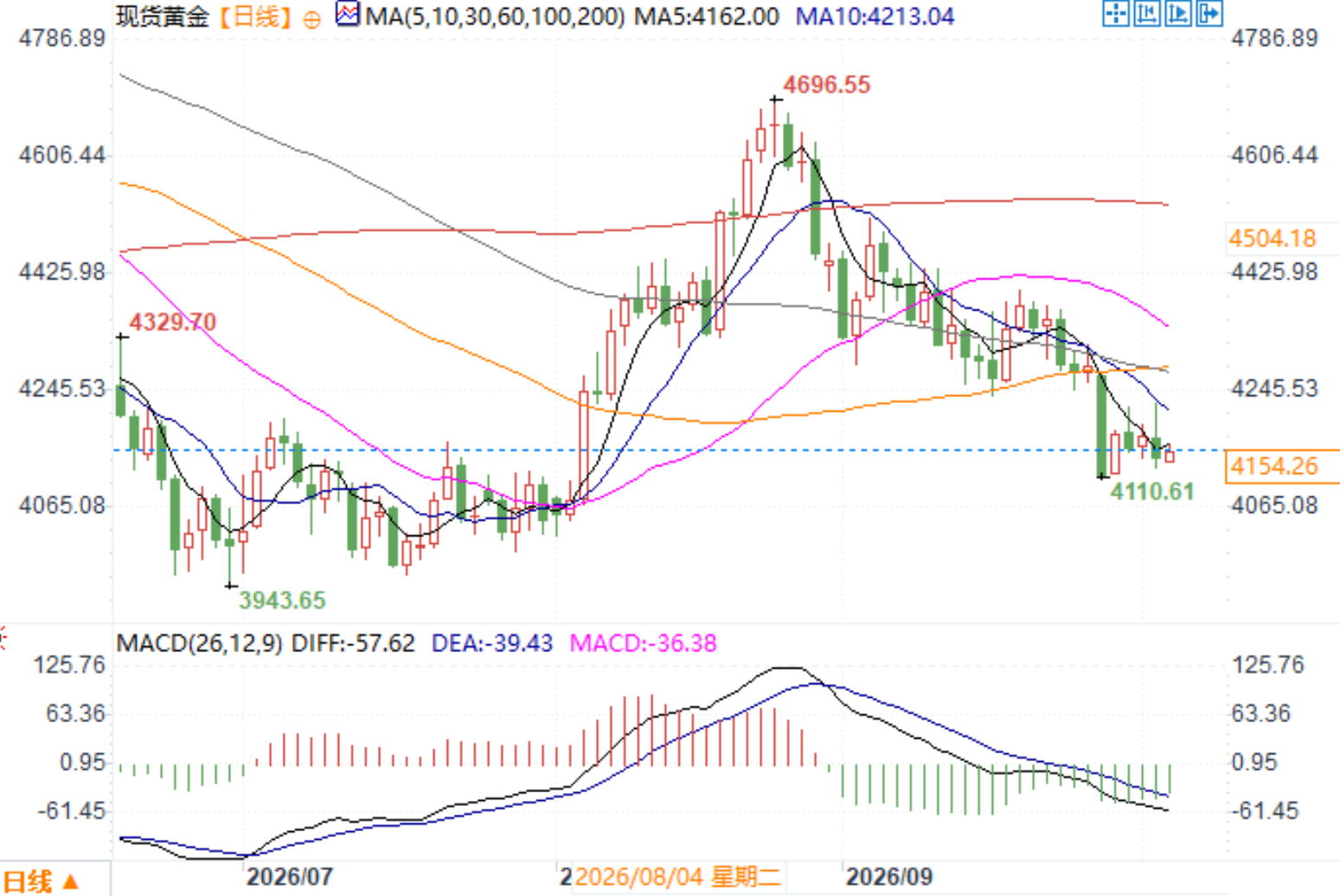 Spot gold daily chart source: FX678. At 9:39 AM Beijing time on October 5th, spot gold was trading at $4154.26 per ounce.
Inflationary pressures persist, and high yields are suppressing gold prices.
Simon-Peter Massabni, head of business development at XS, said that the weaker-than-expected gold price performance reflects a market dilemma: a weakening economy versus high yields and inflationary pressures. He stated, "From a monetary policy perspective, the non-farm payroll data should have provided fundamental support for gold, but the technicals haven't yet confirmed a resumption of the medium- to long-term upward trend. The core issue for gold in the next phase isn't whether the labor market weakens, but whether this weakness can suppress yields or whether persistently strong inflation will keep yields high." Slower job growth has led the market to lower its expectations for an interest rate hike later this month. However, economists caution that even with a continued cooling in the US labor market, the Federal Reserve's primary focus remains on persistent inflation. Bill Adams, chief US economist at Fifth Third Commercial Bank, said that the weaker-than-expected September non-farm payroll report is insufficient to shift the Fed's focus away from inflation. He said, "From now until the Fed's interest rate meeting at the end of October, the September CPI, PPI data, gasoline prices, and geopolitical situations will have a greater impact on the Fed's interest rate decision than this lackluster non-farm payroll report." Phillip Streible, chief market strategist at Blue Line Futures, believes that although labor market momentum is slowing, the US economy remains resilient. Earlier last week, the US Bureau of Economic Analysis reported that second-quarter US GDP grew by 2.2%, significantly exceeding expectations, and first-quarter GDP growth was also revised upward to 2.5%. He said, "We are not currently in a stagflation environment; the technology sector continues to expand. In this environment, I am not bullish on gold."Markets are betting on another Fed rate hike in December.
Weak non-farm payroll data has largely ruled out a rate hike in October, but trading is still pricing in another Fed rate hike in December. Analysts say this expectation will continue to push up US Treasury yields, increasing the opportunity cost of holding gold, a non-interest-bearing asset. David Morrison, senior market analyst at Trade Nation, said the gold price decline is likely not over yet. He said, "The pause in monetary policy tightening this month does not mean that subsequent rate hikes are completely canceled. Inflation remains the Federal Open Market Committee's primary consideration, while its other policy objective, ensuring full employment, has to take a backseat at this stage." He also mentioned that gold still has room for short-term volatility, but the downside is relatively limited. He said, "I think gold prices are not far from bottoming out again, just like the market this summer. If gold prices struggle to accumulate upward momentum in a strong dollar environment, they may retest the important support zone around $4,000. Once it reaches that level, gold prices will likely enter a consolidation phase, and as the MACD indicator recovers and accumulates momentum, a strong rally is expected." FXTM Senior Market Analyst Lukman Otunuga added that gold is not yet out of the woods, and its upside potential is limited. Geopolitical factors driving inflation continue to support expectations of interest rate hikes. He said, "If the weekly chart breaks below $4,200, the price may fall back to around $4,100."Conclusion
This week features a limited number of major economic data releases, with the market generally believing that geopolitical risks will dominate gold price movements. Key data to watch includes the ISM Services PMI, the minutes of the Federal Reserve's September monetary policy meeting, and the University of Michigan's preliminary consumer sentiment index. In summary, the gold market is currently mixed; while weak non-farm payroll data has temporarily dampened expectations of a rate hike this month, persistent inflation and expectations of a December rate hike continue to weigh on gold prices. Geopolitical news and the Federal Reserve meeting minutes will be the core variables determining the future direction of gold prices. Spot gold daily chart source: FX678. At 9:39 AM Beijing time on October 5th, spot gold was trading at $4154.26 per ounce.
- Risk Warning and Disclaimer
- The market involves risk, and trading may not be suitable for all investors. This article is for reference only and does not constitute personal investment advice, nor does it take into account certain users’ specific investment objectives, financial situation, or other needs. Any investment decisions made based on this information are at your own risk.