













Crude oil trading alert: G7 release of 100 million barrels from reserves coupled with a rebound in Middle Eastern exports put downward pressure on oil prices.
2026-10-06 08:36:18
On Tuesday (October 6) in early Asian trading, international oil prices entered a new round of trading after a sharp drop on Monday. Brent crude for December delivery closed down $2.29, or 2.23%, at $100.32 per barrel; U.S. crude for November delivery closed down $1.96, or 2.15%, at $89.30 per barrel. Price downward pressure stemmed from two factors: increased Middle Eastern oil exports and the G7's commitment to release 100 million barrels of diesel and crude oil from its emergency reserves. However, persistent concerns about supply disruptions stemming from the conflict in Iran limited further downside for oil prices. 
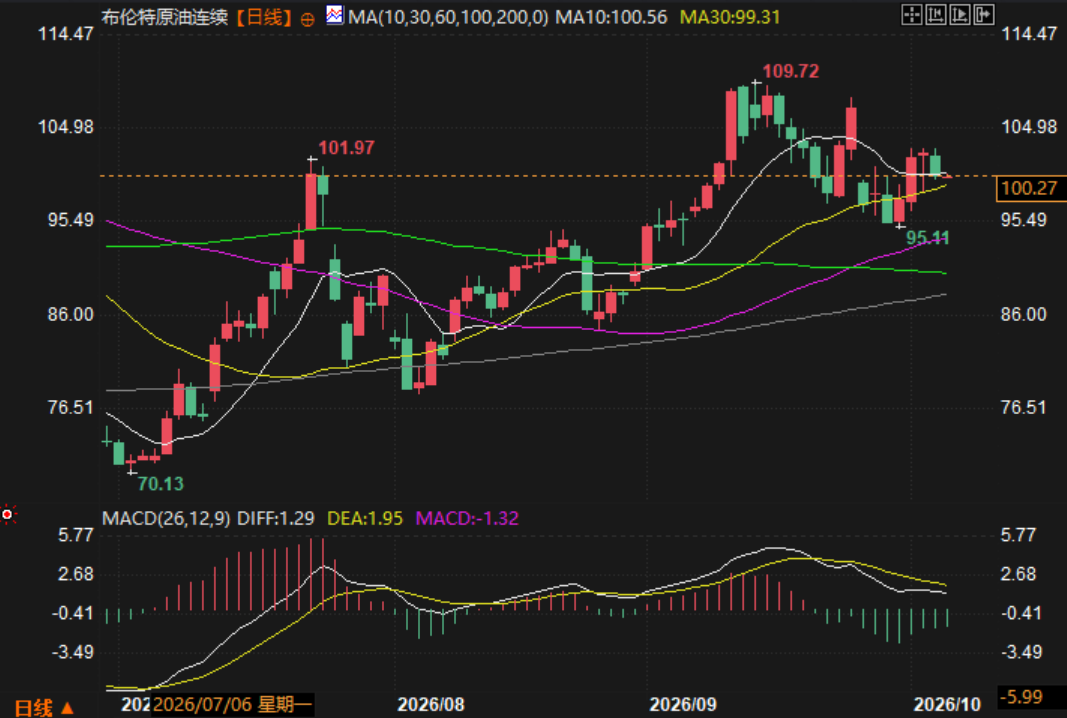 (Brent crude oil futures daily chart, source: EasyTrade) At 8:27 Beijing time, Brent crude oil futures were trading at $100.28 per barrel.
Middle East exports rebound: exceeding pre-war levels for about half of September
Shipping data was the direct driver of Monday's oil price decline. Shipping data showed that Gulf oil-producing countries exported crude oil at levels higher than pre-war for about half of September, although tanker attacks and shipping bottlenecks still cast a shadow over the sustainability of export growth. Preliminary data from Kpler showed that as of September 30, the seven-day moving average of Gulf region crude oil exports was 18.3 million barrels per day, with 14 days in September exceeding pre-war levels. According to Kpler data, in the 12 months before the US and Israel launched their conflict against Iran on February 28, Gulf region crude oil exports averaged approximately 18 million barrels per day. Andrew Lipow, president of Lipow Oil Associates, said, "Although tankers still face risks, there is hope that more crude oil will eventually enter the market." This optimism is the core force suppressing oil prices. However, attacks on tankers continue—the UK Maritime Trade Operations Office stated that a tanker was hit by an unidentified projectile in the Strait of Hormuz, causing a fire in the engine room, and the crew is currently fighting the fire. The coexistence of supply recovery and security risks makes it difficult for the market to form a one-sided pricing strategy.G7 releases 100 million barrels: Market remains skeptical.
Following pressure from US President Trump, the G7 agreed on Friday to release 100 million barrels of diesel and crude oil from their emergency reserves and pledged not to impose energy export restrictions. This decision continued the pullback in oil prices last week. However, Raymond James analyst Pavel Molchanov stated that it remains unclear how much of this 100 million barrels comes from the remaining portion of the 400 million barrels emergency release plan coordinated by the International Energy Agency (IEA) in March, thus keeping the market skeptical. IEA Executive Director Fatih Birol stated last week that member countries had completed approximately two-thirds of the previously agreed-upon release of 400 million barrels of oil. This uncertainty means that the actual increase in reserves released may be lower than the nominal figure, thus limiting the potential decline in oil prices.Geopolitical risks: Ceasefire seems a long way off, attacks continue.
PVM Oil Associates analyst Tamas Varga stated that a ceasefire in the Middle East remains a distant prospect, and the renewed hostilities between Saudi Arabia and the Iranian-backed Houthi rebels will continue attacks on energy infrastructure and ships, keeping geopolitical risk premiums high. Recent geopolitical developments further confirm this assessment. US President Trump stated that the US military has withdrawn B-1 bombers from a British air base due to threats related to Iran. The US Treasury Department warned foreign financial institutions continuing to do business with Iran or its financial sector that these institutions could face sanctions from Washington without prior notice. According to Iranian state media, Iranian President Peskhchiyan stated during a meeting with the Armenian Foreign Minister in Tehran that negotiations with the US are pointless. These signals indicate that a breakthrough through diplomatic means is unlikely in the short term, and geopolitical risk premiums will continue to be reflected in oil prices.Structural supply shortages: Saudi Aramco expects inventory to take two years to replenish.
While short-term supply recovery is suppressing oil prices, the structural tensions on the supply side have not been eliminated. Saudi Aramco CEO Nasser stated that he expects crude oil and refined product supplies to remain tight, and that global inventories could take up to two years to replenish after the emergency release of reserves. This assessment provides medium- to long-term support for oil prices. Data released by the U.S. Department of Energy on Monday showed that crude oil inventories in the U.S. Strategic Petroleum Reserve fell to 283 million barrels last week, the lowest level since October 1982. The continued depletion of strategic reserves means that the U.S.'s buffer against future supply disruptions is declining. Furthermore, two sources familiar with the matter indicated that the conflict in Iran has disrupted capacity expansion projects in the Middle East, making future capacity potential estimates uncertain, thus OPEC+ has postponed its review of member countries' crude oil production quotas for 2027. Saudi Aramco's unexpected reduction of its November crude oil price for Asia to the lowest level in six years reflects Saudi Arabia's intention to gain market share as exports recover.Institutional View: Oil Price Floor May Rise to $70
Ryan Lance, Chairman of ConocoPhillips International, stated that he expects the floor for oil prices to rise to around $70 per barrel, and believes that the medium-term price of West Texas Intermediate crude oil will remain between $65 and $70 per barrel. This assessment implies that although oil prices are under pressure in the short term, the medium- to long-term floor has been raised, reflecting the support for prices from structural supply tightness.Summarize
Crude oil is currently caught in a tug-of-war between "supply recovery" and "geopolitical risks." The recovery of Middle Eastern exports to pre-war levels, the G7's release of 100 million barrels from reserves, and Saudi Aramco's price cuts in Asia have collectively exerted downward pressure on prices in the short term, pushing Brent crude down to around $100 per barrel. However, concerns about supply disruptions stemming from the Iranian conflict persist, tanker attacks continue, a ceasefire remains elusive, Saudi Aramco estimates global inventories will take two years to replenish, and US strategic reserves have fallen to their lowest level since 1982. These factors collectively limit the downside potential for oil prices. The market remains skeptical about the actual increase in G7 reserve releases, as some may come from previously coordinated but unreleased quotas. In the short term, the $100 per barrel level for Brent crude remains a key watershed—if the supply recovery trend continues, oil prices may face further downward pressure; if the situation in the Middle East deteriorates again or actual supply disruptions worsen, the risk premium could be quickly rebuilt. Until clear signals emerge from US-Iran negotiations, crude oil is likely to remain range-bound, with news-driven high volatility continuing. (Brent crude oil futures daily chart, source: EasyTrade) At 8:27 Beijing time, Brent crude oil futures were trading at $100.28 per barrel.- Risk Warning and Disclaimer
- The market involves risk, and trading may not be suitable for all investors. This article is for reference only and does not constitute personal investment advice, nor does it take into account certain users’ specific investment objectives, financial situation, or other needs. Any investment decisions made based on this information are at your own risk.

