EUR/USD Analysis: Political risks and weak economic data weigh on the exchange rate, with repeated resistance at the 1.12 level.
2026-10-06 18:46:28
The euro/dollar pair has been fluctuating around the 1.12 level recently, facing pressure as the overall strength of the US dollar suppresses the performance of non-US currencies. Rising political uncertainty and a deteriorating fiscal outlook in the Eurozone have reignited market concerns about the spread of debt risks. Coupled with collectively weak economic data within the region, the euro's bullish momentum is weak, and its rebound lacks strength. MUFG's latest view indicates that the euro continues to face selling pressure, with the euro/dollar pair approaching the key support level of 1.1200. Year-end market movements will be more constrained by political and bond market risks in various European countries.  Eurozone Political Risk Analysis: Spanish Election Disruptions and French Risks as the Main Themes Geopolitical uncertainty in Europe is the core negative factor suppressing the euro recently. Spanish Prime Minister Sánchez announced a snap election on November 29th. The latest polls show the center-right People's Party is likely to become the largest party in parliament, but it is unlikely to win an absolute majority. It may form a coalition government with the VOX party, exacerbating market risk aversion in the short term. Regarding the situation in Spain, Lee Hardman, an analyst at MUFG Bank, stated that although the snap election has increased short-term uncertainty, the Spanish political situation is unlikely to cause a deep downward impact on the euro and is not the core risk driving the year-end market. Compared to Spain, French risks have a more profound impact on the euro. Currently, France has a high debt level and a persistent domestic political deadlock, leading to continued selling in the French bond market. The potential transmission and diffusion effects of these risks, coupled with policymakers' responses, will be key variables dominating the euro's performance at the end of the year. Overall, the convergence of political risks in multiple European countries keeps the euro under continuous passive pressure. Economic Fundamentals: Weak Data Across Germany and France Highlights Manufacturing Pressure Besides political headwinds, the Eurozone's economic fundamentals continue to weaken, further limiting the euro's upside potential. Germany, the core economy, saw its economic data significantly disappoint: German factory orders plummeted 10.6% month-on-month in August, a sharp reversal of July's 3.2% increase, marking the largest monthly drop since January and fully exposing the severe predicament of German manufacturing. This sharp decline in orders was mainly due to a significant reduction in large-scale orders, completely undermining previous market expectations of German economic resilience. Previously, the Middle East conflict triggered inflationary shocks, leading the market to believe that the Eurozone's leading economy possessed strong risk resistance capabilities; however, this data has completely reversed this optimistic sentiment. In the medium to long term, German manufacturing still faces three major pressures: first, if the Middle East geopolitical conflict continues to escalate, it will push up energy costs, impacting the German industrial system; second, competition in foreign markets remains fierce; and third, the high-interest-rate environment continues to suppress corporate investment. With multiple headwinds combined, Germany's economic recovery faces significant obstacles. Meanwhile, French industrial output unexpectedly declined in August, indicating continued weakness in the overall Eurozone industrial recovery momentum. The Core Catalyst for the Euro's Rebound: No Short-Term Positive Support Given the current market environment, for the euro to achieve a sustained and trend-driven rebound, multiple positive catalysts are needed simultaneously, none of which can be missing: a significant decline in international oil prices easing imported inflation pressures in the Eurozone; market repricing of expectations for the ECB's tightening monetary policy; effective improvement in fiscal deficits in Eurozone countries reducing debt risks; and a significant reduction in political uncertainty in countries like France and Spain. According to comprehensive institutional assessments, these catalysts are unlikely to materialize in the short term, and the euro's weak and volatile pattern may continue. Dollar Fundamentals: High Yields Support a Strong Dollar The continued strength of the dollar is another core reason for the pressure on the euro/dollar exchange rate. Currently, US Treasury yields have climbed to multi-decade highs, providing solid support for the dollar. Even though recent US employment data and core PCE inflation data have fallen short of expectations, and market expectations for a Fed rate hike this month have cooled somewhat, the dollar's upward trend has not stopped. The mainstream market expectation is still that the Fed will complete one rate hike by 2026, and the medium- to long-term strong tone of the dollar remains unshaken. In the short term, the market will focus on the US September services PMI data, ADP private sector employment data, and the speech by New York Fed President Williams, to anticipate the Fed's subsequent interest rate path and guide exchange rate fluctuations. Technical Outlook: The four-hour chart shows a descending channel, with the 1.12 level as a key support.
 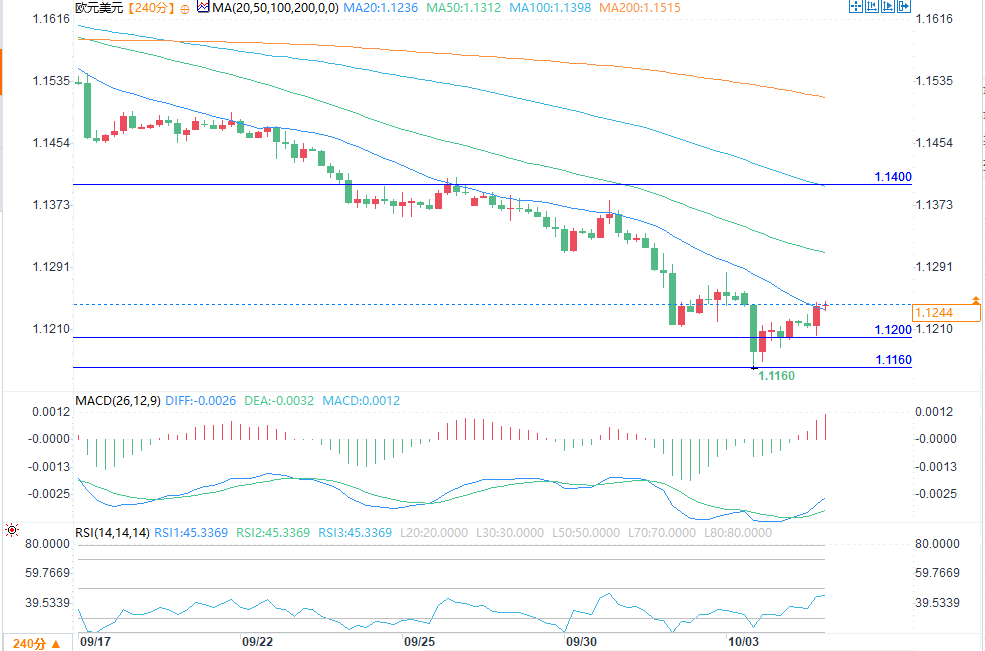 (EUR/USD Daily Chart Source: EasyForex) From a 4-hour technical perspective, EUR/USD has been trading within a standard descending channel since mid-September, clearly indicating a bearish trend. Currently, the pair is testing the key support level around 1.1200. Key Downside Support If the 1.1200 support level is broken, the pair will further decline to 1.1160 (October low, lower trendline of the descending channel). After this level is breached, the next key target will be the May 2025 low of 1.1075, opening up further downside potential. Key Upside Resistance A short-term rebound requires a break above the upper trendline of the descending channel at 1.1250. Only after a stable hold above this level can the rebound potential be unlocked. Subsequent challenges include the psychological level of 1.1300, the 50-period EMA, and further upside to the 1.1400 resistance level. Key Summary Currently, the euro faces triple pressure from political risks, economic weakness, and fiscal uncertainties, lacking short-term rebound drivers. The US dollar remains strong due to high yields and expectations of interest rate hikes this year. Overall, the EUR/USD pair is clearly in a weak and volatile trading pattern. Technically, the bears are in control. The 1.12 level is the short-term dividing line between bulls and bears. A break below this level will lead to a deeper decline, while failure to break it will maintain a weak consolidation within the range.
Eurozone Political Risk Analysis: Spanish Election Disruptions and French Risks as the Main Themes Geopolitical uncertainty in Europe is the core negative factor suppressing the euro recently. Spanish Prime Minister Sánchez announced a snap election on November 29th. The latest polls show the center-right People's Party is likely to become the largest party in parliament, but it is unlikely to win an absolute majority. It may form a coalition government with the VOX party, exacerbating market risk aversion in the short term. Regarding the situation in Spain, Lee Hardman, an analyst at MUFG Bank, stated that although the snap election has increased short-term uncertainty, the Spanish political situation is unlikely to cause a deep downward impact on the euro and is not the core risk driving the year-end market. Compared to Spain, French risks have a more profound impact on the euro. Currently, France has a high debt level and a persistent domestic political deadlock, leading to continued selling in the French bond market. The potential transmission and diffusion effects of these risks, coupled with policymakers' responses, will be key variables dominating the euro's performance at the end of the year. Overall, the convergence of political risks in multiple European countries keeps the euro under continuous passive pressure. Economic Fundamentals: Weak Data Across Germany and France Highlights Manufacturing Pressure Besides political headwinds, the Eurozone's economic fundamentals continue to weaken, further limiting the euro's upside potential. Germany, the core economy, saw its economic data significantly disappoint: German factory orders plummeted 10.6% month-on-month in August, a sharp reversal of July's 3.2% increase, marking the largest monthly drop since January and fully exposing the severe predicament of German manufacturing. This sharp decline in orders was mainly due to a significant reduction in large-scale orders, completely undermining previous market expectations of German economic resilience. Previously, the Middle East conflict triggered inflationary shocks, leading the market to believe that the Eurozone's leading economy possessed strong risk resistance capabilities; however, this data has completely reversed this optimistic sentiment. In the medium to long term, German manufacturing still faces three major pressures: first, if the Middle East geopolitical conflict continues to escalate, it will push up energy costs, impacting the German industrial system; second, competition in foreign markets remains fierce; and third, the high-interest-rate environment continues to suppress corporate investment. With multiple headwinds combined, Germany's economic recovery faces significant obstacles. Meanwhile, French industrial output unexpectedly declined in August, indicating continued weakness in the overall Eurozone industrial recovery momentum. The Core Catalyst for the Euro's Rebound: No Short-Term Positive Support Given the current market environment, for the euro to achieve a sustained and trend-driven rebound, multiple positive catalysts are needed simultaneously, none of which can be missing: a significant decline in international oil prices easing imported inflation pressures in the Eurozone; market repricing of expectations for the ECB's tightening monetary policy; effective improvement in fiscal deficits in Eurozone countries reducing debt risks; and a significant reduction in political uncertainty in countries like France and Spain. According to comprehensive institutional assessments, these catalysts are unlikely to materialize in the short term, and the euro's weak and volatile pattern may continue. Dollar Fundamentals: High Yields Support a Strong Dollar The continued strength of the dollar is another core reason for the pressure on the euro/dollar exchange rate. Currently, US Treasury yields have climbed to multi-decade highs, providing solid support for the dollar. Even though recent US employment data and core PCE inflation data have fallen short of expectations, and market expectations for a Fed rate hike this month have cooled somewhat, the dollar's upward trend has not stopped. The mainstream market expectation is still that the Fed will complete one rate hike by 2026, and the medium- to long-term strong tone of the dollar remains unshaken. In the short term, the market will focus on the US September services PMI data, ADP private sector employment data, and the speech by New York Fed President Williams, to anticipate the Fed's subsequent interest rate path and guide exchange rate fluctuations. Technical Outlook: The four-hour chart shows a descending channel, with the 1.12 level as a key support. (EUR/USD Daily Chart Source: EasyForex) From a 4-hour technical perspective, EUR/USD has been trading within a standard descending channel since mid-September, clearly indicating a bearish trend. Currently, the pair is testing the key support level around 1.1200. Key Downside Support If the 1.1200 support level is broken, the pair will further decline to 1.1160 (October low, lower trendline of the descending channel). After this level is breached, the next key target will be the May 2025 low of 1.1075, opening up further downside potential. Key Upside Resistance A short-term rebound requires a break above the upper trendline of the descending channel at 1.1250. Only after a stable hold above this level can the rebound potential be unlocked. Subsequent challenges include the psychological level of 1.1300, the 50-period EMA, and further upside to the 1.1400 resistance level. Key Summary Currently, the euro faces triple pressure from political risks, economic weakness, and fiscal uncertainties, lacking short-term rebound drivers. The US dollar remains strong due to high yields and expectations of interest rate hikes this year. Overall, the EUR/USD pair is clearly in a weak and volatile trading pattern. Technically, the bears are in control. The 1.12 level is the short-term dividing line between bulls and bears. A break below this level will lead to a deeper decline, while failure to break it will maintain a weak consolidation within the range.
- Risk Warning and Disclaimer
- The market involves risk, and trading may not be suitable for all investors. This article is for reference only and does not constitute personal investment advice, nor does it take into account certain users’ specific investment objectives, financial situation, or other needs. Any investment decisions made based on this information are at your own risk.