Crude oil trading alert: Amid supply-side uncertainties, US crude oil prices are consolidating around $90.
2026-10-07 09:24:19
On Wednesday during Asian trading hours, WTI crude oil continued its gains from the previous trading day, trading around $90 per barrel , compared to the previous settlement price of $89.44, having briefly surpassed the $90 mark during the session. The main driver behind the price increase was that the continued threat from Middle Eastern energy flows outweighed signs of a regional supply recovery : the shipping risks in the Strait of Hormuz have not been eliminated. According to the UK Maritime Trade Action Office, nine attacks have been reported in the area this month, only half the combined number reported in the Strait of Hormuz and the Persian Gulf in September, indicating a significant increase in frequency.  Signals of recovery on the supply side, however, act as a suppressive force. Despite high risks, tankers continue to risk traversing the Strait of Hormuz , demonstrating the resilience of Gulf energy exports in operating as usual despite the risks. More importantly, Saudi Arabia's east-west oil pipeline has restored its daily oil transport to approximately 5.8 million barrels , equivalent to more than 80% of its designed transport capacity of approximately 7 million barrels. This land route, bypassing the Strait of Hormuz and connecting the eastern oil-producing region with the Red Sea port of Yanbu, was suspended for several days in September due to a drone attack, but has now resumed operation faster than the market expected, serving as a "pressure relief valve" for this round of supply concerns. Recently, crude oil transported through the Strait of Hormuz has reached approximately 12 million barrels per day, close to pre-war levels, and the actual supply data partially offsets the "supply disruption" panic. The deeper logic of oil market supply and demand is more subtle than simple flow figures. Strategists at TD Securities point out that while crude oil is indeed being suppressed by increasing flow , the new supply is "increasingly being offset by higher demand and the actions of Iran and the Houthis"—in other words, higher consumption and continued supply disruptions are absorbing the rebound in flow, making the supply-demand balance of benchmark oils tighter than surface data suggests . This also explains why oil prices, after a rapid decline following news of supply recovery, were able to stabilize relatively quickly: the market is trading not only physical flow but also the probability of the next disruption. Other energy industry executives warn that the global available oil inventory buffer is narrowing, and the supply system is more vulnerable than ever before; any sudden disruption could trigger a sharp price reaction. From a global perspective, the tug-of-war around $90 for oil prices affects the balance of inflation expectations and monetary policy: Brent crude has climbed back above $100, and the transmission of energy costs to transportation and manufacturing costs fuels expectations of "high interest rates lasting longer" in major economies, while also putting pressure on the terms of trade for economies reliant on energy imports. Market sentiment is generally dominated by geopolitical concerns, with data taking a backseat. Market focus is concentrated on three points: the frequency and intensity of attacks in the Strait of Hormuz, the recovery progress of Saudi pipelines and other alternative routes, and marginal changes in inventory data —any trend reversal in any of these areas could disrupt the current equilibrium. Technically, WTI is consolidating within the $87.5-$90.5 range on the daily chart. The price center has shifted slightly lower than last week's high above $93, with short-term moving averages intersecting and the direction uncertain. The RSI indicator has flattened after falling from the overbought zone to the neutral zone, indicating a temporary balance between bulls and bears, with the market lacking unilateral momentum. On the upside resistance side, $90.5 is a dense resistance zone from the recent rebound; a successful break above this level could lead to a retest of $91.5 and even $93.5 (the early October high). On the downside support side, $88.5 is the immediate support near this week's low, followed by the psychological level of $87 , with stronger support at $85.5 . From a 4-hour chart perspective, oil prices have formed a higher low structure after rebounding from the low of $87.6. Short-term momentum indicators are running in the strong zone. If the price breaks through $90.5 with increased volume, the short-term rebound is expected to continue. Conversely, if the rebound is blocked and falls back and breaks below $88.5, it may retest the $87 support level.
 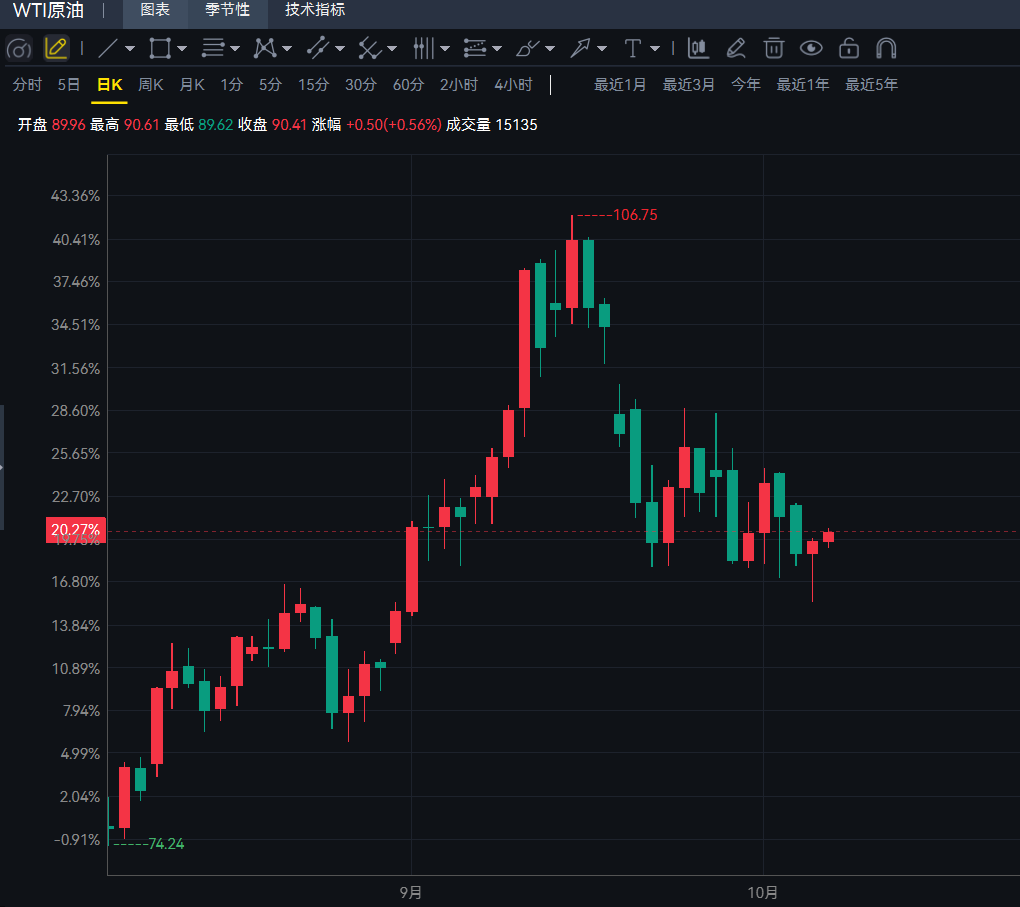 Editor's Summary : Overall, the oil market is caught in a fierce tug-of-war between "geopolitical risk premiums" and "the reality of supply recovery": The increasing frequency of tanker attacks in the Strait of Hormuz continues to provide risk support for oil prices, while the rapid recovery of pipeline capacity and the rebound in Gulf traffic are repeatedly suppressing price increases, thus trapping WTI oil prices in a struggle around the $90 mark. Looking ahead, the short-term direction depends on the relative strength of these two forces—if the conflict escalates further or a substantial supply disruption occurs, oil prices are expected to break through $90.5 and challenge above $93; conversely, if pipeline capacity fully recovers, traffic continues to rebound, and coupled with negative demand, oil prices may fall back to $87 or even lower. TD Securities' warning that "the balance is tighter than it appears" is worth noting: with narrowing inventory buffers and reduced buffer capacity, even a nominal supply recovery will struggle to quickly bridge the market's pricing of tail risks. On the risk front, the unpredictability of the geopolitical situation and unexpected policy developments are the main sources of uncertainty.
Signals of recovery on the supply side, however, act as a suppressive force. Despite high risks, tankers continue to risk traversing the Strait of Hormuz , demonstrating the resilience of Gulf energy exports in operating as usual despite the risks. More importantly, Saudi Arabia's east-west oil pipeline has restored its daily oil transport to approximately 5.8 million barrels , equivalent to more than 80% of its designed transport capacity of approximately 7 million barrels. This land route, bypassing the Strait of Hormuz and connecting the eastern oil-producing region with the Red Sea port of Yanbu, was suspended for several days in September due to a drone attack, but has now resumed operation faster than the market expected, serving as a "pressure relief valve" for this round of supply concerns. Recently, crude oil transported through the Strait of Hormuz has reached approximately 12 million barrels per day, close to pre-war levels, and the actual supply data partially offsets the "supply disruption" panic. The deeper logic of oil market supply and demand is more subtle than simple flow figures. Strategists at TD Securities point out that while crude oil is indeed being suppressed by increasing flow , the new supply is "increasingly being offset by higher demand and the actions of Iran and the Houthis"—in other words, higher consumption and continued supply disruptions are absorbing the rebound in flow, making the supply-demand balance of benchmark oils tighter than surface data suggests . This also explains why oil prices, after a rapid decline following news of supply recovery, were able to stabilize relatively quickly: the market is trading not only physical flow but also the probability of the next disruption. Other energy industry executives warn that the global available oil inventory buffer is narrowing, and the supply system is more vulnerable than ever before; any sudden disruption could trigger a sharp price reaction. From a global perspective, the tug-of-war around $90 for oil prices affects the balance of inflation expectations and monetary policy: Brent crude has climbed back above $100, and the transmission of energy costs to transportation and manufacturing costs fuels expectations of "high interest rates lasting longer" in major economies, while also putting pressure on the terms of trade for economies reliant on energy imports. Market sentiment is generally dominated by geopolitical concerns, with data taking a backseat. Market focus is concentrated on three points: the frequency and intensity of attacks in the Strait of Hormuz, the recovery progress of Saudi pipelines and other alternative routes, and marginal changes in inventory data —any trend reversal in any of these areas could disrupt the current equilibrium. Technically, WTI is consolidating within the $87.5-$90.5 range on the daily chart. The price center has shifted slightly lower than last week's high above $93, with short-term moving averages intersecting and the direction uncertain. The RSI indicator has flattened after falling from the overbought zone to the neutral zone, indicating a temporary balance between bulls and bears, with the market lacking unilateral momentum. On the upside resistance side, $90.5 is a dense resistance zone from the recent rebound; a successful break above this level could lead to a retest of $91.5 and even $93.5 (the early October high). On the downside support side, $88.5 is the immediate support near this week's low, followed by the psychological level of $87 , with stronger support at $85.5 . From a 4-hour chart perspective, oil prices have formed a higher low structure after rebounding from the low of $87.6. Short-term momentum indicators are running in the strong zone. If the price breaks through $90.5 with increased volume, the short-term rebound is expected to continue. Conversely, if the rebound is blocked and falls back and breaks below $88.5, it may retest the $87 support level. Editor's Summary : Overall, the oil market is caught in a fierce tug-of-war between "geopolitical risk premiums" and "the reality of supply recovery": The increasing frequency of tanker attacks in the Strait of Hormuz continues to provide risk support for oil prices, while the rapid recovery of pipeline capacity and the rebound in Gulf traffic are repeatedly suppressing price increases, thus trapping WTI oil prices in a struggle around the $90 mark. Looking ahead, the short-term direction depends on the relative strength of these two forces—if the conflict escalates further or a substantial supply disruption occurs, oil prices are expected to break through $90.5 and challenge above $93; conversely, if pipeline capacity fully recovers, traffic continues to rebound, and coupled with negative demand, oil prices may fall back to $87 or even lower. TD Securities' warning that "the balance is tighter than it appears" is worth noting: with narrowing inventory buffers and reduced buffer capacity, even a nominal supply recovery will struggle to quickly bridge the market's pricing of tail risks. On the risk front, the unpredictability of the geopolitical situation and unexpected policy developments are the main sources of uncertainty.
- Risk Warning and Disclaimer
- The market involves risk, and trading may not be suitable for all investors. This article is for reference only and does not constitute personal investment advice, nor does it take into account certain users’ specific investment objectives, financial situation, or other needs. Any investment decisions made based on this information are at your own risk.