Cooling expectations of a Bank of Japan interest rate hike weighed on the yen, causing the USD/JPY pair to rebound amid fluctuations.
2026-10-07 10:24:18
The USD/JPY pair strengthened against the Japanese yen during Wednesday's Asian trading session, trading around 158.35 . The direct pressure on the yen's weakness stemmed from the waning expectations of a Bank of Japan (BOJ) rate hike: overnight index swaps showed the market pricing in only about a 12% probability of a BOJ rate hike in October , far below the 40% level seen early last week; if the December meeting is taken into account, the probability of a rate hike rises to about 90% —the market has essentially shifted the timing of the rate hike from October to December, thus leaving the yen lacking short-term support. 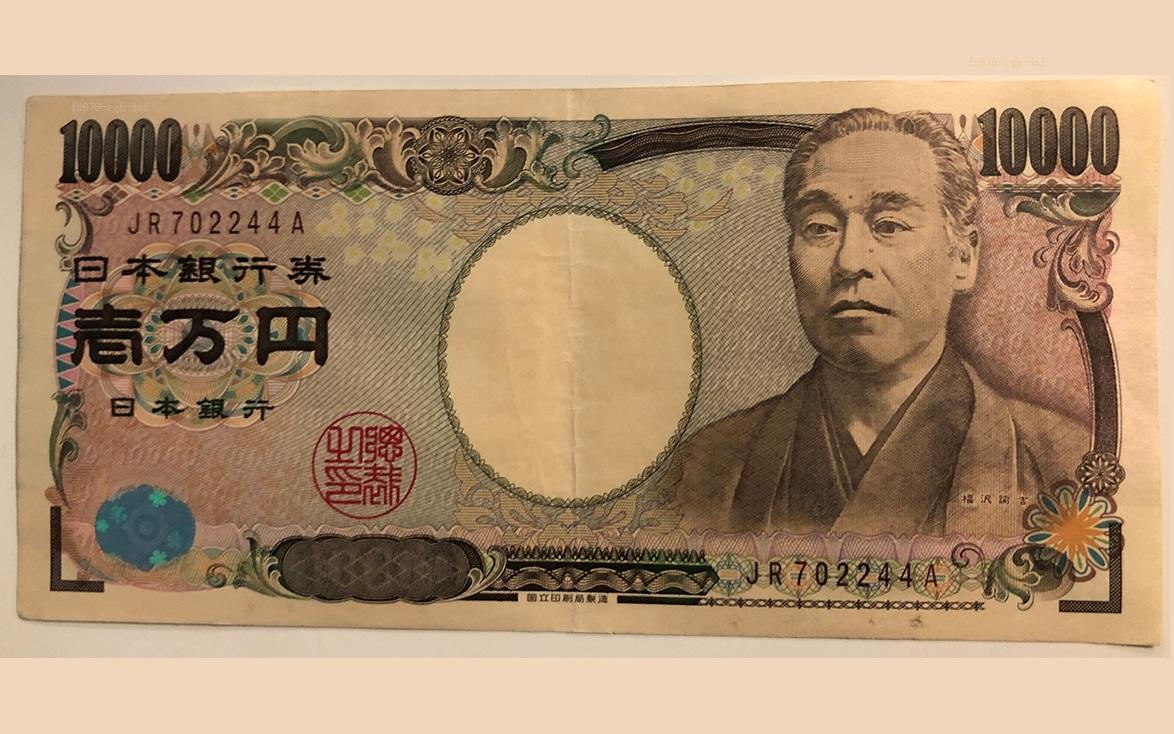 This shift in expectations is closely related to the latest remarks by the Bank of Japan governor. Kazuo Ueda stated on Tuesday that the central bank will consider the timing and pace of policy adjustments after assessing the likelihood and risks of achieving its economic and price baseline scenarios . While this reiterates the stance of "continuing to gradually raise policy rates," it reveals almost no intention to challenge the market's bet of "no change in October," instead reinforcing the market's judgment that the central bank will remain on the sidelines at its October 30 meeting. Furthermore, newly appointed policy board member Ayako Sato expressed support for phased rate hikes —the subtle difference between "phased" and "continuous rate hikes" further confirms the Bank of Japan's current dovish stance. Beyond interest rate expectations, the real constraint of the US-Japan interest rate differential continues to dominate the exchange rate. The Federal Reserve raised interest rates by 25 basis points to 3.75%-4.00% at its September meeting, maintaining a spread of approximately 2.5 percentage points with the Bank of Japan's policy rate of 1.25%. Even with weak US non-farm payroll data in September— only 29,000 new jobs added, far below the expected 90,000, and the unemployment rate rising to 4.2% , with August's data revised down to 133,000—market pricing in another Fed rate hike this year remains high, and the dollar's interest rate advantage has not substantially weakened. There is a subtle divergence between institutional views and market pricing. Rabobank points out that given the limited market expectations for action at the October meeting following the Bank of Japan's "expected 25 basis point rate hike" last month, the market does not have high expectations for a "back-to-back" rate hike by the Bank of Japan ; even so, the possibility of accelerating the pace of rate hikes remains if economic data supports it. The agency also believes that the market may have overestimated the Fed's tightening力度 next year —once some rate hike expectations are priced in, there is room for the USD/JPY to decline in 2027, but the short-term target of 155.00 remains unchanged. It is worth noting that if the USD/JPY returns to around 160, it may trigger Japanese authorities' currency intervention again , and the shadow of this historical experience will continue to limit the upside potential of the exchange rate. In terms of policy communication, the Fed's hawkish tone provides support for the dollar. Kansas City Fed President Schmid recently emphasized that inflation is "frustrating" and the Fed "still has a long way to go," warning that artificial intelligence (AI) investment has become one of the main drivers of current inflation , and even with higher long-term yields, there is still work to be done on short-term interest rates. Market surveys show that the FXS Hawkish Index, which measures the Fed's communication tone, has risen to 137.91, significantly higher than the neutral level of 100— the Fed's overall communication remains restrictive , and the market is therefore pricing in "higher interest rates for longer," thus maintaining the dollar's relative resilience. The FOMC meeting minutes released tonight will be a key variable in the USD/JPY game: the interpretation of the unexpected slowdown in September's non-farm payrolls, the description of sticky inflation, and the guidance on subsequent policy will directly determine the market's repricing of the Fed's December meeting and even the path to 2027. If the minutes signal "patient observation," the dollar may decline in the short term, and the yen may get a breather; if the minutes emphasize inflationary pressures and leave room for further rate hikes, the USD/JPY may challenge the 159 level again. The market's focus is on three points: the policy stance of the FOMC minutes, the statements of Bank of Japan officials before the end-of-October meeting, and the marginal changes in the USD/JPY interest rate differential . From a technical perspective, on the daily chart, USD/JPY remains constrained by the resistance zone formed by the 100-day moving average (around 159.55) and the upper Bollinger Band (around 159.80) , with rebounds repeatedly encountering resistance here. The price is trading above the middle Bollinger Band, and the 14-day RSI is at 56.27 , indicating a mildly bullish momentum but not yet breaking through the bearish structure set by the long-term moving averages, suggesting the overall market remains in a range-bound pattern. On the resistance side, the 100-day moving average at 159.55 is the first resistance level, followed by the upper Bollinger Band at 159.80 . On the support side, the middle Bollinger Band at 156.90 provides immediate support, with a stronger support level at the lower Bollinger Band at 154.00 . If selling pressure regains control and the price breaks below the recent pivot point of 158.38, the exchange rate may fall back towards the lower Bollinger Band. From a 4-hour chart perspective, the exchange rate is facing dynamic resistance from the upper Bollinger Band in the short term around 158.35. If it breaks through with increased volume, it may challenge the 159.00-159.55 area; conversely, if the rebound is weak, it will retrace to the support zone of 157.15-156.90.
 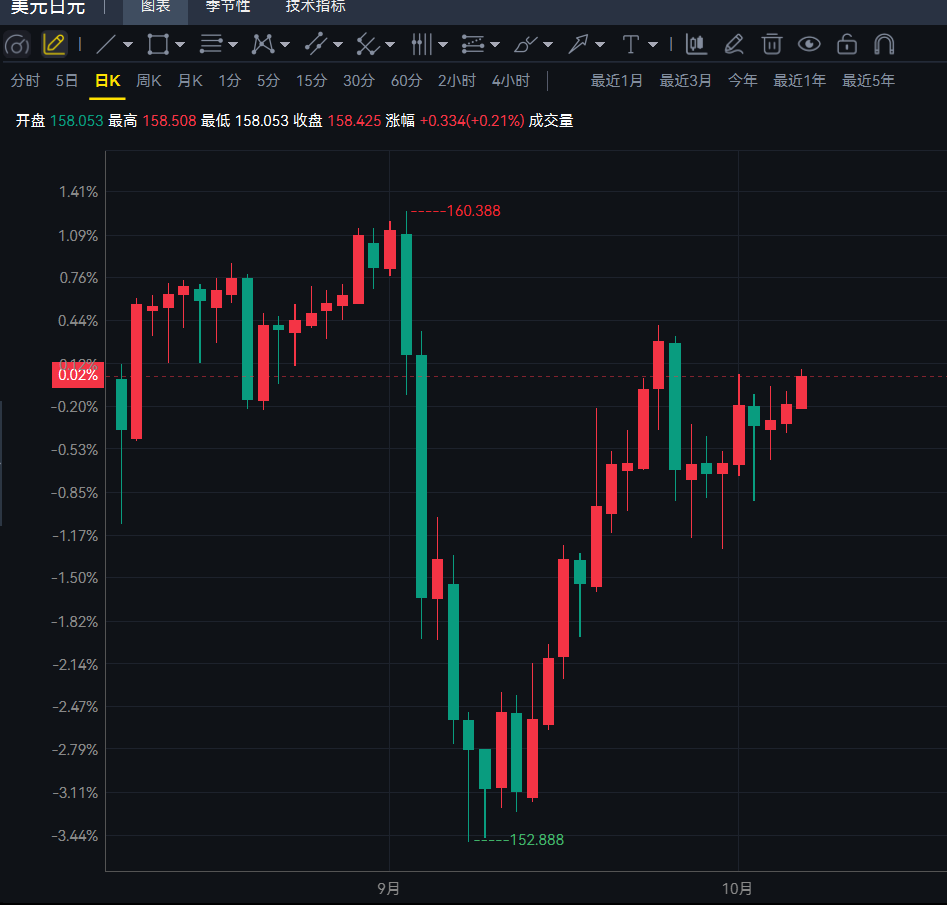 Editor's Summary : Overall, the USD/JPY pair is caught between expectations of a "dominant stance from the Bank of Japan" and a "hawkish stance from the Federal Reserve." The Bank of Japan's decision to hold rates steady in October is almost certain, with the rate hike expected to be delayed until December. The yen is currently weak due to the dual pressures of interest rate differentials and policy pace. However, weak US employment data, potential overestimation of the Fed's tightening expectations for next year, and the risk of intervention near the 160 level limit the upside potential for USD/JPY. Looking ahead, tonight's FOMC minutes will determine the short-term direction of the dollar—a dovish signal could push the exchange rate back to around 157, while a hawkish tone could help push it to challenge the 159.55 resistance level. If the Bank of Japan's quarterly outlook at the end of October formally confirms that potential inflation is close to the 2% target, it will pave the way for a December rate hike, thus providing medium-term support for the yen. On the risk side, attention should be paid to the policy responses of the US and Japanese authorities near the 160 level and the impact of geopolitical tensions on safe-haven flows.
This shift in expectations is closely related to the latest remarks by the Bank of Japan governor. Kazuo Ueda stated on Tuesday that the central bank will consider the timing and pace of policy adjustments after assessing the likelihood and risks of achieving its economic and price baseline scenarios . While this reiterates the stance of "continuing to gradually raise policy rates," it reveals almost no intention to challenge the market's bet of "no change in October," instead reinforcing the market's judgment that the central bank will remain on the sidelines at its October 30 meeting. Furthermore, newly appointed policy board member Ayako Sato expressed support for phased rate hikes —the subtle difference between "phased" and "continuous rate hikes" further confirms the Bank of Japan's current dovish stance. Beyond interest rate expectations, the real constraint of the US-Japan interest rate differential continues to dominate the exchange rate. The Federal Reserve raised interest rates by 25 basis points to 3.75%-4.00% at its September meeting, maintaining a spread of approximately 2.5 percentage points with the Bank of Japan's policy rate of 1.25%. Even with weak US non-farm payroll data in September— only 29,000 new jobs added, far below the expected 90,000, and the unemployment rate rising to 4.2% , with August's data revised down to 133,000—market pricing in another Fed rate hike this year remains high, and the dollar's interest rate advantage has not substantially weakened. There is a subtle divergence between institutional views and market pricing. Rabobank points out that given the limited market expectations for action at the October meeting following the Bank of Japan's "expected 25 basis point rate hike" last month, the market does not have high expectations for a "back-to-back" rate hike by the Bank of Japan ; even so, the possibility of accelerating the pace of rate hikes remains if economic data supports it. The agency also believes that the market may have overestimated the Fed's tightening力度 next year —once some rate hike expectations are priced in, there is room for the USD/JPY to decline in 2027, but the short-term target of 155.00 remains unchanged. It is worth noting that if the USD/JPY returns to around 160, it may trigger Japanese authorities' currency intervention again , and the shadow of this historical experience will continue to limit the upside potential of the exchange rate. In terms of policy communication, the Fed's hawkish tone provides support for the dollar. Kansas City Fed President Schmid recently emphasized that inflation is "frustrating" and the Fed "still has a long way to go," warning that artificial intelligence (AI) investment has become one of the main drivers of current inflation , and even with higher long-term yields, there is still work to be done on short-term interest rates. Market surveys show that the FXS Hawkish Index, which measures the Fed's communication tone, has risen to 137.91, significantly higher than the neutral level of 100— the Fed's overall communication remains restrictive , and the market is therefore pricing in "higher interest rates for longer," thus maintaining the dollar's relative resilience. The FOMC meeting minutes released tonight will be a key variable in the USD/JPY game: the interpretation of the unexpected slowdown in September's non-farm payrolls, the description of sticky inflation, and the guidance on subsequent policy will directly determine the market's repricing of the Fed's December meeting and even the path to 2027. If the minutes signal "patient observation," the dollar may decline in the short term, and the yen may get a breather; if the minutes emphasize inflationary pressures and leave room for further rate hikes, the USD/JPY may challenge the 159 level again. The market's focus is on three points: the policy stance of the FOMC minutes, the statements of Bank of Japan officials before the end-of-October meeting, and the marginal changes in the USD/JPY interest rate differential . From a technical perspective, on the daily chart, USD/JPY remains constrained by the resistance zone formed by the 100-day moving average (around 159.55) and the upper Bollinger Band (around 159.80) , with rebounds repeatedly encountering resistance here. The price is trading above the middle Bollinger Band, and the 14-day RSI is at 56.27 , indicating a mildly bullish momentum but not yet breaking through the bearish structure set by the long-term moving averages, suggesting the overall market remains in a range-bound pattern. On the resistance side, the 100-day moving average at 159.55 is the first resistance level, followed by the upper Bollinger Band at 159.80 . On the support side, the middle Bollinger Band at 156.90 provides immediate support, with a stronger support level at the lower Bollinger Band at 154.00 . If selling pressure regains control and the price breaks below the recent pivot point of 158.38, the exchange rate may fall back towards the lower Bollinger Band. From a 4-hour chart perspective, the exchange rate is facing dynamic resistance from the upper Bollinger Band in the short term around 158.35. If it breaks through with increased volume, it may challenge the 159.00-159.55 area; conversely, if the rebound is weak, it will retrace to the support zone of 157.15-156.90. Editor's Summary : Overall, the USD/JPY pair is caught between expectations of a "dominant stance from the Bank of Japan" and a "hawkish stance from the Federal Reserve." The Bank of Japan's decision to hold rates steady in October is almost certain, with the rate hike expected to be delayed until December. The yen is currently weak due to the dual pressures of interest rate differentials and policy pace. However, weak US employment data, potential overestimation of the Fed's tightening expectations for next year, and the risk of intervention near the 160 level limit the upside potential for USD/JPY. Looking ahead, tonight's FOMC minutes will determine the short-term direction of the dollar—a dovish signal could push the exchange rate back to around 157, while a hawkish tone could help push it to challenge the 159.55 resistance level. If the Bank of Japan's quarterly outlook at the end of October formally confirms that potential inflation is close to the 2% target, it will pave the way for a December rate hike, thus providing medium-term support for the yen. On the risk side, attention should be paid to the policy responses of the US and Japanese authorities near the 160 level and the impact of geopolitical tensions on safe-haven flows.- Risk Warning and Disclaimer
- The market involves risk, and trading may not be suitable for all investors. This article is for reference only and does not constitute personal investment advice, nor does it take into account certain users’ specific investment objectives, financial situation, or other needs. Any investment decisions made based on this information are at your own risk.