A chart shows that the Baltic Dry Index has fallen for the third consecutive week, with weak Capesize freight rates being the main drag.
2026-10-16 23:38:19
The latest data shows that the Baltic Dry Index (BDI) closed at 2511 points on October 16, 2026, a new low since June 30, 2026, down 1.34% month-on-month, marking the 10th consecutive day of decline (including zero growth). Looking at the short-term charts, the BDI has seen positive growth once, negative growth ten times, and zero growth in the last 11 trading days. Specifically, the Panamax Freight Index (BPI) closed at 2314 points, down 1.78%; the Capesize Freight Index (BCI) closed at 3249 points, down 2.20%; and the Supramax Freight Index (BSI) closed at 1865 points, up 0.48%. For detailed charts of the Baltic Dry Index and its three main sub-indices, including the latest 720-day and 10-year trends, please refer to the charts provided by FX678. 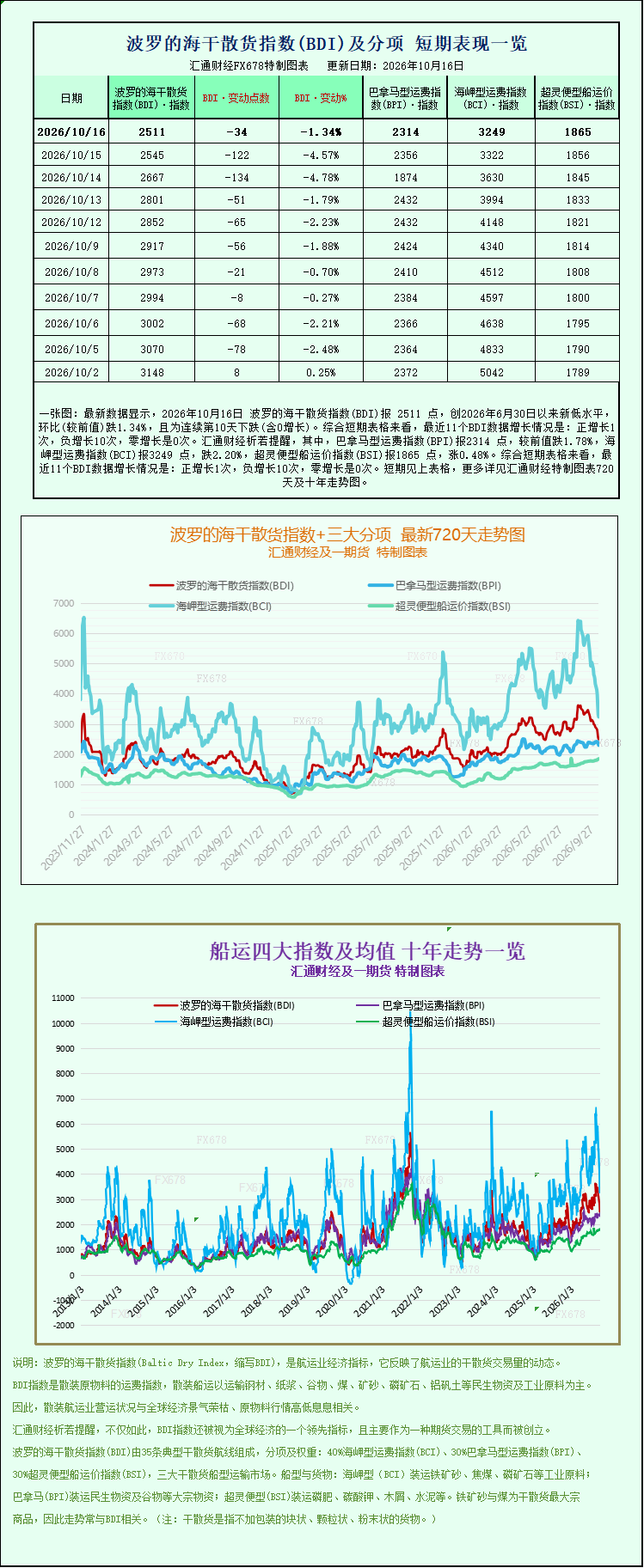 The Baltic Dry Index, which tracks dry bulk shipping rates, continued its downward trend on Friday, marking its third consecutive week of decline. At the close, the composite index, covering the three major vessel types—Capesize, Panamax, and Supramax—fell 34 points, or 1.34%, to 2,511 points, its lowest level since June 30. The cumulative decline for the week was approximately 14%, indicating that the dry bulk shipping market remains in a clear downward trend. Capesize: Freight rates fell to their lowest level since early April, down 25% for the week. Looking at the sub-types, the Capesize index was the main drag on the overall market. The index fell 73 points, or 2.20%, to 3,249 points on Friday, a new low since early April, with a weekly decline of 25%. Capesize vessels are the largest and most volatile class of vessels in the dry bulk market, primarily transporting bulk raw materials such as iron ore and coal. Their sensitivity to macroeconomic demand expectations far exceeds that of other vessel types. Continued pressure on freight rates is directly reflected in shipowner revenue—the average daily revenue of a Capesize vessel with a deadweight tonnage of approximately 150,000 tons has decreased by $664 to $25,961. Iron ore rebound: bargain hunting and improved steel mill profits resonate. It is worth noting that iron ore prices rebounded on Friday, after hitting a more than two-year low the previous day. Market analysts believe that this rebound was mainly driven by two factors: first, signs of improved profit margins in the Chinese steel industry stimulated traders' enthusiasm for replenishing their inventories at lower prices; second, as the world's largest iron ore consumer, China's expected recovery in downstream end-user demand provided some support for prices. However, the continued weakness in Capesize freight rates still reflects the market's cautious attitude towards the medium- to long-term demand strength for iron ore, and the divergence between freight rates and ore prices warrants attention. Panamax: Following the Weakness, Grain and Coal Demand Remains Subdued The Panamax freight rate index fell 42 points, or 1.78%, to 2,314. This type of vessel typically carries 60,000 to 70,000 tons of coal or grain, and its average daily revenue decreased by $373 to $20,827. The decline in Panamax freight rates is related to relatively subdued grain and coal trading activity, with overall trading sentiment weak, failing to provide effective hedging support against the weakening Capesize trend. Supramax: Slightly Upward Against the Trend, Showing Relatively Resilient Performance Among smaller vessels, the Supramax freight rate performed relatively steadily, rising slightly by 9 points, or 0.48%, to 1,865. Related to the transportation demand for small bulk cargoes, nickel ore, and steel, the Supramax freight rate showed some resilience, which also buffered the overall decline in the composite index to some extent. Market Outlook: Short-Term Pressure Likely to Remain Precarious Overall, the current downward pressure in the dry bulk market is mainly concentrated on Capesize vessels. While iron ore prices have shown signs of rebounding, the sustainability of this rebound remains to be seen. If the restocking demand from Chinese steel mills and the improvement in downstream consumption fail to provide sustained support, Capesize freight rates may continue to be weak in the short term, thus dragging down the composite index. Going forward, it is crucial to monitor the impact of variables such as iron ore price trends, Chinese steel mill operating rates, and seasonal restocking patterns on freight rates.
The Baltic Dry Index, which tracks dry bulk shipping rates, continued its downward trend on Friday, marking its third consecutive week of decline. At the close, the composite index, covering the three major vessel types—Capesize, Panamax, and Supramax—fell 34 points, or 1.34%, to 2,511 points, its lowest level since June 30. The cumulative decline for the week was approximately 14%, indicating that the dry bulk shipping market remains in a clear downward trend. Capesize: Freight rates fell to their lowest level since early April, down 25% for the week. Looking at the sub-types, the Capesize index was the main drag on the overall market. The index fell 73 points, or 2.20%, to 3,249 points on Friday, a new low since early April, with a weekly decline of 25%. Capesize vessels are the largest and most volatile class of vessels in the dry bulk market, primarily transporting bulk raw materials such as iron ore and coal. Their sensitivity to macroeconomic demand expectations far exceeds that of other vessel types. Continued pressure on freight rates is directly reflected in shipowner revenue—the average daily revenue of a Capesize vessel with a deadweight tonnage of approximately 150,000 tons has decreased by $664 to $25,961. Iron ore rebound: bargain hunting and improved steel mill profits resonate. It is worth noting that iron ore prices rebounded on Friday, after hitting a more than two-year low the previous day. Market analysts believe that this rebound was mainly driven by two factors: first, signs of improved profit margins in the Chinese steel industry stimulated traders' enthusiasm for replenishing their inventories at lower prices; second, as the world's largest iron ore consumer, China's expected recovery in downstream end-user demand provided some support for prices. However, the continued weakness in Capesize freight rates still reflects the market's cautious attitude towards the medium- to long-term demand strength for iron ore, and the divergence between freight rates and ore prices warrants attention. Panamax: Following the Weakness, Grain and Coal Demand Remains Subdued The Panamax freight rate index fell 42 points, or 1.78%, to 2,314. This type of vessel typically carries 60,000 to 70,000 tons of coal or grain, and its average daily revenue decreased by $373 to $20,827. The decline in Panamax freight rates is related to relatively subdued grain and coal trading activity, with overall trading sentiment weak, failing to provide effective hedging support against the weakening Capesize trend. Supramax: Slightly Upward Against the Trend, Showing Relatively Resilient Performance Among smaller vessels, the Supramax freight rate performed relatively steadily, rising slightly by 9 points, or 0.48%, to 1,865. Related to the transportation demand for small bulk cargoes, nickel ore, and steel, the Supramax freight rate showed some resilience, which also buffered the overall decline in the composite index to some extent. Market Outlook: Short-Term Pressure Likely to Remain Precarious Overall, the current downward pressure in the dry bulk market is mainly concentrated on Capesize vessels. While iron ore prices have shown signs of rebounding, the sustainability of this rebound remains to be seen. If the restocking demand from Chinese steel mills and the improvement in downstream consumption fail to provide sustained support, Capesize freight rates may continue to be weak in the short term, thus dragging down the composite index. Going forward, it is crucial to monitor the impact of variables such as iron ore price trends, Chinese steel mill operating rates, and seasonal restocking patterns on freight rates.
- Risk Warning and Disclaimer
- The market involves risk, and trading may not be suitable for all investors. This article is for reference only and does not constitute personal investment advice, nor does it take into account certain users’ specific investment objectives, financial situation, or other needs. Any investment decisions made based on this information are at your own risk.