Strategic reserves have fallen to their lowest level since 1982; how much "ammunition" does the US have left for the oil market?
2026-10-20 07:34:21
On Tuesday (October 20) during Asian trading hours, WTI crude oil November contracts continued their upward trend, currently trading around $103.60 per barrel. The continued depletion of the US Strategic Petroleum Reserve is becoming a new variable in the market's assessment of supply buffers and long-term risks. The US Strategic Petroleum Reserve (SPR) fell to approximately 283 million barrels last week, the lowest level since October 1982, mainly due to the release of 172 million barrels by the US in response to supply disruptions caused by the conflict with Iran. Currently, the reserve is less than 40% full. 
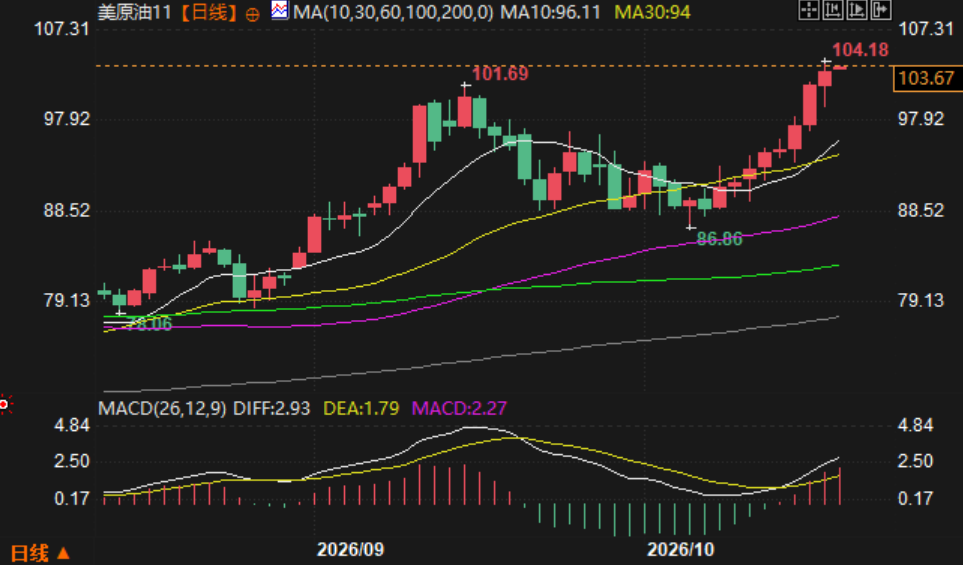 (WTI crude oil November contract daily chart, source: EasyForex) At 7:10 Beijing time, the WTI crude oil November contract was trading at $103.67 per barrel.
Key data: SPR falls to 283 million barrels, lowest since 1982.
According to data from the U.S. Department of Energy cited by prominent media outlets, the U.S. Strategic Petroleum Reserve fell to approximately 283 million barrels last week, the lowest level since October 1982. This decline reflects the ongoing release of 172 million barrels agreed upon by the U.S. on March 11. The U.S. contribution is the largest share of the 400 million barrels of crude oil and refined product releases agreed upon by the 32 member countries of the International Energy Agency. The release is proceeding slower than initially planned. The Department of Energy stated in March that, at the planned emission rate, delivery would take approximately 120 days, meaning completion around mid-July. However, the releases continued into October. According to the Energy Information Administration, the reserves are currently about 130 million barrels less than when the releases began.Reserve background: Established in the 1970s, with an authorized capacity of 714 million barrels.
Established in the 1970s after the Arab oil embargo exposed the U.S.'s vulnerability to supply shocks, the SPR has an authorized storage capacity of 714 million barrels, stored in underground salt caverns at four locations along the Gulf Coast. At current levels, the reserves are less than 40% full. At the heart of this context is the fact that the SPR was designed to respond to supply shocks, and the current release is fulfilling that function, but at the cost of reserves falling to their lowest level since the early 1980s. The depletion of the reserves means that the U.S.'s buffer against future supply disruptions is diminishing.Exchange structure: Approximately 200 million barrels need to be returned, and replenishment will increase long-term demand.
Unlike direct sales, this release is in the form of an exchange. Companies that take barrels from the reserves will need to return them later, along with additional quantities. The Department of Energy says it expects to recover approximately 200 million barrels within a year without increasing taxpayer costs. This means the release should eventually reverse, but once it begins, replenishing the reserves will itself increase demand in the oil market. The implication of this structure is that current releases increase supply to the market, but future replenishments will increase demand, supporting prices in the long term.Market Implications: Depleted reserves weaken response capabilities, and risk premiums may rise.
Low reserves come at a time when crude oil prices remain high. Goldman Sachs stated last week that spot Brent crude carries a risk premium of nearly $25 per barrel over its fair value estimate, citing the threat of further supply disruptions and near-record low global inventories. Depleted emergency reserves leave the U.S. with less room to maneuver in the event of an escalation of conflict and renewed supply disruptions. At its core, this means that dwindling reserves weaken the U.S.'s ability to respond to a new round of supply shocks, which could increase the risk premium for crude oil should the conflict with Iran escalate. Traders will be closely watching the pace of further releases and the timing of any replenishment.Summarize
U.S. strategic petroleum reserves fell to about 283 million barrels last week, the lowest level since October 1982, as the U.S. released 172 million barrels in response to supply disruptions caused by the conflict with Iran. Reserves are currently less than 40% full, about 130 million barrels less than when releases began. Releases are proceeding slower than planned and will continue into October. Since the releases are in exchange, about 200 million barrels will need to be returned in the future, and replenishing the reserves will increase demand later and could support forward prices. Depleted emergency reserves weaken the U.S.'s ability to cope with a new round of supply shocks, and could increase the risk premium for crude oil if the conflict with Iran escalates. Goldman Sachs estimates that spot Brent crude is trading at nearly $25 per barrel above fair value, citing near-record low global inventories. Traders will be closely watching the pace of further releases and the timing of replenishments. For the market, the current releases increase supply to a tight market, but the reduced reserve capacity and future replenishment demand will support the forward price curve. (WTI crude oil November contract daily chart, source: EasyForex) At 7:10 Beijing time, the WTI crude oil November contract was trading at $103.67 per barrel.- Risk Warning and Disclaimer
- The market involves risk, and trading may not be suitable for all investors. This article is for reference only and does not constitute personal investment advice, nor does it take into account certain users’ specific investment objectives, financial situation, or other needs. Any investment decisions made based on this information are at your own risk.