Trump ruled out an immediate strike on Iran, safe-haven buying subsided, and the dollar index hovered near a more than three-week low.
2026-10-26 14:14:25
On Monday (October 26) during Asian trading hours, the US dollar index retreated after rising in the previous session, briefly falling to 101.57 before currently trading around 101.70, still near a three-week low. The market expects the Federal Reserve to keep interest rates unchanged in October and raise them again in December. Trump's decision to rule out an immediate strike on Iran reduced safe-haven demand, putting pressure on the dollar, but geopolitical uncertainty remains after the election. 
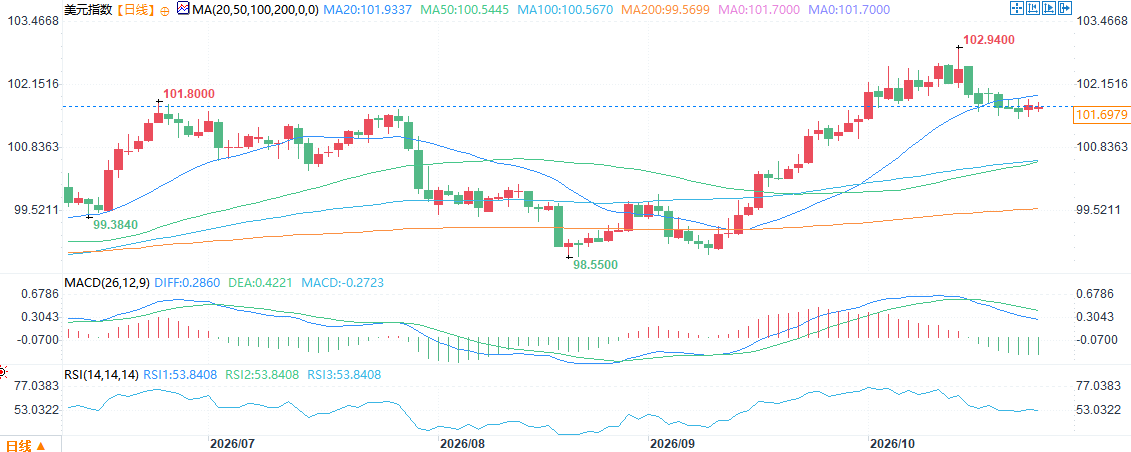 (US Dollar Index Daily Chart, Source: FX678) At 14:10 Beijing time, the US Dollar Index was at 101.71.
Policy expectations: The probability of keeping rates unchanged in October is approximately 90.6%, and the probability of a rate hike in December is approximately 79.7%.
Financial markets anticipate the Federal Reserve will keep interest rates unchanged in October, followed by a possible rate hike in December. According to the CME FedWatch tool, market pricing reflects a roughly 90.6% probability of maintaining rates at the October 27-28 policy meeting and a roughly 79.7% probability of a December rate hike. Elias Haddad of Brown Brothers Harriman noted that the Federal Open Market Committee is expected to keep policy unchanged this week, with the federal funds target range "stable at 3.75% to 4.00%" after the 25 basis point rate hike in September. He stated that "several key Fed officials have called for patience and supported holding rates steady," while the futures market "suggests only a 10% probability of a rate hike this week, with a December 9 rate hike almost fully priced in." Against the backdrop of solid US data and persistent inflationary pressures, Haddad believes this stance continues to support the dollar.Data Focus: PCE and Q3 GDP as Key Guidelines
Investors will be closely watching two key U.S. macroeconomic data releases this week: the Personal Consumption Expenditures (PCE) price index and the preliminary Q3 GDP figure. The PCE, the Federal Reserve's most closely watched inflation indicator, will directly reflect whether core inflationary pressures remain sticky, thus influencing market expectations regarding the future path of interest rates. Better-than-expected PCE data could strengthen expectations of "higher and longer" interest rates, providing support for the dollar; conversely, weaker-than-expected data could intensify discussions about rate cuts or a pause in rate hikes. The preliminary Q3 GDP figure will reveal the true strength of U.S. economic momentum, with the performance of consumption, investment, and net exports being particularly crucial. The combined result of these two data points will form an important bridge between the Fed's post-decision policy guidance and market pricing, dominating the dollar's trajectory and the pace of interest rate expectation adjustments in the short term.Safe-haven demand: Trump rules out immediate strike on Iran, weakening safe-haven buying of the US dollar.
Geopolitically, safe-haven buying of the US dollar has weakened significantly recently. According to Al Jazeera, US President Trump explicitly ruled out immediate military action against Iran, stating "there will be no strikes today," temporarily easing market tensions. However, the risks have not truly subsided. The market remains highly focused on the Israeli election results this week and the potential policy shifts following next week's US midterm elections, with concerns that military action could resume after the elections. Intelligence reports further indicate that Iran is prepared to retaliate against key regional targets such as Israel and the UAE should the conflict escalate. This "temporary but not resolved" state makes it difficult for the safe-haven dollar to gain sustained buying support; instead, it may come under pressure when risk appetite recovers, exacerbating volatility in currency pairs such as the US dollar against the Japanese yen.Institutional Views
ING points out that multiple indicators suggest the US dollar is overvalued, with net long positions and options risk reversals nearing cyclical highs, but no clear triggers are currently driving a reversal. Fed tightening expectations are more persistent than with other central banks, making it difficult for a significant weakening of the dollar even with falling oil prices. Weak global bond markets continue to support demand for liquidity-defensive currencies. ING believes that unless a "sell-the-US" shock similar to that of 2025 or a significant macroeconomic shift occurs, the dollar's momentum is unlikely to reverse easily, and the short-term trend will likely remain one of high-level fluctuations or slight upward movement. HSBC's Global Head of FX Research, Paul Mackel, and others believe the dollar's outlook has improved and it is expected to continue its moderate upward trend. Strong US data and reduced uncertainty surrounding Fed policy are the main supports; fiscal and political risks in Europe and the UK provide additional support for the dollar. HSBC expects the dollar to maintain its advantage relative to the euro, pound, and yen, potentially continuing at least until the first half of 2027. While the pace of interest rate hikes may not be as aggressive as market pricing, the dollar's status as the "cleanest dirty shirt" remains, and gradual appreciation remains the baseline scenario.Summarize
The US dollar index retreated to around 101.50 after rising in the previous trading session, with the core pressure stemming from expectations surrounding Federal Reserve policy: the probability of keeping rates unchanged in October is approximately 90.6%, and the probability of a rate hike in December is approximately 79.7%, with several officials calling for patience and a pause this week. Meanwhile, Trump's decision to rule out an immediate strike on Iran reduced safe-haven demand, further pressuring the dollar, but geopolitical uncertainties following the Israeli and US midterm elections remain. This week's PCE inflation and preliminary Q3 GDP figures will be key indicators for judging the subsequent interest rate path. The short-term dollar movement depends on the tug-of-war between policy expectations and safe-haven sentiment. (US Dollar Index Daily Chart, Source: FX678) At 14:10 Beijing time, the US Dollar Index was at 101.71.
- Risk Warning and Disclaimer
- The market involves risk, and trading may not be suitable for all investors. This article is for reference only and does not constitute personal investment advice, nor does it take into account certain users’ specific investment objectives, financial situation, or other needs. Any investment decisions made based on this information are at your own risk.