Germany's expectations index rose to 91.6; will this cause the euro/dollar exchange rate to reverse course?
2026-10-26 17:54:23
On Monday, October 26, the Ifo Institute released its German Business Climate Index, which rose for the sixth consecutive month to 90.2 points. The expectations index rose to 91.6 points, while the current conditions assessment index fell back to 88.8 points. The euro fluctuated around 1.1210 against the dollar. The European Central Bank will hold its policy meeting on Thursday, with the deposit facility rate currently maintained at 2.5%. The German government previously raised its 2026 economic growth forecast to 1.3%, while the Bundesbank noted that output stagnated in the third quarter but is expected to see significant growth in the fourth quarter. The Purchasing Managers' Survey showed that private sector activity expanded for the fourth consecutive month, but momentum weakened. 
The IFO index continues to rise, signaling a recovery.
The IFO Business Climate Index rose from 89.9 in September to 90.2 in October, exceeding the market consensus of around 90.0 and marking six consecutive months of improvement. The expectations index jumped from 90.4 to 91.6, becoming the main driver of the overall index's rise; the current conditions index, however, fell from 89.5 to 88.8. Clemens Foster, president of the IFO Institute, stated in a press release that the economic recovery is continuing, but businesses' assessment of their current operating conditions has deteriorated slightly. This divergence reflects that business confidence stems more from improved future prospects than from a comprehensive improvement in current orders and capacity utilization. The improvement in manufacturing expectations is particularly pronounced, while the service sector is more constrained by domestic demand. The index has rebounded to its highest level since the spring of 2023, but the absolute level remains below the historical average, indicating that the recovery is not yet fully solidified. Private investment remains cautious, with most economists believing that the current expansion is not yet self-sustaining.The intertwined effects of fiscal expansion and external disturbances
Germany's economic recovery is primarily supported by large-scale government spending on infrastructure, defense, and AI, with exports showing relatively robust performance. The government has raised its 2026 GDP growth forecast to 1.3% from 0.5% in the spring and to 1.1% in 2027. The Bundesbank's monthly report indicates that output may stagnate in the third quarter, mainly due to factors including low Rhine River levels disrupting industrial transport, the Middle East conflict driving up energy prices, and some one-off factors. The Purchasing Managers' Survey (PMI) shows the composite index fell to 52.8 in October from 53.8, remaining in expansion territory for the fourth consecutive month. The manufacturing index rose to 54.2, while the services index fell to 51.7. New orders growth slowed, and manufacturing input costs rose, but overall price pressures eased somewhat. Low water levels and rising energy prices are a short-term drag on energy-intensive industries, while fiscal stimulus and export orders are providing a buffer for the industrial sector. The recovery path is characterized by a combination of fiscal dominance and a lagging private sector, with the speed of structural improvement depending on the decline in energy costs and the recovery in investment intentions.Central Bank Policy Path and Growth Pace
The European Central Bank's deposit facility rate is currently at 2.5%, and the market widely expects it to remain unchanged at Thursday's policy meeting. Officials have previously signaled that further policy tightening may be necessary if price pressures persist. The Federal Bank expects significant growth in the fourth quarter, largely consistent with the continued expansion signaled by the Purchasing Managers' Survey. On the inflation front, rising energy prices triggered by the Middle East conflict are dampening consumer purchasing power, but resilience in manufacturing exports is partially offsetting weak domestic demand. Fiscal expansion is pushing up deficit expectations, with the government budget deficit potentially exceeding 4% of nominal GDP by 2026. Private investment has not yet fully recovered, and contracting labor supply and slowing potential growth pose medium-term constraints. Policymakers are seeking a balance between supporting the recovery and controlling inflation, and the path of interest rates will depend on the relative impact of future data on prices and output.EUR/USD Daily Technical Structure
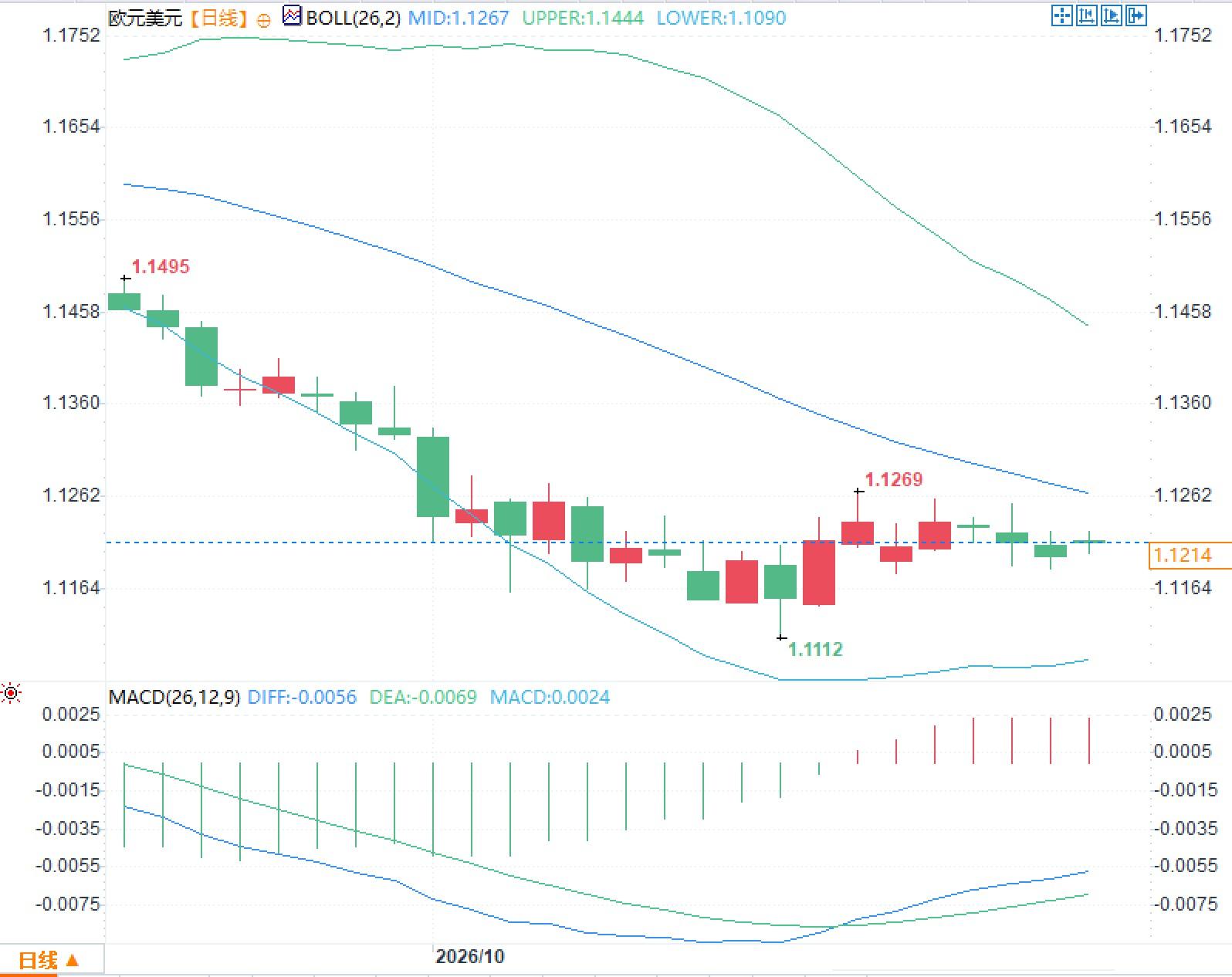
The EUR/USD daily chart shows the Bollinger Bands with the middle band at 1.1267, the upper band at 1.1444, and the lower band at 1.1090. The current price is trading below the middle band, near the lower band. The MACD parameters DIFF is -0.0056, DEA is -0.0069, and the MACD histogram is 0.0024. DIFF is below DEA, but the histogram shows signs of transitioning from negative to positive territory. The price's position relative to the Bollinger Bands indicates it is currently oscillating below the middle band, with fluctuations constrained by the upper and lower bands. Technical indicators reflect a recent shift in momentum from weak to strong, but the absolute values remain in negative territory.Frequently Asked Questions
Question 1: Does the continuous rise in the IFO index mean that the German economy has entered a sustainable recovery phase? Answer: The index rebound is mainly driven by improved expectations. Current assessments suggest a potential decline, private investment is cautious, and the recovery relies more on fiscal spending; a self-reinforcing cycle has not yet formed. Question 2: How will the low Rhine River water level and energy prices affect third-quarter performance? Answer: Low water levels disrupt industrial transportation, and the Middle East conflict has pushed up energy costs, leading to stagnant output. However, fiscal policy and exports provide a buffer, and a rebound is expected in the fourth quarter. Question 3: What does the ECB's meeting on Thursday mean for the interest rate path? Answer: Market expectations are for the rate to remain unchanged at 2.5%, but officials have hinted at further tightening if inflation persists. Policy will weigh growth and price pressures.- Risk Warning and Disclaimer
- The market involves risk, and trading may not be suitable for all investors. This article is for reference only and does not constitute personal investment advice, nor does it take into account certain users’ specific investment objectives, financial situation, or other needs. Any investment decisions made based on this information are at your own risk.