A chart shows that the Baltic Dry Index weakened, with both Capesize and Panamax freight rates declining.
2026-10-27 00:40:24
Latest data shows that on October 26, 2026, the Baltic Dry Index (BDI) closed at 2628 points, a four-day low, down 1.20% from the previous day, marking the second consecutive day of decline (including zero growth). Looking at the short-term charts, the BDI has seen positive growth four times, negative growth seven times, and zero growth in the last 11 BDI data points. Specifically, the Panamax Freight Index (BPI) closed at 2075 points, down 1.61% from the previous day; the Capesize Freight Index (BCI) closed at 3726 points, down 1.71%; and the Supramax Freight Index (BSI) closed at 1888 points, up 0.05%. For detailed charts of the Baltic Dry Index and its three main sub-indices, including the latest 720-day and 10-year trends, please refer to the charts specially created by FX678. 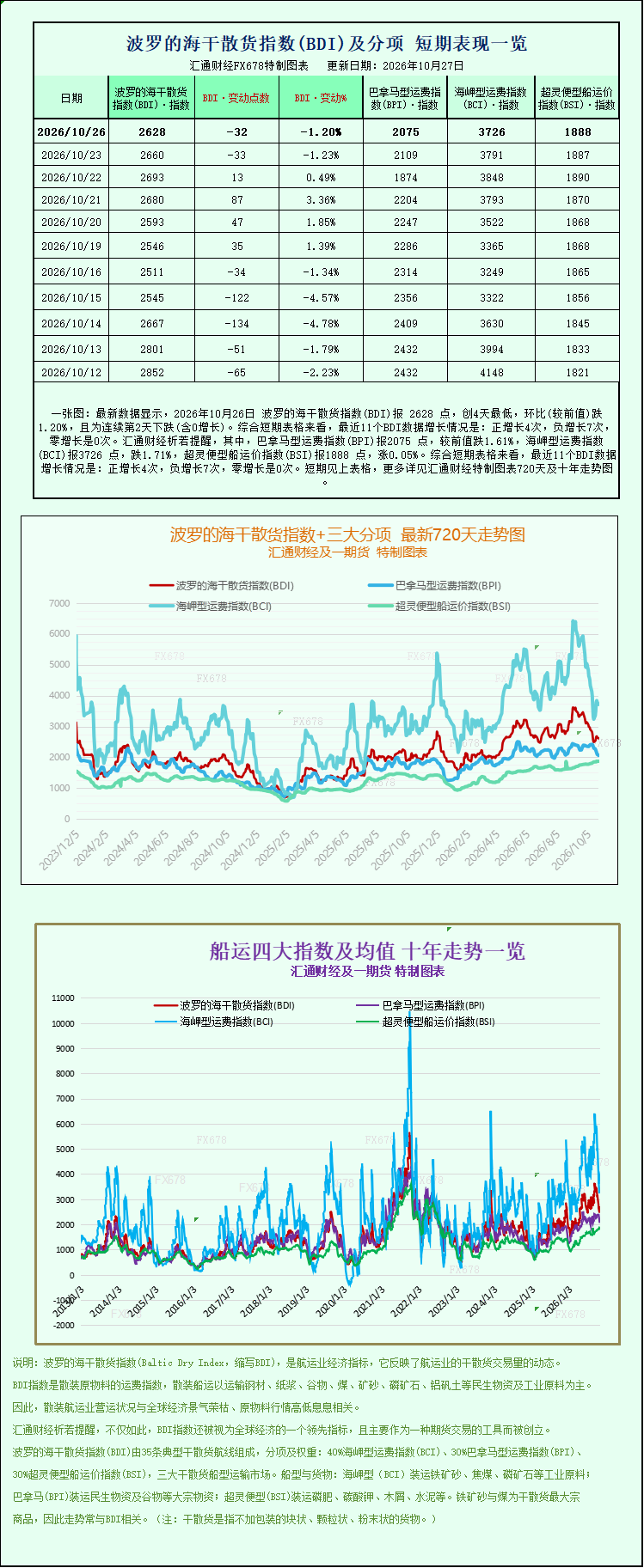 The Baltic Dry Index, the main shipping index tracking dry bulk freight rates, closed lower on Monday, ending a brief rebound in the previous session, dragged down by simultaneous weakness in Capesize and Panamax vessel rates. This trend continues the overall cooling of the dry bulk shipping market since mid-October, reflecting a round of adjustments in shipping rates against the backdrop of slowing demand for downstream commodities. Index Overview: Hit Nearly One-Week Low The Baltic Dry Index (BDI), which tracks freight rates for Capesize, Panamax, and Supramax vessels, fell 32 points, or 1.23%, to 2628 points on Monday, hitting a near one-week low. It is worth noting that just last Tuesday (October 20), the index rose 1.85% to 2593 points due to stronger Capesize vessel rates, demonstrating the volatility of the market in the short term. From a longer-term perspective, the Baltic Dry Index (BDI) has fallen by more than 20% in the past month, but is still about 30% higher than a year ago, indicating that the current decline is more of a rational correction after high-level fluctuations, rather than a trend collapse. According to recent opinions from multiple institutions, the market generally attributes this correction to a rebalancing between seasonally weakening demand and increased shipping capacity. Capesize vessels: Daily earnings fall below $31,000 As the largest weighted segment in the BDI, the Capesize Freight Index (BCI) fell 65 points, or 1.71%, to 3726 points on Monday, also nearing a one-week low. The average daily earnings of Capesize bulk carriers, typically carrying 150,000 tons of cargo (mainly iron ore and coal), fell by $585 to $30,292. Capesize vessels are the most sensitive to commodity market conditions in the dry bulk market, and their freight rate fluctuations often directly reflect the trading activity of major commodities such as iron ore and coal. On Monday, international iron ore prices fluctuated within a narrow range. Market participants are weighing two opposing forces: on the one hand, China, the world's largest consumer, is entering a period of seasonal demand weakness, resulting in insufficient marginal purchasing momentum for steel production; on the other hand, the market anticipates a new round of stimulus measures from Beijing to boost growth expectations for the world's second-largest economy. This tug-of-war between the two forces makes it difficult for iron ore prices to establish a clear direction in the short term, directly limiting the rebound potential of Capesize freight rates. From an industry perspective, China's real estate chain remains the core variable on the demand side. Real estate development investment and new construction starts continue to decline, and the World Steel Association has previously lowered its forecast for China's steel demand growth, further confirming the weakening of end-user demand expectations. Against the backdrop of continued profit pressure and downstream buyers adopting a wait-and-see approach, the negative feedback loop of steel mills reducing production and thus suppressing raw material purchases continues to unfold, dragging down iron ore trade volume and corresponding shipping demand. Panamax Vessels: Hit Nearly Three-Month Low The Panamax Freight Index (BPNI) fell 34 points, or 1.61%, to 2075 points on Monday, hitting a near three-month low since July 30th. The decline was relatively deeper among Capesize and Panamax vessels. Average daily earnings for Panamax vessels fell $309 to $18,672. These vessels typically carry 60,000 to 70,000 tons of coal or grain, and their freight rates are primarily influenced by the pace of coal and grain trade. The recent weakness in Panamax freight rates is partly due to a temporary decline in coal import demand and a slowdown in grain cargo volume. While domestic coal production continues to contract under the constraints of normalized safety regulations and anti-overproduction policies, fluctuations in import procurement also affect capacity demand and freight rates on corresponding routes. Small Vessels: Supramax Relatively Resilient Among small vessels, the Supramax Freight Index (BSIS) rose slightly by 1 point on Monday, a 0.05% increase, to 1888 points, showing relatively stable performance. As a vessel type mainly transporting small and medium-sized bulk cargoes (such as grains, fertilizers, and steel products), Supramax vessels are relatively less affected by fluctuations in a single bulk commodity, thus demonstrating a certain resilience against the backdrop of a general correction in large vessel types. Outlook: Seasonal Pressures and Policy Expectations Intertwined Overall , the current dry bulk shipping market is in a phase of interplay between weakening seasonal demand and rising policy expectations. In the short term, as the Northern Hemisphere gradually enters winter, coal winter stockpiling and grain trade may provide support for some routes; however, whether iron ore trade volume can stabilize and rebound remains a key variable determining the BDI's trend. Analysts generally believe that Capesize freight rates will likely remain in a wide range of fluctuations until there are substantial signs of a recovery in Chinese end-user demand. The market needs to pay close attention to the pace of Chinese steel production, changes in iron ore port inventories, and the actual effects of potential policy stimulus.
- Risk Warning and Disclaimer
- The market involves risk, and trading may not be suitable for all investors. This article is for reference only and does not constitute personal investment advice, nor does it take into account certain users’ specific investment objectives, financial situation, or other needs. Any investment decisions made based on this information are at your own risk.