The dollar index approached a two-week high ahead of the Fed's decision, with an 84.4% probability of a December rate hike.
2026-10-28 14:10:24
The US dollar index rose to around 102.40 on Wednesday (October 28), approaching a two-week high. CME FedWatch showed a 92.8% probability of no rate increase in October and an 84.4% probability of a rate hike in December. Some strategists pointed out that the Fed doesn't need to raise rates today to drive the market; it only needs to change the perceived probability of a December rate hike. Warsh's speech and the wording of the policy statement will be key. 
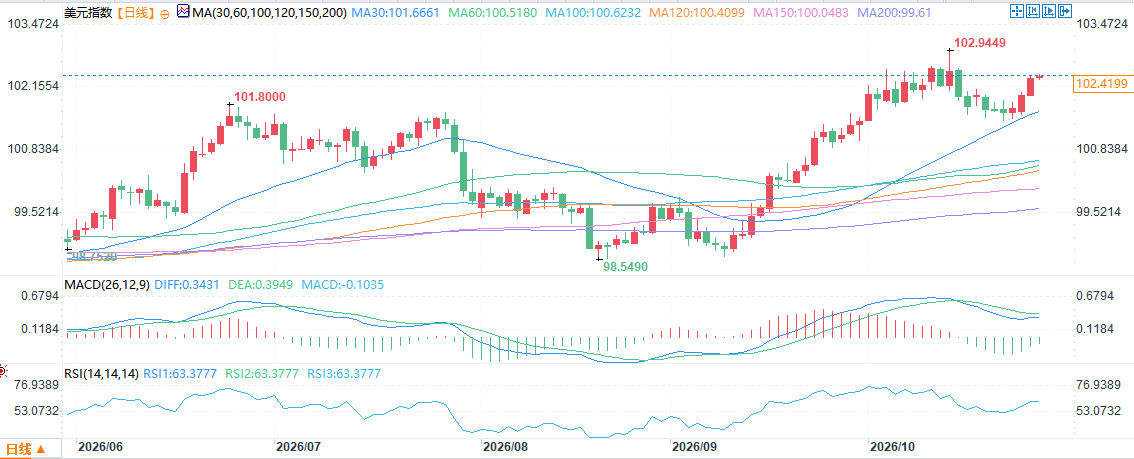 (US Dollar Index Daily Chart, Source: FX678) At 14:08 Beijing time, the US Dollar Index was at 102.42.
Market Overview: The US dollar index is approaching a two-week high, awaiting the Federal Reserve decision.
The dollar index traded around 102.40 in early European trading on Wednesday, nearing a two-week high ahead of the Federal Reserve's interest rate decision, indicating high market sensitivity to upcoming policy signals. The Fed raised its policy rate by 25 basis points to a range of 3.75% to 4.00% last month, and the market widely expects the central bank to maintain the rate this time, while potentially providing further guidance on the possibility of action in December. Traders and investors are closely watching the policy statement and the subsequent press conference, trying to glean from changes in wording whether there is still room for further tightening. This performance of the dollar index also reflects the recent support from energy prices and geopolitical risks for safe-haven demand, keeping the dollar relatively strong among major currencies. The wait-and-see sentiment ahead of the decision has somewhat reduced volatility in the currency market, but once the Fed releases a clear signal, the dollar index may quickly choose a direction, having a ripple effect on global risk assets and other currency pairs.Market pricing: 92.8% probability of no rate increase in October, 84.4% probability of rate hike in December.
According to the CME FedWatch tool, the probability of the Federal Open Market Committee (FOMC) keeping the policy rate unchanged is approximately 92.8%, while the probability of a rate hike in December is as high as 84.4%. Chris Weston, head of research at the Melbourne-based Pepperstone Group, pointed out, "The Fed doesn't need to raise rates today to drive the market; it only needs to change the perceived probability of a December rate hike." This statement accurately summarizes the core logic of the current market—the decision itself to remain unchanged has been largely priced in; the real variable lies in how forward guidance will reshape expectations for December. Any hawkish comments, such as emphasizing that inflation risks have not been eliminated or hinting at the need for further tightening, could quickly boost the dollar against major currencies; conversely, if policymakers release dovish signals, suggesting increasing pressure on the economy or that the rate hike cycle is nearing its end, it could weaken the dollar index in the short term and trigger position adjustments. The market's sensitivity to details of communication has significantly increased.Institutional View: Societe Generale says the US dollar is the strongest recently, but long positions are gaining weight.
Societe Generale strategists pointed out that among the four G10 central banks with policy decisions this week, "the Federal Reserve has had the strongest currency performance in recent weeks," although "the Canadian dollar and New Zealand dollar have looked slightly brighter in recent days (especially the New Zealand dollar)." They believe that from Fed Chairman Warsh's speech in Jackson Hole to the September FOMC meeting, the market has gradually built a more positive outlook for the US dollar, but as time goes on, "the weight of long dollar positions has been felt," thus somewhat suppressing the earlier upward momentum. Looking ahead, Societe Generale stated that if the message conveyed by the FOMC (regardless of how it takes in the current new environment) keeps the expectation of a December rate hike unchanged, their bias remains bullish on the US dollar. At the same time, they warned that unless the European Central Bank behaves very hawkishly, the weakness of the European economic fundamentals will continue to drag down the euro, thereby indirectly supporting the relative advantage of the US dollar. The accumulation of long positions also means that if the decision outcome falls short of expectations, the risk of a short-term correction may quickly emerge.Warsh's speech interpretation: Caution amid crisis trauma coexists with optimism amid surging investment.
Federal Reserve Chairman Warsh's latest remarks indicated a slightly dovish tone, although guidance remained broadly stable. He acknowledged being "over-traumated" by the global financial crisis, highlighting a continued wariness of downside and tail risks, even as he emphasized a phase of structural growth and a surge in investment driven by "good policy." He stressed AI as a tool for the impending demand shock and for strengthening data-driven policies, while refusing to commit to October and December decisions, maintaining a cautious policy stance, but not explicitly dovish on the dollar. The market interprets Warsh's crisis-trauma-induced caution and focus on financial stability and AI-related upside risks as largely consistent with a policy bias of above-neutral for the dollar.Summarize
The dollar index rose to around 102.40 in early European trading on Wednesday, nearing a two-week high, awaiting the Federal Reserve's interest rate decision. The Fed raised rates by 25 basis points to 3.75% to 4.00% last month, and the market widely expects it to remain unchanged this time. CME FedWatch shows a 92.8% probability of no change in October and an 84.4% probability of a rate hike in December. Some strategists point out that the Fed doesn't need to raise rates today to drive the market; it only needs to change the perceived probability of a December rate hike. Societe Generale believes the dollar is the strongest performing currency among the four major G10 central banks this week, but the weight of long dollar positions is gradually becoming apparent. If the FOMC information keeps the expectation of a December rate hike unchanged, they lean towards a bullish view on the dollar. Warsh emphasized the impact of AI demand and surging investment, but refused to pre-commit to decisions in October and December, maintaining a cautious policy stance but not explicitly dovish on the dollar. (US Dollar Index Daily Chart, Source: FX678) At 14:08 Beijing time, the US Dollar Index was at 102.42.
- Risk Warning and Disclaimer
- The market involves risk, and trading may not be suitable for all investors. This article is for reference only and does not constitute personal investment advice, nor does it take into account certain users’ specific investment objectives, financial situation, or other needs. Any investment decisions made based on this information are at your own risk.