Oil prices failed to rise despite upcoming US-Iran-Russia-Ukraine negotiations, and election risks remain a hidden variable.
2026-10-28 17:20:23
On Wednesday (October 28th) during the Asian and European sessions, international oil prices continued to rebound, showing a bullish but ultimately weak performance, trading at 101.23. Recently, the market has consistently released positive news regarding geopolitical easing, even creating a resonance of positive factors, but oil prices have continued to fluctuate at high levels. Geopolitical conflicts and physical constraints such as diesel shortages have repeatedly increased the risk premium for crude oil. While oil prices are still supported by fundamentals and are currently on an upward trend, news has caused some easing. A price correction is the baseline scenario; if oil prices rise instead, this unexpected movement would cause market concern. After all, the Russia-Ukraine negotiations are scheduled for early November, and the Tarhuna mediator submitted a new draft agreement to Iran on Sunday. Iran is considering the proposal and is expected to respond this week. These are two observable positive factors, and given the current atmosphere, oil prices should normally fall. Therefore, there is also a significant possibility that the market is pricing in the November 3rd midterm elections. If Trump loses both houses of Congress, the international situation may become even more unpredictable, and it's hard to imagine a lame-duck president being able to better improve the US-Iran and Russia-Ukraine situations and control oil prices. 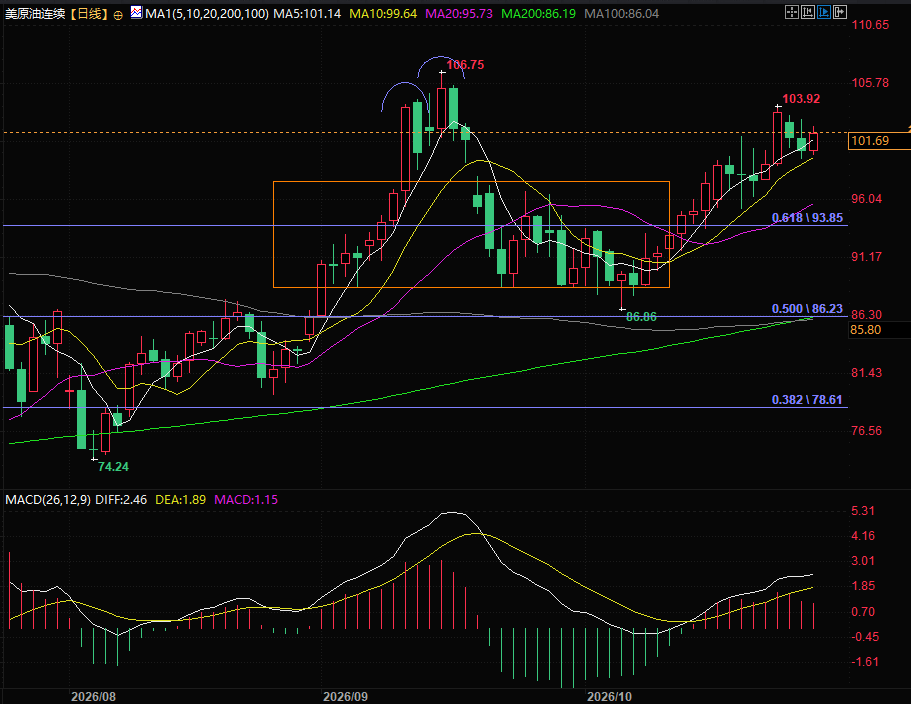 (WTI crude oil futures daily chart, source: EasyTrade) At 17:16 Beijing time, WTI crude oil futures are currently trading at $101.55 per barrel.
The unresolved US-Iran conflict keeps shipping risks in the Taiwan Strait high.
The biggest uncertainties surrounding crude oil currently stem from US-Iran relations and the Strait of Hormuz. The US has already informed Gulf states to prepare for a potential short-term, high-intensity military operation against Iran following the midterm elections. Although Trump has not yet issued the final strike order, the US military has already deployed air defense equipment, replenished ammunition, and increased naval forces in the region. The Israeli election has introduced new variables, with exit polls indicating that Netanyahu's camp is unlikely to secure a majority in parliament, increasing the likelihood of him resorting to military means due to the coalition's impasse. Saudi Arabia continues to intercept Houthi missiles and drones, and the Houthis have claimed responsibility for attacking the Rastanura oil refinery. This base, which handles both refining and crude oil exports, is a key node in the Persian Gulf. Although Saudi Arabia has not yet confirmed that the facility suffered severe damage or that there has been no substantial disruption to exports, fires near the facility have ignited market concerns. Iran has stated its intention to control navigation in the Strait of Hormuz, and with frequent attacks on oil tankers and rising shipping insurance costs, the risk of functional limitations on the Strait of Hormuz persists. On the diplomatic front, dialogue between Saudi Arabia, Turkey, Pakistan, and Iran continues, and Iran has also presented the US with preconditions for negotiations. Market consensus is cautious: it is unlikely that a strong, long-term agreement will be reached in the short term, and an optimistic scenario could only achieve a temporary de-escalation of the conflict; once negotiations reach a stalemate, expectations of military strikes will be quickly re-incorporated into oil prices.Russia and Ukraine: Only a partial humanitarian ceasefire; the overall outlook for the conflict remains bleak.
The overall situation in Russia and Ukraine is not optimistic. Currently, only the Kherson-Aleschki region maintains a humanitarian ceasefire, which is limited to the delivery of humanitarian aid and the evacuation of civilians, covering a very small area and not equivalent to a comprehensive ceasefire. The Russian military continues to strike Ukrainian military-industrial complexes and transportation and logistics nodes, and attacks on Belgorod and the Black Sea shipping lanes continue. The Russian Foreign Minister has also clearly stated that the conflict still has room for escalation. Diplomatically, all parties are preparing for the trilateral talks between the US, Russia, and Ukraine in Abu Dhabi in November. The US and Russia are discussing including the return of US energy companies to Russian Far East oil and gas projects and the resumption of the Friendship Pipeline for oil supplies to Europe on the negotiation agenda. Putin has also expressed goodwill towards cooperation in the Arctic and natural gas sectors. However, Germany has clearly opposed the US and Russia bypassing Ukraine and finalizing a separate agreement with Europe. The core demands of all parties differ significantly, and negotiations face numerous obstacles. Energy transactions are a key bargaining chip in this round of negotiations. With the implementation of the Russia-Ukraine "energy ceasefire" and the easing of the disturbances caused by the attacks on refineries, Russian refineries saw a 25% increase in crude oil processing volume in the second half of October, and diesel production rose significantly. Russian Deputy Prime Minister Novak confirmed that the fourth Russian diesel tanker will set sail on October 28, with three others already en route. Traders expect Russian Baltic and Black Sea crude oil exports to decrease by 100,000-200,000 barrels per day in November, with crude oil being prioritized for domestic processing into diesel to align with the supply agreement reached with the US. However, this increased supply comes with hard constraints: US Energy Secretary Wright has repeatedly emphasized that the diesel-related sanctions waivers are only temporary, and Ukraine has not committed to abandoning attacks on ships carrying Russian diesel. The risk of disruption to Black Sea port transportation remains, making this additional diesel supply unstable and unlikely to drive a comprehensive ceasefire between Russia and Ukraine.Market Outlook: The market is expected to fluctuate at high levels; closely monitor several key catalysts.
International oil prices are likely to see a correction following the easing of tensions between the US and Iran, and Russia and Ukraine. However, the market's bet on the midterm elections, with some believing a lame-duck president would make energy control more difficult, cannot be ruled out. We also need to be wary of a substantial escalation in the Middle East and renewed attacks on oil fields like Rastanura by Russia and Ukraine. Key events to watch in subsequent trading include: the last positive news before the midterm elections, whether the US has finalized its military action against Iran, the verification results of the Houthi attacks on Saudi oil and gas facilities, navigation and insurance developments in the Strait of Hormuz, the progress of the US-Russia-Ukraine trilateral talks in Abu Dhabi in November, EIA weekly inventory data, and statements from the OPEC+ meeting on Sunday. Technically, oil prices remain above the 5-day moving average, which also provides support. If oil prices break below the 5-day moving average following news, a trend reversal is highly probable. More importantly, we must be cautious of an upward breakout in oil prices potentially triggering a second wave of panic selling in gold and equity markets. (WTI crude oil futures daily chart, source: EasyTrade) At 17:16 Beijing time, WTI crude oil futures are currently trading at $101.55 per barrel.
- Risk Warning and Disclaimer
- The market involves risk, and trading may not be suitable for all investors. This article is for reference only and does not constitute personal investment advice, nor does it take into account certain users’ specific investment objectives, financial situation, or other needs. Any investment decisions made based on this information are at your own risk.