The timetable for the UAE's second Hormuz bypass pipeline has been released, providing Asian buyers with a more reliable route.
2026-10-29 08:16:23
Brent crude futures traded in a narrow range during Asian trading hours on Thursday (October 29), currently hovering around $110.50 per barrel. While the market awaits further clarity on the geopolitical situation, a supply-side development provides a medium-term perspective: according to media reports citing sources familiar with the matter, Abu Dhabi National Oil Company (ADNOC) has informed some Asian refineries that some of its offshore oil field supplies may be delivered via a new pipeline bypassing the Strait of Hormuz starting early next year. The report states that ADNOC indicated it may begin supplying some Upper Zakum crude from its Fujairah terminal to regular customers in the first few months of 2027. Upper Zakum oil is produced in the Persian Gulf, meaning its exports typically must pass through the Strait of Hormuz, a strait whose shipping has been disrupted due to the conflict with Iran. This guidance represents the most concrete timeline for the pipeline project to date. ADNOC stated in May that construction was accelerating and the pipeline would be ready next year, but did not provide further details. 
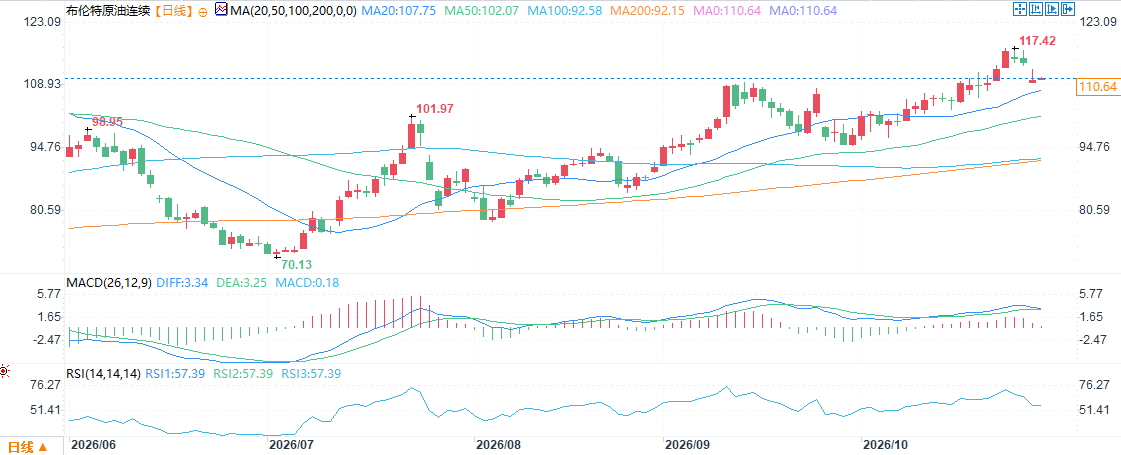 (Brent crude oil futures daily chart, source: EasyTrade) At 8:10 Beijing time, Brent crude oil futures were trading at $110.66 per barrel.
Project Progress: The East-West No. 1 pipeline accelerated in May, with nearly half completed, and its export capacity will double.
Construction of the East-West 1 pipeline accelerated in May 2026. Adnoc CEO Sultan Jaber stated that the project is nearly half completed and is expected to be operational in 2027. Once operational, Adnoc's export capacity via the port of Fujairah will double. The existing Habshan-Fujairah pipeline transports approximately 1.5 million to 1.8 million barrels per day; the new pipeline, running parallel to it, will increase the combined capacity to approximately 3 million to 3.6 million barrels per day. The project is integrated with existing pumping stations and port facilities, and procurement of key equipment is underway. Senior management has explicitly demanded accelerated delivery to address risks in the Strait of Hormuz and match capacity expansion.Strategic Background: The UAE withdrew from OPEC in May, aiming for a production capacity of 5 million barrels per day by 2027.
This project is a key step for the UAE in reducing its reliance on the Strait of Hormuz. The UAE will withdraw from OPEC on May 1, 2026, and will no longer be subject to production quotas. Adnoc aims to increase its crude oil production capacity to 5 million barrels per day by 2027. With the removal of institutional barriers after withdrawal, capacity release and export infrastructure development will accelerate simultaneously. The new pipeline directly supports this goal, allowing more crude oil to bypass the Strait of Hormuz and be transported to Asian markets, reflecting a strategy that emphasizes both "de-bottlenecking" and export resilience.For Asian buyers: The second export route offers a more reliable channel, but it does not eliminate overall risk.
Asian buyers are highly dependent on Gulf crude oil, with most requiring transit through the Strait of Hormuz or through limited competitive detours. The new pipeline will provide Adnoc's regular customers with a more reliable second export route, reducing the risk of disruptions. However, other Gulf oil-producing countries lack comparable alternatives and remain heavily reliant on the Strait. While the UAE's supply resilience has improved, it cannot eliminate overall regional supply risks. The Asian market faces a situation of "partial improvement, but overall pressure."Key variables: On-time commissioning and traffic ramp-up speed
Whether the project can be put into operation on schedule in 2027, and the speed of traffic ramp-up, are key indicators of the Gulf's ability to mitigate shocks in its supply chain. Construction is nearly halfway complete, and the goals are clear, but large pipelines require commissioning and gradual capacity increases from completion to stable operation. If the ramp-up proceeds smoothly, export capacity could quickly nearly double; if there are delays or insufficient supporting infrastructure, the actual increase will lag behind. The market will closely monitor the trial operation and supply schedules, as these directly determine the extent to which new capacity is converted into reliable supply.Summarize
According to media reports, Abu Dhabi National Oil Company (ADNOC) has informed some Asian refineries that it may begin supplying Upper Zakum crude oil from the Fujairah terminal via the new Hormuz bypass pipeline, "East-West 1," starting in early 2027. The pipeline, which accelerated its construction in May and is nearly half-finished, will double Adnoc's export capacity via Fujairah upon commissioning. The existing Habshan-Fujairah pipeline has a capacity of 1.8 million barrels per day. The UAE withdrew from OPEC on May 1st, aiming for a production capacity of 5 million barrels per day by 2027. For the oil market, this provides a medium-term hedge against Hormuz risk rather than a short-term relief. Without new bypass capacity in place before early 2027, the war risk premium is unlikely to subside in the short term. The second export route will provide a more reliable channel for regular Asian customers, but it cannot eliminate the overall risk of other Gulf oil-producing countries lacking comparable bypass routes. The timely commissioning of the project and the speed of flow ramp-up are key variables. (Brent crude oil futures daily chart, source: EasyTrade) At 8:10 Beijing time, Brent crude oil futures were trading at $110.66 per barrel.
- Risk Warning and Disclaimer
- The market involves risk, and trading may not be suitable for all investors. This article is for reference only and does not constitute personal investment advice, nor does it take into account certain users’ specific investment objectives, financial situation, or other needs. Any investment decisions made based on this information are at your own risk.