Diplomatic thaw in the Middle East fails to stabilize oil prices; institutions predict high oil and gas prices will continue into winter.
2026-10-29 13:56:27
Several Middle Eastern countries have restarted diplomatic efforts, with delegations from Saudi Arabia, Turkey, and Pakistan traveling to Tehran to meet with Iranian officials in an attempt to establish a regional security framework and ease tensions. However, geopolitical risks have not dissipated quickly. Standard Chartered Bank's assessment of the future of crude oil and European natural gas prices indicates that even with diplomatic progress, the path to a decline in energy prices remains bumpy.

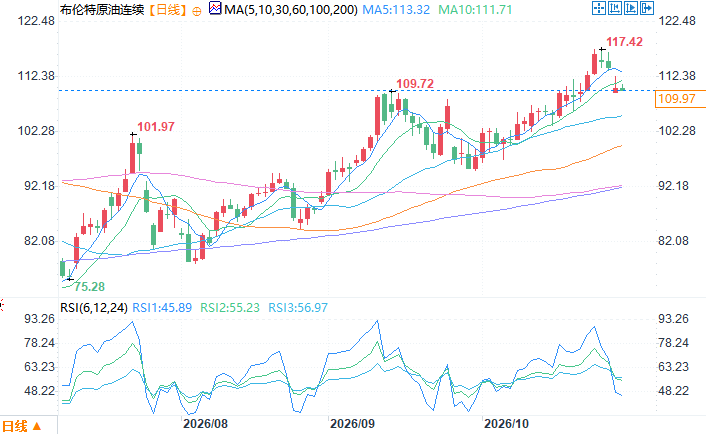 Brent crude oil daily chart source: FX678. At 13:55 Beijing time on October 29th, Brent crude oil was trading at $110.14 per barrel.
Diplomatic efforts continue, but attacks and disruptions persist.
On Monday (October 26), high-level delegations from Saudi Arabia, Turkey, and Pakistan visited Tehran to discuss a regional security mechanism with Iranian officials, hoping to ease regional tensions. Iranian President Pesashkyan expressed a willingness to resolve differences, but Iran insisted that US sanctions and the blockade of Iranian ports must be addressed first before large-scale negotiations could begin. Standard Chartered stated that a credible agreement could quickly erase some of the geopolitical risk premium in oil prices; however, oil prices will only truly fall once shipping routes are secure and oil supplies from the Gulf region return to stability. During the Saudi-Iranian talks, the Houthi rebels claimed responsibility for a new round of attacks on pumping stations along the Saudi East-West oil pipeline, but there is currently no reliable evidence of pipeline damage or disruption. Against this backdrop, Standard Chartered predicts that crude oil prices will remain high in the coming months, and the speed and sustainability of the recovery of Gulf oil supply will be the core variable determining the oil market's supply and demand balance. The partial resumption of crude oil exports has temporarily alleviated the supply shortage, but issues such as damaged production capacity, limited refining capacity, and high costs of alternative shipping continue to suppress effective supply. The risks associated with refined oil products are particularly prominent. Diesel shortages and rising freight rates have created inflationary pressures that have already spread outwards, impacting the market far beyond the crude oil market itself. Diplomatic negotiations can mitigate risk premiums, while a continued decline in oil prices depends on the safety of tanker passage through the Gulf and the recovery of crude oil supply. Currently, the release of strategic reserves and adjustments to trade routes have filled some of the gap, but neither of these methods can compensate for supply losses in the long term.Countries continue to deplete their reserves, and the demand for restocking is supporting oil prices.
Many countries have already used their emergency oil reserves to offset supply gaps, and subsequent restocking will further boost crude oil demand in the near future. The latest data from the U.S. Energy Information Administration shows that the U.S. Strategic Petroleum Reserve has dwindled to only 282.7 million barrels, the lowest level since 1982. Major Asian crude oil importers have also depleted their strategic reserves and commercial inventories to fill the supply gap in Gulf crude oil. Standard Chartered believes that restocking will absorb a large amount of crude oil released back into the market. If countries begin purchasing before Gulf production and shipping fully return to normal, the amount of oil available for commercial inventory replenishment will be less, and even if geopolitical tensions ease, oil prices will be supported.European natural gas prices are under pressure, approaching the $100 mark at normal temperatures.
Regarding natural gas, Standard Chartered maintains its previous assessment that European natural gas prices will bottom out and rise this winter. Recent temperatures, at the average level, have already tightened the regional supply-demand balance. The TTF benchmark natural gas price reached €98.58 per megawatt-hour on Wednesday, nearing the €100 mark, officially marking the start of the winter inventory depletion cycle in Europe. Heating gas demand in Northwest Europe increased by approximately 42% month-on-month, while net gas storage injections plummeted by 71%. Net inventory withdrawals occurred for two consecutive days on October 20th and 21st. Although inventory was slightly replenished throughout the week, the depletion inflection point is approaching. Currently, there has been no cold snap, and the TTF near-month contract is already approaching €100. The market is only pricing in the expectation of a mild winter; even if temperatures remain at normal levels, gas prices still have room to rise.Eurasia vie for LNG supplies, with price differences becoming the key factor in the competition.
Europe's competitiveness in the LNG supply race has improved. On October 26, the spread between the next-month TTF contract and the Asian JKM contract narrowed to $1.08 per million British thermal units (MMBtu), a significant decrease from the beginning of the month. This allowed Europe to compete with Asia for flexible supplies from the US and the Atlantic Basin. The rising premium of TTF relative to Henry Hub gas also incentivized US exporters to ship to Europe. However, LNG exports from the Gulf region remain hampered, with European and Asian buyers vying for limited supplies. For Europe to weather the winter comfortably, TTF prices need to keep pace with or even surpass Asian JKM prices to continuously attract shipments and compensate for low gas storage levels.Conclusion
Diplomatic easing is expected to reduce the risk premium for energy, but with multiple factors such as supply recovery, shipping safety, reserve replenishment, and the Eurasian LNG bidding war, crude oil and European natural gas are likely to remain strong this winter. Brent crude oil daily chart source: FX678. At 13:55 Beijing time on October 29th, Brent crude oil was trading at $110.14 per barrel.
- Risk Warning and Disclaimer
- The market involves risk, and trading may not be suitable for all investors. This article is for reference only and does not constitute personal investment advice, nor does it take into account certain users’ specific investment objectives, financial situation, or other needs. Any investment decisions made based on this information are at your own risk.