Geopolitical risks remain, yet gold prices are falling. Who is selling below $4,000?
2026-10-30 14:56:28
Spot gold faced heavy selling pressure for the second consecutive day, trading below the psychological level of $4,000 in Asian trading on Friday (October 30), weighed down by hawkish expectations from the Federal Reserve. Thursday's US macroeconomic data pointed to resilient economic growth and persistent price pressures, reinforcing market bets on an imminent December rate hike, thus weakening non-yielding gold and supporting the assessment of further depreciation. Preliminary Q3 GDP figures showed the US economy growing at an annualized rate of 3.4%, higher than the previous quarter's 2.2% and exceeding the consensus expectation of 3.2%. The US Commerce Department also reported that the Personal Consumption Expenditures (PCE) price index rose 0.5% month-over-month and 3.6% year-over-year in September; the core index, excluding volatile food and energy prices, rose 0.3% month-over-month and 3.1% year-over-year. This, coupled with inflation concerns stemming from high US Treasury yields, reinforced the prospect of further tightening by the Federal Reserve. 
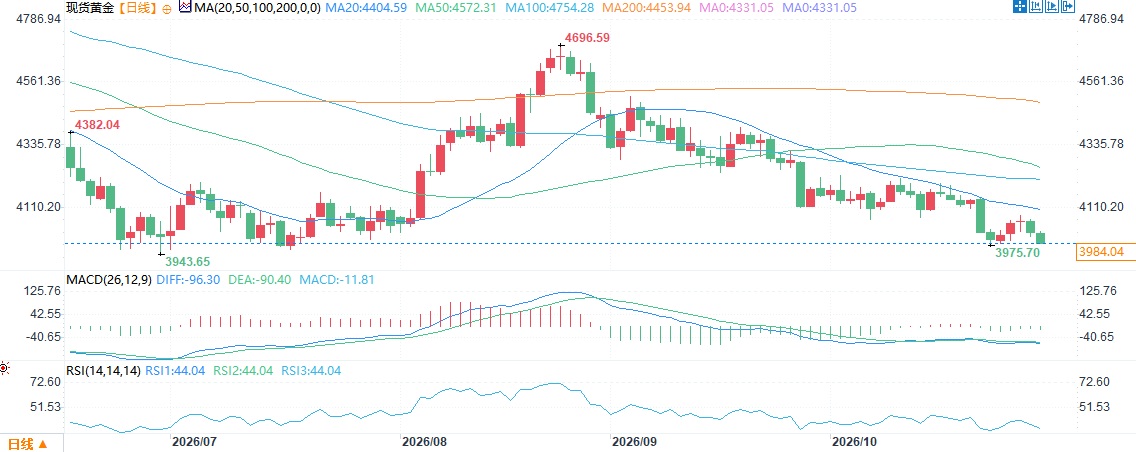 (Spot gold daily chart, source: EasyTrade) At 14:49 Beijing time, spot gold was trading at $3984.80 per ounce.
Safe-haven funds flowed into US Treasuries, bypassing gold.
Meanwhile, US Treasury yields fell sharply as weak earnings from tech stocks raised concerns that rising AI spending might not provide sufficient returns, prompting investors to flock to safe-haven government bonds. Additionally, renewed hopes for a diplomatic solution to the Middle East conflict led to a third consecutive day of declines for the safe-haven dollar, but this did little to alleviate bearish pressure around gold. In other recent developments, US Vice President JD Vance sent a letter to Mohsen Rezaei, secretary of Iran's Supreme National Security Council, to push for the resumption of peace talks; Qatar also submitted a draft new agreement to Iran to end its conflict with the US and Israel.Geopolitical risk premiums remain, but a gold price rebound is likely to be met with selling pressure.
However, investors remain cautious amid escalating hostilities between Yemen's Houthi rebels and Saudi Arabia. Furthermore, threats from the US and Israel to resume attacks after the midterm elections keep geopolitical risk premiums firmly in place. Meanwhile, the Iranian navy's statement on Thursday that four oil tankers struck mines in the Strait of Hormuz exacerbated supply disruption concerns and supported oil prices. This supports the rationale for buying the dollar on dips, suggesting that the path of least resistance for gold is downside, and any rallies are likely to be met with selling pressure.Institutional Views
Tang Yuxuan, Head of Asia Interest Rates and FX Strategy at JPMorgan Private Bank, stated that gold still faces further downside risks after the recent sell-off, primarily due to weak market liquidity and the Federal Reserve's continued room for interest rate hikes. The bank expects the Fed to raise rates once in December and once in the first quarter of 2027, pushing the 10-year US Treasury yield to a peak of 5.25%-5.5% by mid-2027. Higher yields will weaken gold's appeal. However, once interest rates peak, gold will form a solid bottom, expected to rise to $4,500 by mid-2027 and $5,000 by the end of the year, mainly benefiting from safe-haven demand and economic policy uncertainty. UBS's Chief Investment Office (CIO) maintains a constructive view on gold over the next 12 months, predicting a price of $4,600 in December 2026, followed by a gradual rise to $5,000 in March 2027, $5,200 in June 2027, and reaching $5,400 in September 2027. UBS believes that while recent high real yields and a strong dollar pose short-term headwinds, central bank gold purchases, reserve diversification, high government debt, and geopolitical uncertainty remain key supports. Any pullback to around $4,000 is seen as an opportunity to increase exposure. UBS recommends investors maintain a medium-single-digit gold allocation.in conclusion
Gold fell for the second consecutive day, primarily pressured by bets on a Federal Reserve rate hike – better-than-expected Q3 GDP and persistent PCE inflation have reinforced expectations of a December rate hike, diminishing the appeal of non-yielding gold. Notably, both declining US Treasury yields and a three-day losing streak for the dollar, typically bullish factors for gold, failed to provide support this time, reflecting that the market's current pricing strategy is driven by interest rate paths rather than safe-haven demand. While geopolitical risk premiums remain, high oil prices have actually strengthened the logic of buying the dollar on dips, suggesting that any gold rebound is likely to be met with selling pressure. (Spot gold daily chart, source: EasyTrade) At 14:49 Beijing time, spot gold was trading at $3984.80 per ounce.
- Risk Warning and Disclaimer
- The market involves risk, and trading may not be suitable for all investors. This article is for reference only and does not constitute personal investment advice, nor does it take into account certain users’ specific investment objectives, financial situation, or other needs. Any investment decisions made based on this information are at your own risk.