Gold Trading Alert: Gold prices have rebounded from a one-year low. With the midterm elections and non-farm payrolls data coming this week, can the bulls reverse the downward trend?
2026-11-02 07:54:24
On Monday (November 2nd) in early Asian trading, spot gold saw a slight recovery after Friday's sharp sell-off, trading around $3900 per ounce, up about 0.6%. This followed a third consecutive day of talks between Iranian and Qatari officials, hoping to reach an agreement to end the US-Israel war against Iran. A nearly 2% drop in oil prices on Monday slightly eased inflation concerns, also providing an opportunity for a gold price rebound. On Friday (October 30th), spot gold plunged 3.5% to $3876.69 per ounce, hitting a low of $3870, its lowest level since October 2025. US December gold futures also closed down 3.3% at $3898.90 per ounce. From the record high of $5595 per ounce in January of this year, gold prices have cumulatively retreated by about 30%. On the surface, this was a gold "flash crash" triggered by a plunge in tech stocks; at a deeper level, it was also due to multiple negative factors, including cracks in AI trading, expectations of a Fed rate hike, rising oil prices pushing up inflation, and weak Asian demand. This week will see the US midterm elections and the US October non-farm payroll report, which investors should pay close attention to. 
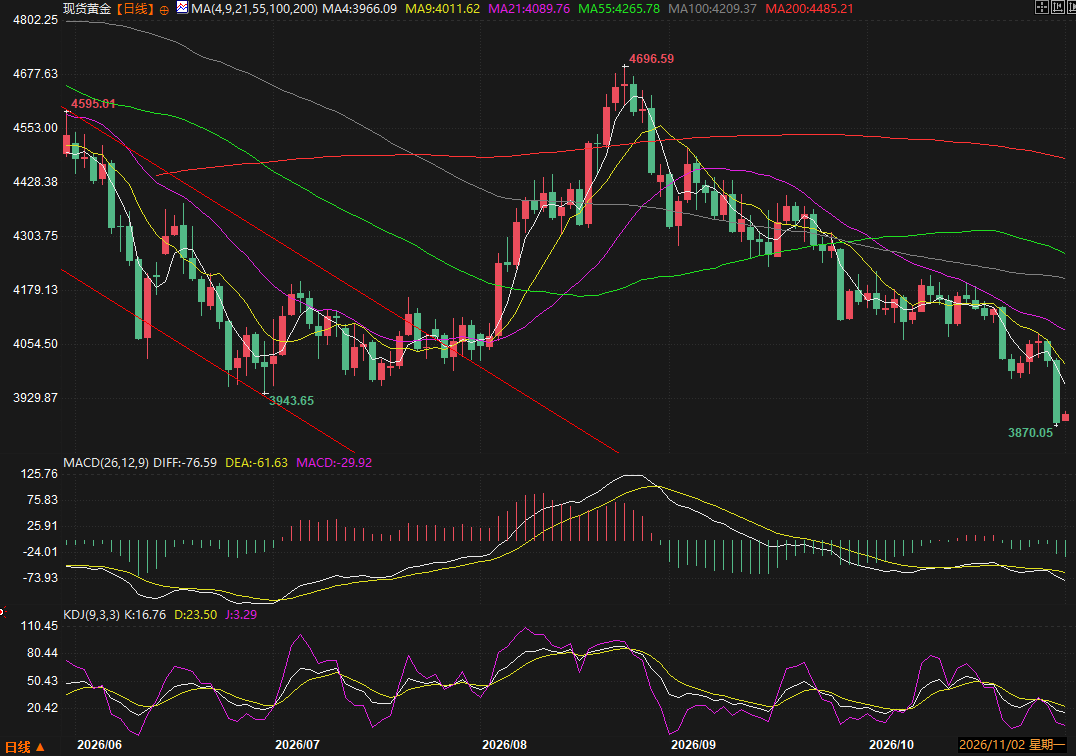 (Spot gold daily chart, source: FX678) At 07:50 Beijing time, spot gold is currently trading at $3900.36 per ounce.
The AI stock market crash dragged gold down, forcing safe-haven assets to liquidate their positions.
The most striking change in global markets last Friday wasn't gold itself, but the collective plunge in tech stocks. Disappointing quarterly results from Intel and Amazon exacerbated investor concerns about whether investments in AI infrastructure would yield sufficient returns. The Nasdaq Composite plunged 2.86%, its largest single-day percentage drop since early June, and is now down 7.8% from its record high on October 6. Intel plummeted 28.6%, Nvidia fell 4.2%, AMD plunged 10.9%, and the Philadelphia Semiconductor Index fell 7.2%, with a monthly decline exceeding 15%. Against this backdrop, gold did not benefit as a traditional safe-haven asset; instead, it was sold off. Independent precious metals trader Tai Wong described market sentiment as "the sky has fallen," stating bluntly that precious metals cannot escape the gravitational pull of the sharp stock market correction. Corporate earnings have always been the foundation of the AI rally, and now this pillar is beginning to crack. The logic behind this is not complicated. When tech stock crashes trigger fund net asset value drawdowns and margin calls, gold is often not "buyable as a safe haven," but rather forced to be sold as one of the most liquid assets. Analysts at Commerzbank also pointed out that the sharp decline in tech stocks could trigger forced liquidations of safe-haven assets such as gold, leading to margin calls. However, they also expect precious metal prices to rebound in the future. In other words, Friday's decline was more like a "cash-out sell-off" in response to an extreme risk event, and not entirely equivalent to the collapse of gold's long-term safe-haven logic. The rebound in gold prices to around $3,995 in early trading on Monday reflects this oversold correction.The Federal Reserve's hawkish rhetoric has reignited expectations of interest rate hikes, suppressing non-interest-bearing assets.
The second force weighing on gold prices came from hawkish statements by Federal Reserve officials. Last Friday, Dallas Fed President Logan stated that current price pressures and the duration of inflation remaining above the 2% target were "unacceptable." She believed the Fed needed at least two more rate hikes of 25 basis points each before pausing to observe the situation. St. Louis Fed President Musaleem also advocated for further tightening, emphasizing the need for swift action, arguing that earlier, gradual adjustments are generally less shocking than large, sudden actions later. Richmond Fed President Barkin stated that with persistently high inflation, robust demand, and relatively low unemployment, the next direction for interest rates was quite clear, and gradual rate hikes were reasonable. It's worth noting that the Fed had just decided earlier last week to maintain its target range for interest rates at 3.75% to 4.00%, but this was a choice made after a rate hike in September and widespread indications from officials that the rate hike cycle was not yet over. While futures market expectations for a December rate hike have cooled somewhat, from about 78% to about 70%, the probability of a rate hike remains significantly higher than holding rates steady. For gold, which does not generate interest, a prolonged period of high interest rates means an increased opportunity cost of holding gold, and high real yields directly suppress gold price valuations. Although the yield on the 10-year US Treasury note fell 6.4 basis points to 4.925% last Friday due to safe-haven buying, marking a cumulative drop of 36 basis points in October—the largest monthly decline since December 2023—the absolute level of the yield remains high. Therefore, the gold rebound is more of a correction than a trend reversal.White metals are oversold; silver falling below $50 exposes its weakness as an industrial metal.
Compared to gold, white precious metals are in a weaker position. Spot silver fell 5.85% to $49.09 per ounce last Friday, breaking below $50 for the first time in 11 months; palladium fell below $1,000 per ounce; silver, platinum, and palladium all fell 7% to 9% this week, while gold fell 2.9% over the same period. The relative strength index (RSI) for these three white precious metals has fallen deep into "oversold" territory for the first time in three years, indicating strong bearish momentum. Tai Wong specifically cautioned that what is particularly worrying for white precious metals is that this decline is slow, persistent, and relentless, rather than a sharp drop followed by a rapid rebound. Silver's weakness also has fundamental reasons. Silver is increasingly seen as a commodity dependent on industrial growth. HSBC stated that industrial and jewelry demand for silver is declining and predicts an average silver price of $64 per ounce in 2027, lower than its forecast of $71 per ounce for this year. Currently, it takes 79 ounces of silver to buy one ounce of gold, the highest in 11 months; when silver hit a record high of $122 per ounce in January this year, it only took 46 ounces of silver to buy one ounce of gold. Consulting firm Metals Focus states that the gold-silver ratio will average 82 from 2020 to 2025, and historically, silver still has room to fall further relative to gold. The lack of central bank purchases and safe-haven demand that gold has enjoyed in recent years makes it more vulnerable to selling when risk appetite contracts. Silver's oversold condition may lead to a technical rebound, but weakening industrial demand and pressure for a return to a more conservative gold-silver ratio mean that its rebound may be weaker than gold's.The oil and bond markets are locked in a tug-of-war, and inflation expectations are a double-edged sword for gold.
Oil prices are an undeniable variable in the current macroeconomic narrative. Last Friday, oil prices jumped over 2%, closing at their highest level since the end of April. Brent crude for December settled at $117.64 per barrel, and WTI settled at $104.12. October Brent crude surged 13.6%, and WTI rose 15.2%. A tanker in the Strait of Hormuz was attacked by an explosive device; the US ordered the evacuation of non-emergency government employees and their families from Saudi Arabia due to security risks; Houthi attacks on Saudi oil facilities and escalating concerns about the Iranian situation further exacerbated the situation. High oil prices will intensify inflation concerns, thus supporting the Federal Reserve's continued interest rate hikes, indirectly putting downward pressure on gold. However, oil prices and geopolitical risks themselves will increase safe-haven demand, providing support for gold. Last Friday, the US bond market saw safe-haven buying due to a sell-off in tech stocks, with the 10-year Treasury yield experiencing its largest monthly drop in nearly two years, indicating that the market has not completely abandoned safe-haven trading, but rather prioritizes more liquid Treasury bonds in extreme times. Oil prices fell nearly 2% in early Asian trading on Monday after Iranian and Qatari officials held talks for the third consecutive day, hoping to reach an agreement to end the US-Israel war against Iran. The decline in oil prices slightly eased inflation concerns, coupled with demand for a rebound in gold prices after a sharp drop, causing spot gold to rebound slightly to around $3,900. This change illustrates that gold's short-term price movements are highly sensitive to the "inflation-interest rate hike-real interest rate" chain. If the situation in Iran eases and oil prices continue to fall, the urgency of a Fed rate hike in December may decrease, giving gold a breather; however, if tanker attacks and geopolitical conflicts escalate again, inflation concerns will reignite expectations of rate hikes, and gold may come under pressure again.Market Outlook: The midterm elections, non-farm payrolls, and the December interest rate decision will determine whether gold can hold its current price level.
Gold will face multiple tests in the coming week. The US midterm elections will be held on Tuesday, with all 435 seats in the House of Representatives and 35 of the 100 seats in the Senate up for re-election. Polls suggest the Democrats are likely to regain control of the House and even the Senate, and political uncertainty could trigger safe-haven volatility. On the economic data front, the October ISM Purchasing Managers Index, JOLTS Job Openings, ADP Employment Report, and initial jobless claims will be released. Friday's October non-farm payrolls report is particularly crucial, with the market expecting 40,000 new jobs and the unemployment rate remaining at 4.2%. Speeches by Federal Reserve officials Goolsby, Hamak, Barkin, Logan, and Williams, along with earnings reports from Apple, AMD, and Qualcomm, will also influence AI trading sentiment. Ahead of the December FOMC meeting, the probability of a December rate hike is currently around 70%, and any changes in inflation or employment data could trigger a repricing. In summary, gold prices fell to a one-year low last Friday as a result of a combination of factors, including forced liquidation triggered by the AI stock market crash, hawkish calls for rate hikes from the Federal Reserve, high oil prices pushing up inflation expectations, and weak Asian demand. The rebound to around $3900 in early trading on Monday was a technical correction driven by the easing of inflation concerns due to falling oil prices and demand for a rebound from oversold levels. In the short term, the $3900 level is a key support/resistance level. If gold prices can hold above $4000 and recover, the oversold rebound is likely to continue. However, if prices fall below the one-year low near $3870, the market may continue to search for support from central bank gold purchases. In the medium term, whether the Federal Reserve raises interest rates in December, whether AI tech stocks can stop falling, the situation in Iran, and the direction of oil prices will determine whether gold emerges from the "golden pit" or continues its correction. In the long term, central bank gold purchases and safe-haven demand continue to provide underlying support for gold, but the high-interest-rate environment and weak Asian demand limit upside potential. For gold, the current situation is more like a tug-of-war between a "short-term liquidity shock" and "long-term allocation value." The rebound at the beginning of Monday's trading session was just the beginning of this tug-of-war. The real direction will depend on the non-farm payrolls, the midterm elections, and the December interest rate decision. (Spot gold daily chart, source: FX678) At 07:50 Beijing time, spot gold is currently trading at $3900.36 per ounce.
- Risk Warning and Disclaimer
- The market involves risk, and trading may not be suitable for all investors. This article is for reference only and does not constitute personal investment advice, nor does it take into account certain users’ specific investment objectives, financial situation, or other needs. Any investment decisions made based on this information are at your own risk.