













A chart shows that the Baltic Dry Index has fallen across the board, with freight rates for all vessel types dropping to recent lows.
2026-11-03 00:22:25
Latest data shows that the Baltic Dry Index (BDI) closed at 2648 points on November 2, 2026, a four-day low, down 2.43% from the previous day, marking the largest drop since October 15, 2026. Looking at the short-term charts, the BDI has seen positive growth 7 times, negative growth 4 times, and zero growth 0 times in the last 11 BDI readings. Specifically, the Panamax Freight Index (BPI) closed at 1874 points, down 0.79% from the previous day; the Capesize Freight Index (BCI) closed at 3963 points, down 3.95%; and the Supramax Freight Index (BSI) closed at 1856 points, down 0.48%. For detailed charts of the Baltic Dry Index and its three main sub-indices, including the latest 720-day and 10-year trends, please refer to the charts provided by FX678. 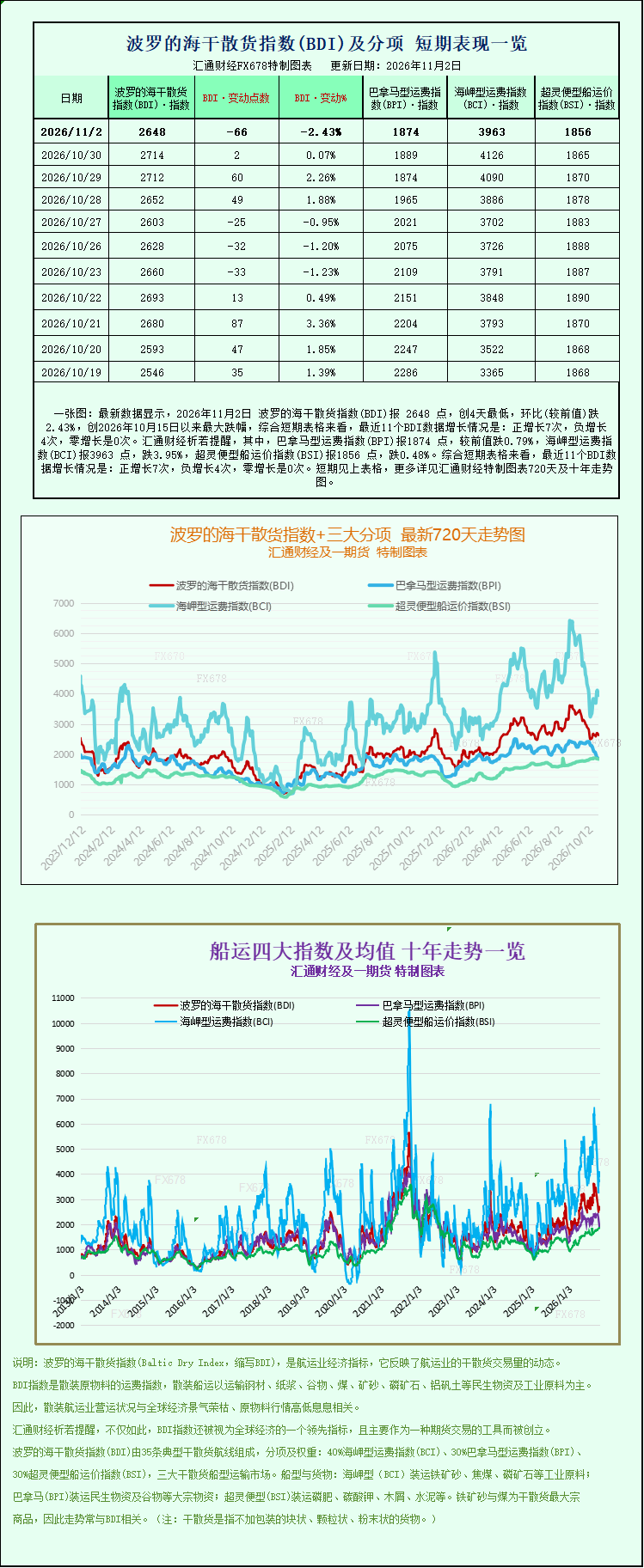 Dragged down by a simultaneous weakening of freight rates across the entire Capesize, Panamax, and Supramax vessel class, the Baltic Dry Index (BDI), a key indicator of global dry bulk shipping activity, fell to its lowest level in nearly a week on Monday. Overall market sentiment was negative, reflecting a cooling of global commodity shipping activity. The Baltic Dry Index, which aggregates spot charter rates for different deadweight bulk carriers, is a core indicator of the activity in cross-border trade of basic raw materials such as iron ore, coal, and grain. A decline in the index signifies weakening demand for spot chartering in the shipping market, leading to a significant contraction in shipowners' profit margins. Data shows that the Baltic Dry Index, which measures the market performance of the three main vessel types, fell 66 points on the day, a drop of 2.43%, closing at 2648 points, its lowest reading since October 27. Looking at the various sub-indices, almost all ship types recorded varying degrees of decline, indicating a lack of supporting sectors in the market. Larger vessels saw significantly larger drops than smaller vessels, reflecting the direct impact of declining demand for bulk industrial raw materials via sea. The Capesize Index (BCI), with the highest weighting, became the main drag on the overall market, plunging 163 points (3.95%) to close at 3963. Capesize bulk carriers primarily transport 150,000 tons of iron ore and thermal coal, making them the most important transport carrier in the global steel industry's seaborne transportation segment. Their freight rates are highly correlated with the production pace of China's steel industry. The average daily spot charter rate for this ship type declined by $1476 to $32441, a significant correction from previous highs. Market observers point out that Capesize vessel price fluctuations largely depend on the release pace of China's iron ore imports, and current marginal changes in domestic steel mill production are being transmitted to the shipping market. On the same day as the index's sharp drop, iron ore spot prices showed signs of stabilizing. As the world's largest iron ore consumer, China's demand for steelmaking raw materials has not fallen beyond previous pessimistic market expectations, supporting a temporary halt in the price decline. However, the market remains generally concerned that the iron ore market may face oversupply pressure in the fourth quarter. Overseas mine shipments remain high, while domestic steel mills, constrained by profits, have limited room for increasing pig iron production. Import purchases are mainly for replenishing existing inventory, with insufficient motivation to significantly increase long-haul bookings. This directly suppresses chartering demand for Capesize vessels on long-haul routes, putting continued pressure on freight rates for large vessels. The Panamax market has also failed to recover, with the Panamax Freight Index (BPI) falling for 14 consecutive trading days. On Monday, it fell another 15 points, a drop of 0.79%, to 1874 points, a new low since April 13th of this year. Panamax vessels mainly carry 60,000-70,000 tons of coal and grain, traversing multiple food and energy trade routes across the Pacific and Atlantic Oceans. Its continued weakness reflects a simultaneous decline in global coal import demand and international grain shipping volume. The average daily revenue for this vessel type decreased by $132 to $16,867, with consecutive days of decline leading to a continued reduction in profits for shipowners operating in the spot market. As the Northern Hemisphere enters the fourth quarter, the peak season for grain exports is gradually coming to an end. Coupled with a slowdown in coal imports by some countries, the number of new cargoes entering the market has decreased, charterers' bargaining power has increased, and freight rates have continued to decline. Even the more flexible Supramax bulk carriers, which can call at smaller ports, are not immune. The Supramax Freight Index (BSI) fell slightly by 9 points, a drop of 0.48%, closing at 1856 points, hitting its lowest point since October 15th. These vessels handle small-volume transport of diversified bulk cargoes such as grain, steel, and bauxite, and are theoretically less affected by the cycle of a single commodity. However, in the context of an overall market downturn, regional feeder trade cargoes have also decreased, and the vessels have followed the general trend of correction, although the decline is significantly smaller than that of large bulk carriers, demonstrating a certain degree of resilience. From a market perspective, this round of index correction is the result of multiple factors. On the demand side, the purchasing pace of China's steel industry is the core variable affecting the entire dry bulk market. Steel mills' willingness to actively replenish their inventories on a large scale was limited in the fourth quarter, and the contraction of iron ore ocean freight directly pressured Capesize vessels. Global coal trade entered a period of adjustment, and the pace of grain ocean freight slowed, leading to a weakening of Panamax vessels. Regional general bulk cargo trade activity declined, and freight rates for smaller vessels fell accordingly. On the supply side, vessels that had completed ocean voyages earlier are gradually returning to the spot market, increasing available capacity in some regions and creating a temporary easing of the supply-demand balance, further pushing down spot rates. However, industry institutions also caution that a short-term decline in freight rates does not equate to a complete reversal of the market trend. Looking ahead, on the one hand, overseas mines' year-end rush to ship goods may bring a temporary increase in cargo volume; on the other hand, with winter approaching in the Northern Hemisphere, the restocking demand for heating coal in the Asia-Pacific region is expected to gradually be released, potentially providing some support for freight rates. Meanwhile, El Niño's impact on the efficiency of the Panama Canal and disruptions to operations at some ports will also introduce uncertainty into the market, and the Baltic Dry Index is expected to remain highly volatile. Market participants are currently closely monitoring Chinese steel production data, iron ore port inventories, and overseas mine shipment data to determine whether dry bulk freight rates will decline further or experience a period of stabilization and recovery.
- Risk Warning and Disclaimer
- The market involves risk, and trading may not be suitable for all investors. This article is for reference only and does not constitute personal investment advice, nor does it take into account certain users’ specific investment objectives, financial situation, or other needs. Any investment decisions made based on this information are at your own risk.

