How will the market interpret the midterm election-related market movements?
2026-11-03 01:36:25
There are three possible scenarios for tomorrow's election. The first scenario: Due to some unexpected event, the Republicans retain control of Congress. Objectively speaking, this would be a huge surprise and the most valuable scenario for trading. The market would interpret this as unexpected news that benefits economic growth, pushing up the S&P 500 and the US dollar, similar to the market reaction after Trump's unexpected victory in 2016 and the Republican landslide victory in 2024.  The second scenario: Democrats win the House of Representatives, but Republicans retain control of the Senate. I believe this is the baseline expectation for most people, and almost no funds will be traded or speculated on this outcome. The third scenario: Democrats win both the House and Senate, representing the most complete rejection of Trump. Some might think this is the most beneficial for the market because it would constrain Trump to the greatest extent, but I believe this view misunderstands what the market truly cares about. After all, the market often goes long on markets like China and Turkey, which lack Western-style democratic checks and balances. The market values returns, namely economic growth, not idealized democratic concepts. If you have doubts about this, recall this time last year, when everyone was certain that the dollar was losing its status as the global reserve currency. But this didn't happen because the market doesn't value institutional constraints on figures like Trump; the market only values growth. Even disregarding the above factors, there are two fundamental reasons why tomorrow's midterm elections are unlikely to shake the market. First, regardless of the election results, the issue of whether the US will restart its bombing campaign against Iran will be overshadowed. I have previously written an analysis of how the market would react if a "hot war" broke out. Unfortunately, the risk of war will completely outweigh the impact of the election results. Secondly, even without the external interference of war, the midterm elections themselves typically do not trigger significant market volatility. This article reviews the situation in 2022: at that time, the market widely expected a "red wave" (a landslide victory for the Republicans), which did not materialize, a major surprise, but the market paid no attention to it, completely ignoring the midterm elections. I predict that the current market will repeat this scenario.
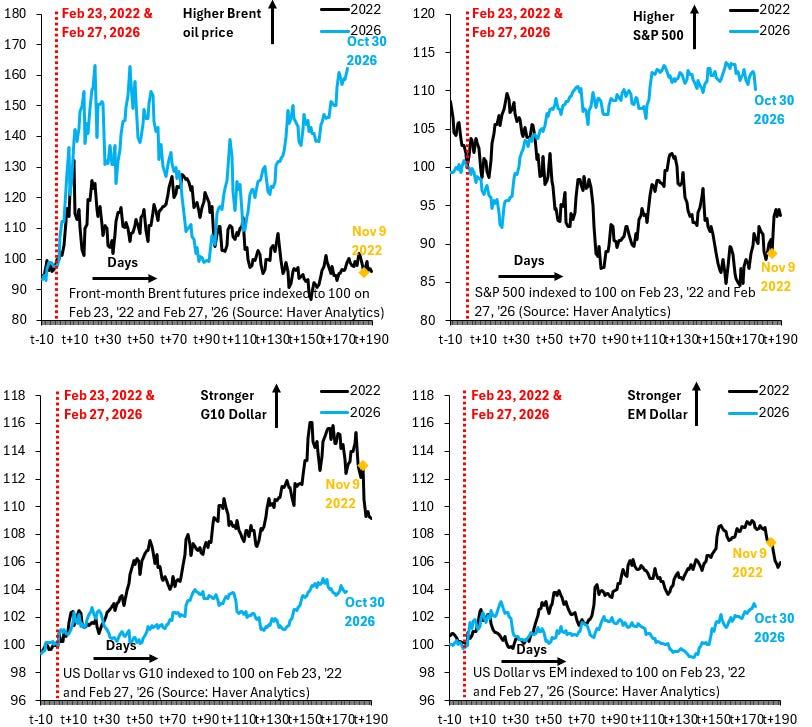 (Chart caption: The chart above shows the price movements of Brent crude oil (top left), the S&P 500 index (top right), the US dollar relative to the G10 basket of currencies (bottom left), and the US dollar relative to emerging market currencies (bottom right). The blue line represents the current market situation in 2026, and the black line represents the market situation on November 8, 2022, when the midterm elections were expected and a "red wave" was widely anticipated. Both years' data are based on the day before the outbreak of war, indexed to 100; the 2022 baseline is February 23, the start of the Russia-Ukraine war, and the 2026 baseline is February 27, the day the US and Israel bombed Iran. The orange diamond marks November 9, 2022, after the midterm elections. The chart clearly shows that the market did not react accordingly to the unexpected failure of the "red wave." The weakening of the US dollar and the rise of the S&P 500 at the end of 2022 were rooted in the Federal Reserve's halt to its aggressive 75-basis-point rate hikes, signaling a slowdown in the pace of monetary tightening.)
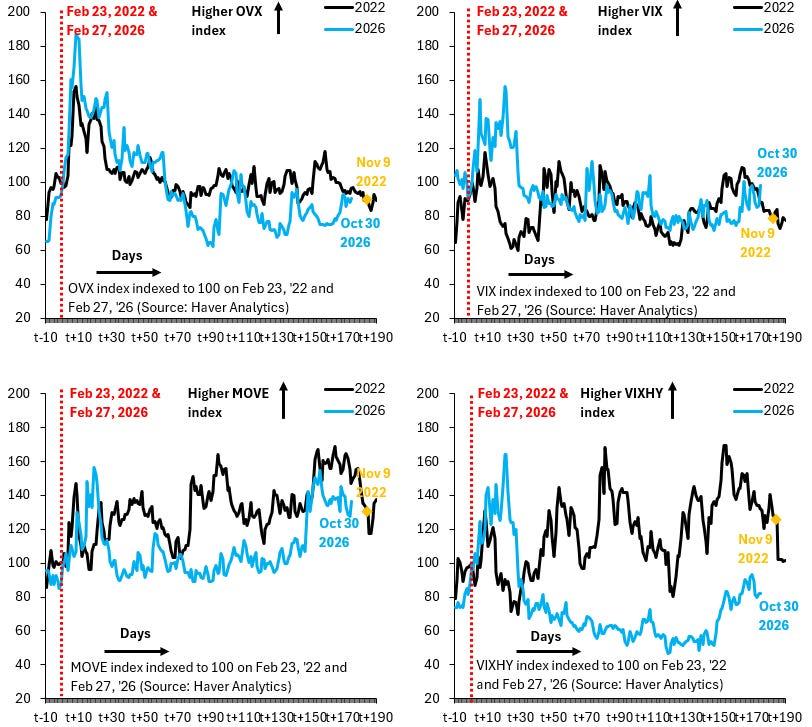 (Chart caption: The four charts below show the 30-day implied volatility of crude oil (top left), S&P 500 (top right), bond market (bottom left), and high-yield corporate bonds (bottom right), respectively. The index is set to 100, with the day before the outbreak of war as the base: February 23, 2022 (Russia-Ukraine War), February 27, 2026 (US-Iran Conflict). The orange diamond still marks November 9, 2022, further demonstrating that the options market did not experience any significant volatility.) There are two main reasons why the market will not react to the midterm elections. First and foremost: the potential for a renewed hot war with Iran poses a significant event risk. With such a risk looming, almost no traders will trade the midterm elections. Secondly: even if the external environment is calm, the midterm elections themselves are unlikely to drive the market. 2022 is a good example—the Republican "red wave" did not materialize, a genuine unexpected event, yet the market remained calm.
The second scenario: Democrats win the House of Representatives, but Republicans retain control of the Senate. I believe this is the baseline expectation for most people, and almost no funds will be traded or speculated on this outcome. The third scenario: Democrats win both the House and Senate, representing the most complete rejection of Trump. Some might think this is the most beneficial for the market because it would constrain Trump to the greatest extent, but I believe this view misunderstands what the market truly cares about. After all, the market often goes long on markets like China and Turkey, which lack Western-style democratic checks and balances. The market values returns, namely economic growth, not idealized democratic concepts. If you have doubts about this, recall this time last year, when everyone was certain that the dollar was losing its status as the global reserve currency. But this didn't happen because the market doesn't value institutional constraints on figures like Trump; the market only values growth. Even disregarding the above factors, there are two fundamental reasons why tomorrow's midterm elections are unlikely to shake the market. First, regardless of the election results, the issue of whether the US will restart its bombing campaign against Iran will be overshadowed. I have previously written an analysis of how the market would react if a "hot war" broke out. Unfortunately, the risk of war will completely outweigh the impact of the election results. Secondly, even without the external interference of war, the midterm elections themselves typically do not trigger significant market volatility. This article reviews the situation in 2022: at that time, the market widely expected a "red wave" (a landslide victory for the Republicans), which did not materialize, a major surprise, but the market paid no attention to it, completely ignoring the midterm elections. I predict that the current market will repeat this scenario. (Chart caption: The chart above shows the price movements of Brent crude oil (top left), the S&P 500 index (top right), the US dollar relative to the G10 basket of currencies (bottom left), and the US dollar relative to emerging market currencies (bottom right). The blue line represents the current market situation in 2026, and the black line represents the market situation on November 8, 2022, when the midterm elections were expected and a "red wave" was widely anticipated. Both years' data are based on the day before the outbreak of war, indexed to 100; the 2022 baseline is February 23, the start of the Russia-Ukraine war, and the 2026 baseline is February 27, the day the US and Israel bombed Iran. The orange diamond marks November 9, 2022, after the midterm elections. The chart clearly shows that the market did not react accordingly to the unexpected failure of the "red wave." The weakening of the US dollar and the rise of the S&P 500 at the end of 2022 were rooted in the Federal Reserve's halt to its aggressive 75-basis-point rate hikes, signaling a slowdown in the pace of monetary tightening.) (Chart caption: The four charts below show the 30-day implied volatility of crude oil (top left), S&P 500 (top right), bond market (bottom left), and high-yield corporate bonds (bottom right), respectively. The index is set to 100, with the day before the outbreak of war as the base: February 23, 2022 (Russia-Ukraine War), February 27, 2026 (US-Iran Conflict). The orange diamond still marks November 9, 2022, further demonstrating that the options market did not experience any significant volatility.) There are two main reasons why the market will not react to the midterm elections. First and foremost: the potential for a renewed hot war with Iran poses a significant event risk. With such a risk looming, almost no traders will trade the midterm elections. Secondly: even if the external environment is calm, the midterm elections themselves are unlikely to drive the market. 2022 is a good example—the Republican "red wave" did not materialize, a genuine unexpected event, yet the market remained calm.
- Risk Warning and Disclaimer
- The market involves risk, and trading may not be suitable for all investors. This article is for reference only and does not constitute personal investment advice, nor does it take into account certain users’ specific investment objectives, financial situation, or other needs. Any investment decisions made based on this information are at your own risk.