Gold is pressured by two major headwinds, and its rebound remains bumpy.
2026-11-03 13:20:31
Gold prices dipped below $3,900 an ounce last week, hitting a yearly low, before bargain hunters spurred a slight recovery. However, Pepperstone market strategist Dilin Wu believes gold has not yet escaped downward pressure and will need to overcome multiple resistance levels to sustain a rally.
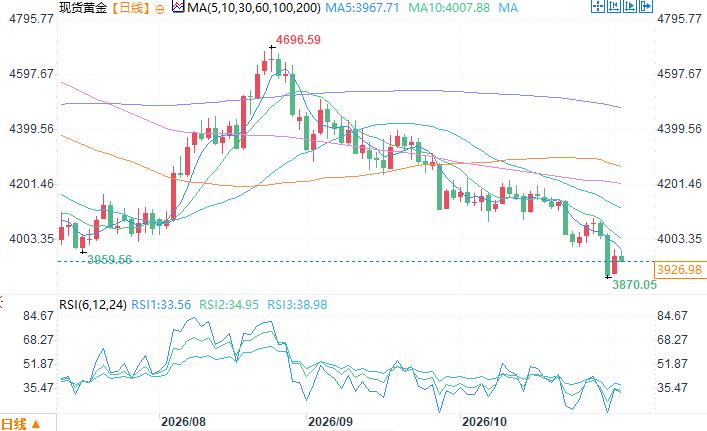 Spot gold daily chart source: FX678. As of 13:18 Beijing time on November 3rd, spot gold was trading at $3926.78 per ounce.
Gold prices have rebounded in the short term, but key levels still need to be overcome.
In her latest precious metals research report, Wu stated that gold can only alleviate recent downward pressure and open up room for continued technical recovery if it regains a foothold above $4,000 per ounce. Last week, gold prices broke through two key support levels, $4,000 and $3,900, hitting a low of $3,870, a new low in over a year. On Monday, bargain hunters entered the market, and spot gold closed at $3,946.47 per ounce, a single-day increase of 1.80%. Despite these signs of stabilization, Wu stated that the downside risk for gold has not been eliminated, and interest rates remain the core factor driving gold price movements. She explained that gold itself does not generate interest, and the continued strengthening of the US dollar and high real yields will increase the opportunity cost of holding gold, suppressing the upside potential. In terms of indicators, although the 14-day Relative Strength Index (RSI) for gold is gradually approaching oversold territory, the technical pattern is weak, and the price still has the potential to continue its downward trend.Interest rate hike expectations combined with liquidity selling pressure create a double drag.
Better-than-expected US economic data reinforced market sentiment that the Federal Reserve's tightening cycle is not yet over. The Fed kept interest rates unchanged last week, but the market still prices in a possible rate hike in December. Wu added that the expectation of a rate hike is only one of the negative factors facing gold; the tightening liquidity pressure from significant financial market volatility should not be underestimated. Last week, tech stocks suffered a sharp decline, with Intel's stock price falling nearly 29% in a single day on Friday, leading to market concerns about overheated investment and lower-than-expected returns in the artificial intelligence infrastructure sector. When risk assets are sold off, some investors need to sell gold to obtain cash to meet margin calls, further amplifying the selling pressure on gold. Currently, safe-haven demand is shifting towards US Treasuries, resulting in insufficient safe-haven buying of gold. She explained that relying solely on declining US Treasury yields is insufficient to support a sustained rise in gold prices; the market also needs to lower its expectations for further rate hikes, while overall market liquidity needs to recover.This week is packed with important events, with the non-farm payroll data being the key focus.
Wu noted that several important US economic and political events this week will guide gold prices, including the US midterm elections on Tuesday, a new round of technology company earnings reports, and the October non-farm payroll report released on Friday. The election results will influence market expectations regarding future fiscal spending, government deficits, and the scale of US Treasury issuance, which will then impact US Treasury yields and the US dollar. If there is a change in control of Congress, the market will lower its fiscal deficit expectations, leading to a decline in long-term bond yields, which will support gold. However, a decrease in political uncertainty may also push up the dollar, limiting the rise in gold prices. Of all the events, the October non-farm payroll report has the most crucial impact on precious metals. Economists generally expect the US to add 65,000 jobs in October, higher than September's 29,000, with the unemployment rate remaining unchanged at 4.2%. Wu said that if the employment data is stronger than expected, while wages remain resilient, the market will strengthen expectations of a December rate hike, which will benefit the dollar and real US Treasury yields, and be bearish for gold. Conversely, weaker employment data will cool down tightening expectations, giving gold some breathing room. However, she also cautioned that if risk assets fall sharply in tandem, even if employment data weakens, investors will still liquidate their gold holdings to raise funds, making it difficult for gold prices to sustain a continuous upward trend.Conclusion
Short-term bargain hunting has driven a slight recovery in gold prices, but the negative factors in the gold fundamentals have not yet been cleared. This week's non-farm payroll data will be the core variable determining the short-term direction of gold prices, and changes in the liquidity environment are also worth monitoring. Spot gold daily chart source: FX678. As of 13:18 Beijing time on November 3rd, spot gold was trading at $3926.78 per ounce.
- Risk Warning and Disclaimer
- The market involves risk, and trading may not be suitable for all investors. This article is for reference only and does not constitute personal investment advice, nor does it take into account certain users’ specific investment objectives, financial situation, or other needs. Any investment decisions made based on this information are at your own risk.