The US stock market crash failed to drag down gold prices; geopolitical factors provided long-term support for a rebound.
2026-11-06 17:10:26
On Friday (November 6th) during the Asian and European sessions, spot gold prices fell under pressure, briefly dipping to around $4035 per ounce; a two-day pullback of over 2%. Yesterday's article warned of a potential pullback after a surge in gold prices. The immediate trigger for this correction was the concentrated selling of assets by Wall Street, impacting market liquidity, and the Strait of Hormuz attack, which spurred a rebound in crude oil prices and reignited energy inflation expectations, pushing up market expectations for continued high interest rates from the Federal Reserve. Consequently, gold, a non-interest-bearing asset, faced selling pressure. [Image link: https://upload.fx678img.com/upload/ht/20250801/2025080117030543.jpg]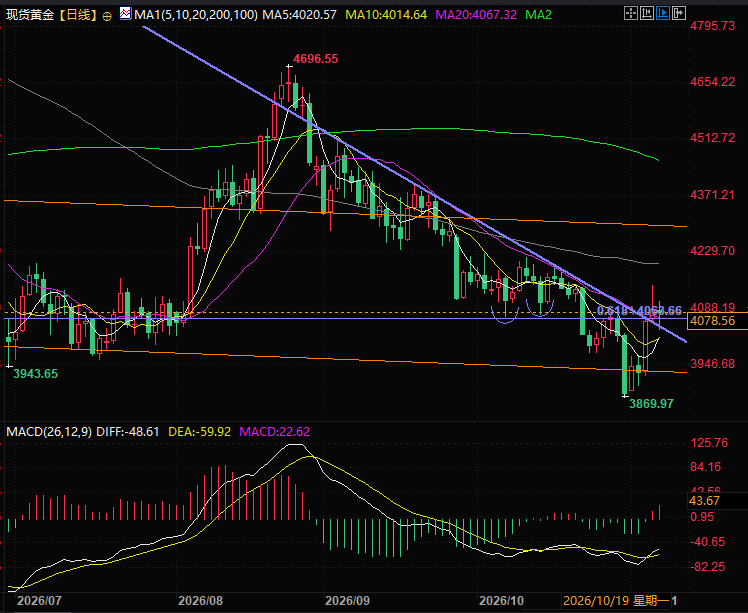 (Spot gold daily chart, source: EasyTrade) At 17:05 Beijing time, spot gold is currently trading at $4078 per ounce.
The attack on ships in the Taiwan Strait pushed up oil prices, while inflation expectations put pressure on gold, but long-term geopolitical support limited the decline.
News of attacks on oil tankers in the Strait of Hormuz disrupted crude oil prices. After surging over 3% the previous day, crude oil continued its upward trend on Friday. The rebound in energy prices reignited concerns about sticky inflation, becoming a key negative factor suppressing gold prices in the short term. However, gold prices only experienced a temporary pullback and did not fall sharply. The core logic lies in the fact that the long-term geopolitical landscape, including the US-Iran standoff, the Middle East situation, and even global geopolitical competition, is undergoing fundamental changes following the US midterm elections. The market is simultaneously trading the short-term risk of rising interest rates due to energy inflation and pricing in the possibility of a potential easing of the US-Iran conflict. This long-term geopolitical support offset the negative impact of the oil price rebound, preventing gold from falling sharply along with the strengthening of crude oil.US tech stocks were sold off, and gold prices showed a mixed performance this time.
With the Democrats controlling both the House and Senate, the market pre-priced in expectations of stricter AI regulations, leading to a large-scale withdrawal of funds from the chip, computing power, and data center sectors. This resulted in a significant pullback in the Nasdaq, with AI leaders like Nvidia, AMD, and Micron collectively weakening, and the semiconductor index experiencing a marked decline. Stock market crashes can exacerbate liquidity issues, and some investors may choose to liquidate their gold positions to withdraw cash to meet margin calls in other markets. However, this can also trigger safe-haven buying in gold. Recently, the former has had a greater impact; generally, gold prices fall along with US tech stocks. However, this time the market has improved, and gold prices have not fallen sharply following the decline in US stocks. The underlying pricing logic is that tighter AI regulations and a slowdown in related infrastructure investment have led the market to pre-price a downward shift in the US economic growth center. Looking at the long term, slower economic growth will lower real interest rates, creating a long-term positive for gold. Therefore, gold's pullback is only due to short-term interest rate expectations, with long-term positive factors limiting its downside.The market is awaiting the non-farm payrolls report, and expectations for an interest rate hike have cooled somewhat compared to the previous period.
The market's focus is currently on the upcoming US non-farm payroll data, the most important indicator to watch before the Fed's December policy meeting. The latest CME FedWatch pricing shows a 68.7% probability of a 25 basis point rate hike in December, a further decline from nearly 100% previously to a recent 70% expectation. Fed Chair Barkin believes domestic demand is resilient, corporate profits are stable, and there are no signs of a rapid decline in inflation, supporting a gradual rate hike. Fed Chair Hamak's statement was more direct (he was one of the three hawkish officials who voted for a rate hike), suggesting a shift in monetary policy towards a restrictive stance. He stated that persistently high inflation is trending in an unfavorable direction, and he favors frequent, small rate hikes to reduce the impact on the economy and financial system. He also emphasized the dollar's stable status as the global reserve currency and that the Fed's independence is key to keeping inflation back to the 2% target. The market's focus has shifted from the certainty of a rate hike to how the non-farm payroll data will reshape the interest rate path.This non-farm payrolls report will focus on three key indicators:
Non-farm payrolls: Indicate whether the job market remains in a weak equilibrium or experiences unexpected overheating or underheating; Unemployment rate: Observe the tightness or looseness of the labor market; Average hourly earnings: A core indicator of inflation stickiness; stronger wages will further push up interest rate expectations and suppress gold prices; weaker wages will alleviate interest rate pressure and benefit gold's recovery. At the institutional level, Goldman Sachs lowered its year-end 2026 gold price forecast to $4150/ounce, based on the assumption that the Federal Reserve will maintain a hawkish policy. However, this downward revision only reflects short-term high interest rate pressure and does not negate the geopolitical support logic for gold. They believe that the Fed's policy expectations are more hawkish than before, and high interest rates will suppress speculative buying of non-interest-bearing gold; they also added the additional negative factors of rising oil prices, stock market deleveraging, and margin selling of gold.Summary and Technical Analysis:
The Hormuz attack on ships pushed up oil prices and raised inflation expectations. Coupled with the Fed's gradual interest rate hike stance, gold prices faced downward pressure. Margin selling pressure from the US stock market decline further weighed on gold in the short term. However, the midterm elections are reshaping geopolitical expectations, and AI regulation is dragging down US economic growth, with real interest rates potentially falling further. Gold has solid support below, limiting its downside potential. The key to recent market movements lies in the non-farm payroll data: stronger-than-expected wages will continue to put pressure on gold prices; weaker employment and lower-than-expected wages will cool interest rate hike expectations, potentially allowing gold to quickly recover its losses. Technically, gold prices had already reached the measured decline from the previous head and shoulders pattern around 3930. Currently, gold has reversed, broken the downtrend line, and is temporarily closing above the 0.618 Fibonacci retracement level of 4063. If it can hold above 4063, it is expected to continue its upward trend. (Spot gold daily chart, source: EasyTrade) At 17:05 Beijing time, spot gold is currently trading at $4078 per ounce.
- Risk Warning and Disclaimer
- The market involves risk, and trading may not be suitable for all investors. This article is for reference only and does not constitute personal investment advice, nor does it take into account certain users’ specific investment objectives, financial situation, or other needs. Any investment decisions made based on this information are at your own risk.