On the eve of a major shift in the gold market! The US dollar has fallen for seven consecutive days, so why is the price of gold unable to rise?
2025-12-03 21:12:17
On Wednesday (December 3), during the Asian and European sessions, spot gold prices rose and then fell back, maintaining a fluctuating pattern. Currently, influenced by the sharp decline in the US dollar index, it has rebounded into positive territory and is trading around 4211. On Tuesday night during the New York session, gold prices were affected by the sharp rise and fall of the US dollar index, showing a significant bottoming out and rebound, with gold prices once dipping to around 4163.
Gold prices remain caught between positive and negative factors, and are at the end of this rebound. Long positions are hesitant, based on the fact that the US dollar index has fallen by about 0.4% while gold prices have not rebounded significantly. This article summarizes recent market information.

US President Donald Trump said on Tuesday that he will formally announce his nominee for the next Federal Reserve chairman in early 2026, after he had given a clear signal on Sunday that "the nominee has been identified and will be officially announced later."
Currently, Kevin Hassett, the director of the National Economic Council (NEC), is the frontrunner, and the market widely interprets this as paving the way for a more dovish policy shift at the Federal Reserve if he is successfully appointed. This expectation aligns with Trump's advocacy of an accommodative interest rate environment, providing medium- to long-term support for the precious metals market.
Meanwhile, the US dollar index is under pressure from dovish expectations and is currently hovering near its lowest level since October 30, at 98.99, having declined for seven consecutive trading days.
On Tuesday evening, Federal Reserve Vice Chair for Supervision Michelle Bowman expressed her stance on the direction of digitalizing the dollar. The Fed is working with other institutions to advance the formulation of capital and liquidity rules required by legislation. The core is to ensure that issuers of digital dollars operate within the framework of "maintaining the safety and soundness of the banking system," while reserving space for fair competition among market participants.
The US dollar index surged and then fell sharply after news of the hearing, indicating that the market was not very interested in it. Gold prices were supported by this and rebounded after hitting a low.
The U.S. manufacturing PMI, released on Monday, continued its weak trend in November, remaining in contraction territory for the ninth consecutive month and marking a record 37 consecutive months without a reversal in the PMI's trend. This reflects a severe lack of momentum in the recovery of the U.S. real economy.
According to real-time data from the CME FedWatch tool, the market has now priced in an 87% probability of a 25 basis point (bps) rate cut by the Federal Reserve in December. This strong expectation continues to suppress dollar liquidity, providing broad-based support for gold prices.
The recent continuous rise in Japanese bond yields and the rapid short-term depreciation of the yen have narrowed the interest rate differential between the US and Japan, and increased the cost of yen carry trades. The expectation of carry trades funds flowing back to Japan has exacerbated the expectation of reduced market liquidity for carry trades, suppressing the market performance of highly leveraged products, such as gold futures.
Inventory fluctuations have become a significant support for the market. Last week, silver inventories on the Shanghai Futures Exchange fell to a 10-year low, while gold inventories on the Shanghai Gold Exchange also dropped to their lowest point in nine years.
The core trigger for this phenomenon was that China's gold exports in October exceeded 660 tons, setting a new historical peak. This batch of exported gold mainly flowed to the London market, which had already experienced a clear supply gap in October, effectively filling the local supply shortage.
Geopolitical risk premiums also remained high. U.S. Special Envoy Steve Vitkov traveled to Moscow on Tuesday to meet with Russian President Vladimir Putin to discuss a U.S.-proposed ceasefire in Ukraine, but the talks failed to achieve a breakthrough.
Putin's foreign policy advisor, Yuri Ushakov, described the talks as "constructive and information-dense," but pointed out that "no compromise has been reached" on the core territorial dispute, and revealed that related consultations will continue. Geopolitical uncertainty was previously a positive factor for gold prices.
However, the increase in peace talks related to the Russia-Ukraine conflict and the unfavorable development of the Ukrainian military situation have begun to become risk factors for gold prices. After all, if the two sides cannot be evenly matched, the balance may soon collapse, and gold prices are always trying to bet on more aggressive predictions.
Manish Sharma, Vice President of Commodities and Foreign Exchange at Anand Latti Stock Brokerage, pointed out that gold prices are likely to continue their upward trend this month, showing an overall positive momentum, but short-term volatility may increase.
The precious metals market is currently showing signs of improvement, with a trend of upward movement last week, among which silver spot contracts performed particularly well.
Driven by both the continued depletion of global visible silver inventories and the rapid rise in market expectations for interest rate cuts, silver prices surged from below $50 per troy ounce to around $58.85, significantly outperforming gold and directly pushing the gold/silver ratio down to above 73, hitting its lowest level this year.
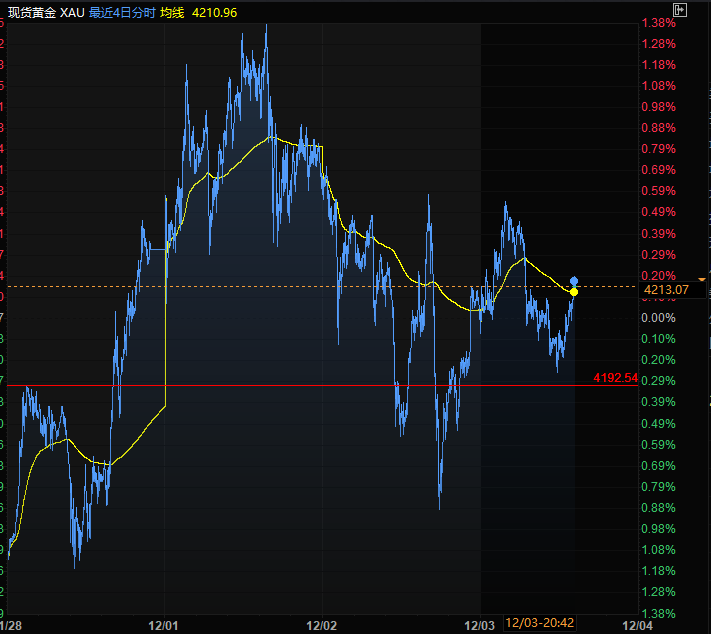
The intraday chart for spot gold shows that the price around 4192 is a key level in the near term. If the closing price of gold is above this level, it is highly likely that the rebound will continue.
(Spot gold intraday chart)
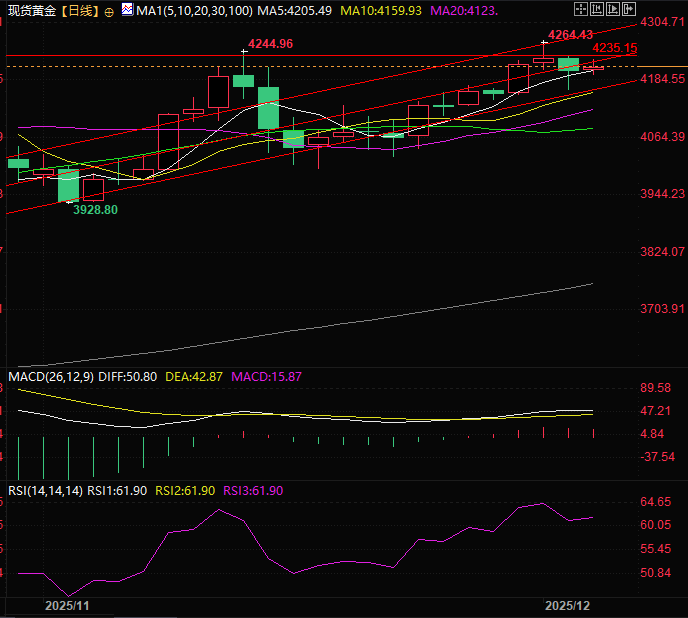
The daily chart for spot gold shows that after the price broke below the middle line of the upward channel, the rebound failed to surpass the middle line, which means that the price may turn into range-bound trading and the upward speed will slow down. The 5-day moving average is an important observation point around 4200, and the subsequent support level is around the lower line, around 4164.
(Spot gold daily chart, source: FX678)
At 21:09 Beijing time, spot gold is currently trading at $4214 per ounce.
Gold prices remain caught between positive and negative factors, and are at the end of this rebound. Long positions are hesitant, based on the fact that the US dollar index has fallen by about 0.4% while gold prices have not rebounded significantly. This article summarizes recent market information.
Federal Reserve personnel changes: Dovish candidates lead the pack, providing medium- to long-term support for precious metals.
US President Donald Trump said on Tuesday that he will formally announce his nominee for the next Federal Reserve chairman in early 2026, after he had given a clear signal on Sunday that "the nominee has been identified and will be officially announced later."
Currently, Kevin Hassett, the director of the National Economic Council (NEC), is the frontrunner, and the market widely interprets this as paving the way for a more dovish policy shift at the Federal Reserve if he is successfully appointed. This expectation aligns with Trump's advocacy of an accommodative interest rate environment, providing medium- to long-term support for the precious metals market.
Meanwhile, the US dollar index is under pressure from dovish expectations and is currently hovering near its lowest level since October 30, at 98.99, having declined for seven consecutive trading days.
The digital dollar has limited appeal, and gold prices rebound accordingly.
On Tuesday evening, Federal Reserve Vice Chair for Supervision Michelle Bowman expressed her stance on the direction of digitalizing the dollar. The Fed is working with other institutions to advance the formulation of capital and liquidity rules required by legislation. The core is to ensure that issuers of digital dollars operate within the framework of "maintaining the safety and soundness of the banking system," while reserving space for fair competition among market participants.
The US dollar index surged and then fell sharply after news of the hearing, indicating that the market was not very interested in it. Gold prices were supported by this and rebounded after hitting a low.
Macroeconomic and Policy Expectations: Weak US Economy and Expectations of Interest Rate Cuts Weigh on the Dollar
The U.S. manufacturing PMI, released on Monday, continued its weak trend in November, remaining in contraction territory for the ninth consecutive month and marking a record 37 consecutive months without a reversal in the PMI's trend. This reflects a severe lack of momentum in the recovery of the U.S. real economy.
According to real-time data from the CME FedWatch tool, the market has now priced in an 87% probability of a 25 basis point (bps) rate cut by the Federal Reserve in December. This strong expectation continues to suppress dollar liquidity, providing broad-based support for gold prices.
Rising yields on Japanese government bonds dampened arbitrage activity.
The recent continuous rise in Japanese bond yields and the rapid short-term depreciation of the yen have narrowed the interest rate differential between the US and Japan, and increased the cost of yen carry trades. The expectation of carry trades funds flowing back to Japan has exacerbated the expectation of reduced market liquidity for carry trades, suppressing the market performance of highly leveraged products, such as gold futures.
Easing inventory pressure puts downward pressure on gold prices.
Inventory fluctuations have become a significant support for the market. Last week, silver inventories on the Shanghai Futures Exchange fell to a 10-year low, while gold inventories on the Shanghai Gold Exchange also dropped to their lowest point in nine years.
The core trigger for this phenomenon was that China's gold exports in October exceeded 660 tons, setting a new historical peak. This batch of exported gold mainly flowed to the London market, which had already experienced a clear supply gap in October, effectively filling the local supply shortage.
Geopolitical risks and disturbances may be a negative factor.
Geopolitical risk premiums also remained high. U.S. Special Envoy Steve Vitkov traveled to Moscow on Tuesday to meet with Russian President Vladimir Putin to discuss a U.S.-proposed ceasefire in Ukraine, but the talks failed to achieve a breakthrough.
Putin's foreign policy advisor, Yuri Ushakov, described the talks as "constructive and information-dense," but pointed out that "no compromise has been reached" on the core territorial dispute, and revealed that related consultations will continue. Geopolitical uncertainty was previously a positive factor for gold prices.
However, the increase in peace talks related to the Russia-Ukraine conflict and the unfavorable development of the Ukrainian military situation have begun to become risk factors for gold prices. After all, if the two sides cannot be evenly matched, the balance may soon collapse, and gold prices are always trying to bet on more aggressive predictions.
Institutional Outlook:
Manish Sharma, Vice President of Commodities and Foreign Exchange at Anand Latti Stock Brokerage, pointed out that gold prices are likely to continue their upward trend this month, showing an overall positive momentum, but short-term volatility may increase.
The precious metals market is currently showing signs of improvement, with a trend of upward movement last week, among which silver spot contracts performed particularly well.
Driven by both the continued depletion of global visible silver inventories and the rapid rise in market expectations for interest rate cuts, silver prices surged from below $50 per troy ounce to around $58.85, significantly outperforming gold and directly pushing the gold/silver ratio down to above 73, hitting its lowest level this year.
Technical Analysis:
The intraday chart for spot gold shows that the price around 4192 is a key level in the near term. If the closing price of gold is above this level, it is highly likely that the rebound will continue.
(Spot gold intraday chart)
The daily chart for spot gold shows that after the price broke below the middle line of the upward channel, the rebound failed to surpass the middle line, which means that the price may turn into range-bound trading and the upward speed will slow down. The 5-day moving average is an important observation point around 4200, and the subsequent support level is around the lower line, around 4164.
(Spot gold daily chart, source: FX678)
At 21:09 Beijing time, spot gold is currently trading at $4214 per ounce.
- Risk Warning and Disclaimer
- The market involves risk, and trading may not be suitable for all investors. This article is for reference only and does not constitute personal investment advice, nor does it take into account certain users’ specific investment objectives, financial situation, or other needs. Any investment decisions made based on this information are at your own risk.