A slight rebound in the US dollar index limited gold prices, which are expected to remain range-bound in the short term.
2025-12-08 10:04:50
Gold prices maintained a positive performance in early trading, with XAU/USD remaining stable around $4200, and market sentiment generally leaning towards optimism. Investors widely expect the Federal Reserve to announce a 25 basis point interest rate cut at its meeting this Wednesday to address the economic slowdown pressures caused by the continued cooling of the labor market.
The expectation of interest rate cuts is the core driver of current gold prices. With the latest employment data showing signs of a slowdown in the labor market, the market believes the Federal Reserve needs to stimulate economic momentum by lowering policy rates. Lower interest rates directly reduce the opportunity cost of holding non-yielding assets, thus supporting gold prices.
 Central bank buying has provided structural support for gold prices. According to the latest data, central banks in major Asian countries have increased their gold reserves for the 13th consecutive month, adding approximately 30,000 ounces last month, further expanding their gold reserves.
The long-term trend of increasing holdings is seen as a strategic support for gold prices, especially given the global trend of diversifying foreign exchange reserves, which keeps gold allocation popular.
Stronger-than-expected US economic data may limit gold's gains. The latest University of Michigan Consumer Sentiment Index rose to 53.3 in December, higher than the expected 52.0, indicating continued economic resilience. If this supports the US dollar, gold prices may be suppressed, as a stronger dollar increases the cost of gold for holders of other currencies, thereby dampening demand.
Overall, gold is caught in a tug-of-war between the support of interest rate cut expectations and the pressure of a stronger dollar. There is short-term upward momentum, but the upside potential remains limited.
Market research indicates that institutions generally believe gold's upward movement still depends on the pace of interest rate cuts by the Federal Reserve, while the risk of a rebounding dollar will be a significant obstacle limiting gold prices from breaking through resistance levels. Precious metals strategists state that the trend of central bank buying strengthens gold's long-term investment value, but in the short term, attention should still be paid to the direction of US economic data.
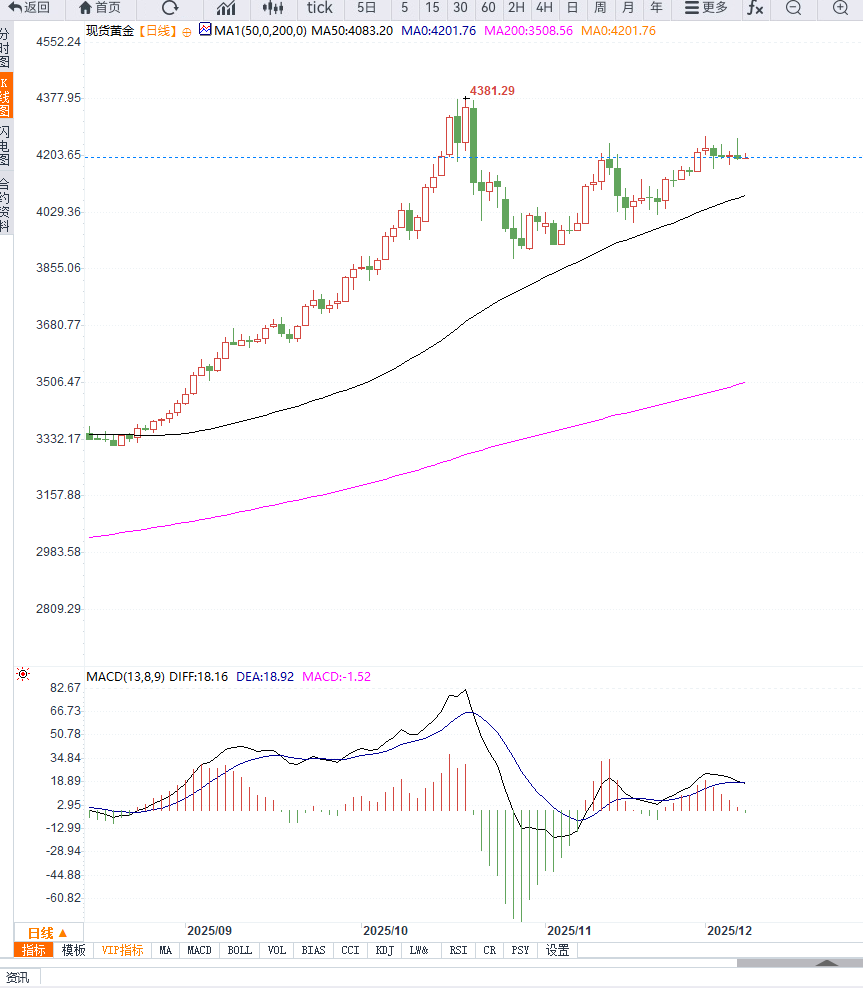
From the daily chart, XAU/USD is still hovering near the upper edge of the bullish channel, with multiple candlesticks finding support at the 5-day and 10-day moving averages, indicating that short-term buying power remains stable.
Although the MACD histogram has retreated, it remains above the zero line, indicating that the trend structure has not been broken. However, there is a significant resistance zone in the $4215-$4230 area, and the price has repeatedly failed to break through this level, suggesting that funds are awaiting further guidance from the Federal Reserve meeting.
If positive factors strengthen, gold prices have a chance to break through this range; otherwise, they may retrace to the 20-day moving average in the short term to seek new support.
Editor's Note:
This week's key focus is the Federal Reserve's guidance on the future path of interest rates. If the rate-cutting statement is dovish, gold prices may continue to test key resistance levels; if the Fed remains confident in the economy, the dollar may strengthen in the short term, thus putting downward pressure on gold prices. Structural demand remains, but the short-term oscillating pattern is unlikely to change.
The expectation of interest rate cuts is the core driver of current gold prices. With the latest employment data showing signs of a slowdown in the labor market, the market believes the Federal Reserve needs to stimulate economic momentum by lowering policy rates. Lower interest rates directly reduce the opportunity cost of holding non-yielding assets, thus supporting gold prices.
Central bank buying has provided structural support for gold prices. According to the latest data, central banks in major Asian countries have increased their gold reserves for the 13th consecutive month, adding approximately 30,000 ounces last month, further expanding their gold reserves.The long-term trend of increasing holdings is seen as a strategic support for gold prices, especially given the global trend of diversifying foreign exchange reserves, which keeps gold allocation popular.
Stronger-than-expected US economic data may limit gold's gains. The latest University of Michigan Consumer Sentiment Index rose to 53.3 in December, higher than the expected 52.0, indicating continued economic resilience. If this supports the US dollar, gold prices may be suppressed, as a stronger dollar increases the cost of gold for holders of other currencies, thereby dampening demand.
Overall, gold is caught in a tug-of-war between the support of interest rate cut expectations and the pressure of a stronger dollar. There is short-term upward momentum, but the upside potential remains limited.
Market research indicates that institutions generally believe gold's upward movement still depends on the pace of interest rate cuts by the Federal Reserve, while the risk of a rebounding dollar will be a significant obstacle limiting gold prices from breaking through resistance levels. Precious metals strategists state that the trend of central bank buying strengthens gold's long-term investment value, but in the short term, attention should still be paid to the direction of US economic data.
From the daily chart, XAU/USD is still hovering near the upper edge of the bullish channel, with multiple candlesticks finding support at the 5-day and 10-day moving averages, indicating that short-term buying power remains stable.
Although the MACD histogram has retreated, it remains above the zero line, indicating that the trend structure has not been broken. However, there is a significant resistance zone in the $4215-$4230 area, and the price has repeatedly failed to break through this level, suggesting that funds are awaiting further guidance from the Federal Reserve meeting.
If positive factors strengthen, gold prices have a chance to break through this range; otherwise, they may retrace to the 20-day moving average in the short term to seek new support.
Editor's Note:
This week's key focus is the Federal Reserve's guidance on the future path of interest rates. If the rate-cutting statement is dovish, gold prices may continue to test key resistance levels; if the Fed remains confident in the economy, the dollar may strengthen in the short term, thus putting downward pressure on gold prices. Structural demand remains, but the short-term oscillating pattern is unlikely to change.
- Risk Warning and Disclaimer
- The market involves risk, and trading may not be suitable for all investors. This article is for reference only and does not constitute personal investment advice, nor does it take into account certain users’ specific investment objectives, financial situation, or other needs. Any investment decisions made based on this information are at your own risk.