From Trump's "political manifesto" to the European delegation's "collective revelry," gold bulls are celebrating.
2025-12-15 10:49:18
From the new US National Security Strategy, which former EU High Representative for Foreign Affairs Josep Borrell called a "declaration of political warfare," to President Donald Trump's dismissive attitude in an interview, this is clearly not a time for celebration for European diplomats.

The atmosphere at several Christmas parties held by European embassies last week was noticeably somber. A diplomat from a mid-sized European country revealed, "The Western alliance is over. This relationship will never be the same again." He chose to be cautious to avoid international controversy, especially after his political advisor issued a statement denying the comments, and ultimately gave an anonymous interview.
Other European diplomats were also socializing, enjoying snacks, and drowning their sorrows in drinks at receptions in Washington's prestigious embassy district. Who would want to publicly comment on the turmoil Trump has brought to transatlantic relations? Why invite trouble?
Given the Trump administration's relentless pursuit of diplomats who make careless remarks, the silence of those involved is entirely understandable. Last month, a Belgian military attaché—a brigadier general—was forced to resign simply for describing the Trump administration as "characterized by chaos and unpredictability," which angered Pentagon official Peter Hegseth.
However, despite the general reluctance to discuss the issue, there was a broad consensus at the Christmas party that Borrell's call for European leaders to recognize Trump's view of the continent as an adversary and to stop "hiding behind a deadly and complacent silence" might be the right thing to do.
Psychologists might diagnose the current state of European diplomats in the US as "psychological disorientation"—due to the current US administration's complete break with the international order established by President Harry Truman after 1945 and continuously improved by successive presidents, these diplomats are experiencing profound confusion about their place in the world and their future direction. This state of disorientation was unprecedented before Trump's presidency.
Coping with a sense of disorientation requires several transitional phases: First, accept the fact that familiar things are gone. People experiencing dramatic change should start by stabilizing their emotions with manageable small things, such as organizing a Christmas party, gradually ceasing to resist change and learning to adapt. The key to psychological reconstruction during periods of intense transformation lies in cultivating the courage to accept uncertainty.
As Trump has turned the world upside down, even the usually composed diplomats and envoys are clearly still in the early stages of adjustment. The deputy head of mission at an embassy in a Southeast European country frankly stated, "Everything will return to normal in two years when the new president takes office."
Others whispered that Trump's description of Europe as "declining" was not without merit, noting that he echoed, to some extent, former European Central Bank President Mario Draghi's criticisms of the group. Draghi, too, warned that the EU faced marginalization and decline unless it acted swiftly and implemented sweeping reforms. "Taking action" was a constant mantra for Draghi. But Draghi always kept Europe's best interests at heart. What about Trump?
The envoy admitted, "Perhaps, but what he's doing might be helping us, pushing us to become stronger, more capable allies." But does Trump really want a stronger Europe? After all, he has publicly stated that the purpose of the EU was to "take advantage of the United States."
Robert Pittenger, a former Republican congressman from North Carolina and a traditional politician in his seventies, delivered a brief speech reminiscent of the Reagan era, praising freedom and democracy. This old-school politician clearly hadn't read Trump's new National Security Strategy—which explicitly states that future U.S. foreign policy should not be based on values or "rooted in traditional political ideologies," but rather follow principles "that are in America's interest."
What truly works is not the promotion of freedom and democracy, but rather cultivating good relations with authoritarian rulers and ceasing criticism of members of the group that was frequently referred to as the "authoritarian axis." At the same time, it involves abandoning the outdated interventionist rhetoric of deceiving countries into implementing "democracy or other social changes that are drastically different from their traditional histories."
Others in the European diplomatic corps, while attending various seasonal gatherings and enjoying delicate bite-sized appetizers, seemed to still hold onto the hope that the rhetoric consistently made by Trump and his aides since taking office was not their true intention.
In short, they can still be harmonized and optimized.
Similar expectations were raised when US Vice President Vance delivered a bombshell speech at the Munich Security Conference earlier this year—when he championed the MAGA illiberal ideology and warned Europe that it would either accept Trump’s nationalist populist ideology or be deemed unworthy of defense guarantees and friendship, the audience gasped noticeably.
But not all diplomats in Washington have lost their way. Or rather, they have adapted flexibly to their environment. Take the sprightly Germans, for example: they not only braved the biting wind, but stood against it. Their embassy's Christmas market-themed event was deliberately held outdoors, with mulled wine and steaming German sausages to warm the guests. German Ambassador Jens Hansfeld told the shivering participants, "To hold it indoors would be cheating."
When discussing the Russia-Ukraine conflict, his defense attaché took a similarly tough stance. General Gunnar Bruegner stated, "We will do everything in our power to ensure Ukraine's continued fighting."
Trump also showed great interest in Qatar, which has abundant fuel reserves. This week, Qataris held a grand banquet at the magnificent National Architecture Museum to celebrate their National Day. They successfully invited numerous members of Congress, senior Trump administration officials, and Washington dignitaries, filling the grand venue to capacity.
This banquet was far more than just snacks. A steady stream of authentic Qatari cuisine...and fine wines were served. Guests and hosts alike enjoyed themselves immensely, without a trace of gloom. A Qatari diplomat, beaming, remarked, "We are very happy."
What the text reveals is not just short-term diplomatic friction, but a profound rupture in the post-World War II world order. The United States has shifted from "leader of the free world" to "transactional power," and Europe has slid from "close ally" to "adversary under scrutiny." This fundamental role shift will generate decades of uncertainty.
Gold will become a quintessential asset in this era of "great transformation": its brilliance is overshadowed when alliances are reliable; its value shines brightly when alliances rust and rules fade. The current environment—collapsed strategic trust, broken ideological ties, and a faltering security architecture—is almost a tailor-made backdrop for a gold bull market.
Although the process may be volatile, the structural and long-term forces driving gold prices upward are already very clear and strong.
On Monday (December 15) during the Asian session, spot gold fluctuated and rose by about 0.60%, continuing the gains of the previous four trading days. The previous trading day, it touched a high of $4,353.36 per ounce, the highest level since October 21.
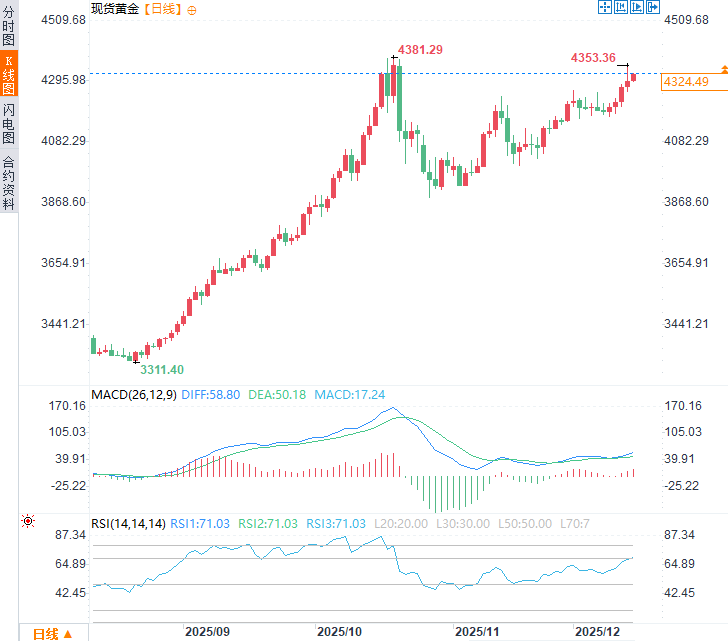
(Spot gold daily chart, source: FX678)
At 10:48 Beijing time, spot gold was trading at $4,326.15 per ounce.
The Twilight of the Transatlantic Alliance
The atmosphere at several Christmas parties held by European embassies last week was noticeably somber. A diplomat from a mid-sized European country revealed, "The Western alliance is over. This relationship will never be the same again." He chose to be cautious to avoid international controversy, especially after his political advisor issued a statement denying the comments, and ultimately gave an anonymous interview.
Other European diplomats were also socializing, enjoying snacks, and drowning their sorrows in drinks at receptions in Washington's prestigious embassy district. Who would want to publicly comment on the turmoil Trump has brought to transatlantic relations? Why invite trouble?
Silent protests and fragile hope
Given the Trump administration's relentless pursuit of diplomats who make careless remarks, the silence of those involved is entirely understandable. Last month, a Belgian military attaché—a brigadier general—was forced to resign simply for describing the Trump administration as "characterized by chaos and unpredictability," which angered Pentagon official Peter Hegseth.
However, despite the general reluctance to discuss the issue, there was a broad consensus at the Christmas party that Borrell's call for European leaders to recognize Trump's view of the continent as an adversary and to stop "hiding behind a deadly and complacent silence" might be the right thing to do.
Psychologists might diagnose the current state of European diplomats in the US as "psychological disorientation"—due to the current US administration's complete break with the international order established by President Harry Truman after 1945 and continuously improved by successive presidents, these diplomats are experiencing profound confusion about their place in the world and their future direction. This state of disorientation was unprecedented before Trump's presidency.
Coping with a sense of disorientation requires several transitional phases: First, accept the fact that familiar things are gone. People experiencing dramatic change should start by stabilizing their emotions with manageable small things, such as organizing a Christmas party, gradually ceasing to resist change and learning to adapt. The key to psychological reconstruction during periods of intense transformation lies in cultivating the courage to accept uncertainty.
Europe's Difficult Interpretation of Conflicting Signals
As Trump has turned the world upside down, even the usually composed diplomats and envoys are clearly still in the early stages of adjustment. The deputy head of mission at an embassy in a Southeast European country frankly stated, "Everything will return to normal in two years when the new president takes office."
Others whispered that Trump's description of Europe as "declining" was not without merit, noting that he echoed, to some extent, former European Central Bank President Mario Draghi's criticisms of the group. Draghi, too, warned that the EU faced marginalization and decline unless it acted swiftly and implemented sweeping reforms. "Taking action" was a constant mantra for Draghi. But Draghi always kept Europe's best interests at heart. What about Trump?
The envoy admitted, "Perhaps, but what he's doing might be helping us, pushing us to become stronger, more capable allies." But does Trump really want a stronger Europe? After all, he has publicly stated that the purpose of the EU was to "take advantage of the United States."
Robert Pittenger, a former Republican congressman from North Carolina and a traditional politician in his seventies, delivered a brief speech reminiscent of the Reagan era, praising freedom and democracy. This old-school politician clearly hadn't read Trump's new National Security Strategy—which explicitly states that future U.S. foreign policy should not be based on values or "rooted in traditional political ideologies," but rather follow principles "that are in America's interest."
What truly works is not the promotion of freedom and democracy, but rather cultivating good relations with authoritarian rulers and ceasing criticism of members of the group that was frequently referred to as the "authoritarian axis." At the same time, it involves abandoning the outdated interventionist rhetoric of deceiving countries into implementing "democracy or other social changes that are drastically different from their traditional histories."
Others in the European diplomatic corps, while attending various seasonal gatherings and enjoying delicate bite-sized appetizers, seemed to still hold onto the hope that the rhetoric consistently made by Trump and his aides since taking office was not their true intention.
In short, they can still be harmonized and optimized.
Similar expectations were raised when US Vice President Vance delivered a bombshell speech at the Munich Security Conference earlier this year—when he championed the MAGA illiberal ideology and warned Europe that it would either accept Trump’s nationalist populist ideology or be deemed unworthy of defense guarantees and friendship, the audience gasped noticeably.
The Germans standing against the wind and the feast in Qatar
But not all diplomats in Washington have lost their way. Or rather, they have adapted flexibly to their environment. Take the sprightly Germans, for example: they not only braved the biting wind, but stood against it. Their embassy's Christmas market-themed event was deliberately held outdoors, with mulled wine and steaming German sausages to warm the guests. German Ambassador Jens Hansfeld told the shivering participants, "To hold it indoors would be cheating."
When discussing the Russia-Ukraine conflict, his defense attaché took a similarly tough stance. General Gunnar Bruegner stated, "We will do everything in our power to ensure Ukraine's continued fighting."
Trump also showed great interest in Qatar, which has abundant fuel reserves. This week, Qataris held a grand banquet at the magnificent National Architecture Museum to celebrate their National Day. They successfully invited numerous members of Congress, senior Trump administration officials, and Washington dignitaries, filling the grand venue to capacity.
This banquet was far more than just snacks. A steady stream of authentic Qatari cuisine...and fine wines were served. Guests and hosts alike enjoyed themselves immensely, without a trace of gloom. A Qatari diplomat, beaming, remarked, "We are very happy."
Shining gold
What the text reveals is not just short-term diplomatic friction, but a profound rupture in the post-World War II world order. The United States has shifted from "leader of the free world" to "transactional power," and Europe has slid from "close ally" to "adversary under scrutiny." This fundamental role shift will generate decades of uncertainty.
Gold will become a quintessential asset in this era of "great transformation": its brilliance is overshadowed when alliances are reliable; its value shines brightly when alliances rust and rules fade. The current environment—collapsed strategic trust, broken ideological ties, and a faltering security architecture—is almost a tailor-made backdrop for a gold bull market.
Although the process may be volatile, the structural and long-term forces driving gold prices upward are already very clear and strong.
On Monday (December 15) during the Asian session, spot gold fluctuated and rose by about 0.60%, continuing the gains of the previous four trading days. The previous trading day, it touched a high of $4,353.36 per ounce, the highest level since October 21.
(Spot gold daily chart, source: FX678)
At 10:48 Beijing time, spot gold was trading at $4,326.15 per ounce.
- Risk Warning and Disclaimer
- The market involves risk, and trading may not be suitable for all investors. This article is for reference only and does not constitute personal investment advice, nor does it take into account certain users’ specific investment objectives, financial situation, or other needs. Any investment decisions made based on this information are at your own risk.