Non-Farm Payrolls Preview: The US job market may "stop breathing," and the dollar is on the brink of a precipice!
2025-12-15 13:24:47
Americans seeking employment will face a challenging environment in 2025, and the situation may not be much better in 2026.
As of the latest month with available official data—September of last year—the unemployment rate remained at 4.4%. While this figure is historically low, it is the highest since October 2021. University of Michigan data from November showed that most consumers expect the unemployment rate to continue rising over the next year.
Job growth has also been lackluster, and signs of a wave of layoffs are already emerging. Current employment rates remain at levels seen in the early stages of the pandemic and since the Great Depression.
A report from Indeed’s Recruiting Lab last month pointed out that, given the current frozen labor market, “the problem is not whether the market can thaw, but whether it will collapse.”
Taking the healthcare industry as an example, as of August, this sector accounted for a staggering 47.5% of new jobs created in 2025. If this sector experiences a severe contraction while other industries fail to improve in tandem, the job market will face even greater pressure.
An expert from Indeed’s Recruiting Lab stated, “The most likely scenario is not a dramatic shift from the current situation, but rather a continuation of the current trend of low hiring and low firing—both employers and job seekers will face a slower, more selective market environment.”
The U.S. government is working to clear the data backlog caused by the 43-day government shutdown that ended last month, with the November non-farm payrolls report scheduled for release on Tuesday (December 16).
The Federal Reserve's projections released this week show that officials estimate the unemployment rate will peak at 4.5% this year, before falling back to 4.4% by the end of 2026. Federal Reserve Chairman Jerome Powell noted last Wednesday that the job market is "under pressure" and that "job creation may actually have turned negative."
Powell stated, "The labor supply is also significantly reduced at present, so the unemployment rate is not yet showing obvious fluctuations, but it must be recognized that there are clearly significant downside risks in the labor market. This is a major focus of public attention."
The “low-hit, low-layoff” labor market, which presents a difficult situation for job seekers, is likely to continue.
Elise Gould, a senior economist at the Economic Policy Institute, said: “What is worrying is that our economic situation at the beginning of the year is weaker than last year. Do I think a recession is inevitable? I’m not sure, but I do have concerns—and it’s important to remember that even a mild recession can hit historically vulnerable groups hard.”
The employment situation is particularly challenging for young Americans just entering the workforce.
A survey of 183 employers conducted by the National Association of Colleges and Employers (NACE) between August 7 and September 22 showed that just over half of the respondents believed the job market for the class of 2026 would be poor or average, a sentiment similar to that felt during the height of the pandemic.
When discussing the job prospects for the class of 2026, most employers said they plan to maintain their current headcount—meaning the current predicament plaguing young job seekers, who have submitted hundreds of applications this year with few responses, will continue.
"Companies expect to hire about 1.6 percent more 2026 graduates, which is roughly the same as hiring last year's graduates," said Mary Gatta, director of research and public policy at the National Association of Colleges and Employers (NACE).
Gata suggests that college students who want to remain competitive should strive to upgrade their skills, seek internships, and look for on-campus jobs. Artificial intelligence skills are particularly likely to be valuable, although 14% of employers in the NACE survey said they were already discussing replacing junior staff with the technology.
Gata added, "What we actually observed in our survey was that people were not talking about replacing jobs, but about enhancing capabilities."
Nevertheless, Princeton University economics and public affairs professor Aishgur Sahin points out that although current sentiment toward the labor market is negative, the decrease in immigration could reduce demand for jobs, which could actually make the unemployment rate more stable.
Sahin said, "There is some disagreement about whether what we are seeing now is the beginning of a recession or the beginning of a mature expansion phase due to slow population growth caused by immigration restrictions. I tend to think it is the latter because I think what we are seeing is the delayed effect of the Fed’s near-perfect 'soft landing'."
KPMG's senior U.S. economist, Matt Nestler, noted: "An aging population and restrictive immigration policies are putting pressure on the labor supply. As a result, the break-even point for job growth needed to maintain the current monthly unemployment rate has fallen sharply. Job growth in the monthly jobs report is expected to remain low."
The landscape of the US labor market—characterized by stagnant growth, accumulating risks, and structural fragility—has fundamentally undermined the two pillars supporting the dollar: a relatively strong US economy and a relatively hawkish Federal Reserve policy. Therefore, its overall impact on the dollar is negative.
The market's focus may shift from "inflation" to "employment and growth." Any data confirming a deterioration in the labor market could catalyze a decline in the dollar. However, the dollar's downward path will not be linear, and will be influenced by fluctuations in risk aversion, the performance of other economies, and the complex interplay of the Federal Reserve's oscillation between "fighting inflation" and "protecting employment."
The US dollar index is likely to enter a phase of increased volatility and a gradual downward shift in its center of gravity, until clear signs of a US economic recovery emerge or a more severe global crisis erupts, pushing it out of its safe-haven role. On Monday, the US dollar index fluctuated around 98.40 during the Asian session.
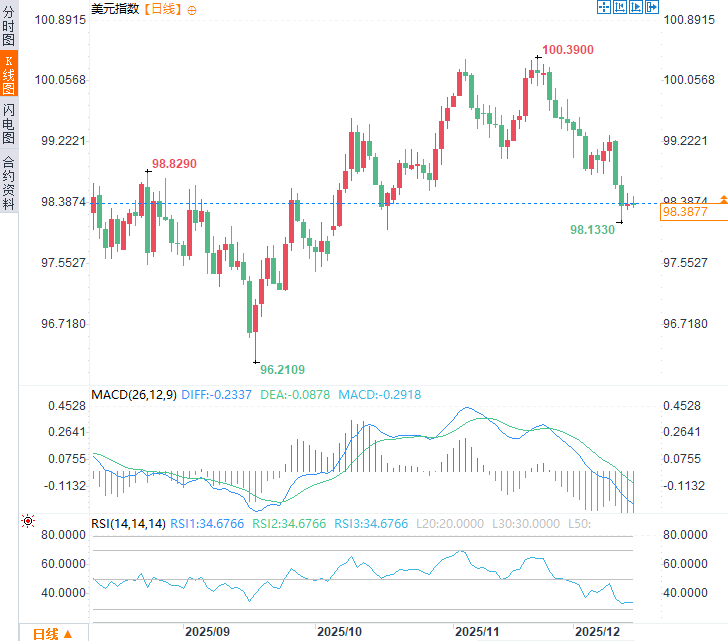
(US Dollar Index Daily Chart, Source: FX678)
At 13:23 Beijing time, the US dollar index is currently at 98.38.
As of the latest month with available official data—September of last year—the unemployment rate remained at 4.4%. While this figure is historically low, it is the highest since October 2021. University of Michigan data from November showed that most consumers expect the unemployment rate to continue rising over the next year.
Peak pressure shrouded in data uncertainty: Unemployment rate may climb to 4.5%.
Job growth has also been lackluster, and signs of a wave of layoffs are already emerging. Current employment rates remain at levels seen in the early stages of the pandemic and since the Great Depression.
A report from Indeed’s Recruiting Lab last month pointed out that, given the current frozen labor market, “the problem is not whether the market can thaw, but whether it will collapse.”
Taking the healthcare industry as an example, as of August, this sector accounted for a staggering 47.5% of new jobs created in 2025. If this sector experiences a severe contraction while other industries fail to improve in tandem, the job market will face even greater pressure.
An expert from Indeed’s Recruiting Lab stated, “The most likely scenario is not a dramatic shift from the current situation, but rather a continuation of the current trend of low hiring and low firing—both employers and job seekers will face a slower, more selective market environment.”
The U.S. government is working to clear the data backlog caused by the 43-day government shutdown that ended last month, with the November non-farm payrolls report scheduled for release on Tuesday (December 16).
The Federal Reserve's projections released this week show that officials estimate the unemployment rate will peak at 4.5% this year, before falling back to 4.4% by the end of 2026. Federal Reserve Chairman Jerome Powell noted last Wednesday that the job market is "under pressure" and that "job creation may actually have turned negative."
Structural Freeze: The New Normal Under Low Employment and the Impact of AI
Powell stated, "The labor supply is also significantly reduced at present, so the unemployment rate is not yet showing obvious fluctuations, but it must be recognized that there are clearly significant downside risks in the labor market. This is a major focus of public attention."
The “low-hit, low-layoff” labor market, which presents a difficult situation for job seekers, is likely to continue.
Elise Gould, a senior economist at the Economic Policy Institute, said: “What is worrying is that our economic situation at the beginning of the year is weaker than last year. Do I think a recession is inevitable? I’m not sure, but I do have concerns—and it’s important to remember that even a mild recession can hit historically vulnerable groups hard.”
Youth Dilemmas and Demographic Shifts: The Ice Age of Graduates
The employment situation is particularly challenging for young Americans just entering the workforce.
A survey of 183 employers conducted by the National Association of Colleges and Employers (NACE) between August 7 and September 22 showed that just over half of the respondents believed the job market for the class of 2026 would be poor or average, a sentiment similar to that felt during the height of the pandemic.
When discussing the job prospects for the class of 2026, most employers said they plan to maintain their current headcount—meaning the current predicament plaguing young job seekers, who have submitted hundreds of applications this year with few responses, will continue.
"Companies expect to hire about 1.6 percent more 2026 graduates, which is roughly the same as hiring last year's graduates," said Mary Gatta, director of research and public policy at the National Association of Colleges and Employers (NACE).
Gata suggests that college students who want to remain competitive should strive to upgrade their skills, seek internships, and look for on-campus jobs. Artificial intelligence skills are particularly likely to be valuable, although 14% of employers in the NACE survey said they were already discussing replacing junior staff with the technology.
Gata added, "What we actually observed in our survey was that people were not talking about replacing jobs, but about enhancing capabilities."
Nevertheless, Princeton University economics and public affairs professor Aishgur Sahin points out that although current sentiment toward the labor market is negative, the decrease in immigration could reduce demand for jobs, which could actually make the unemployment rate more stable.
Sahin said, "There is some disagreement about whether what we are seeing now is the beginning of a recession or the beginning of a mature expansion phase due to slow population growth caused by immigration restrictions. I tend to think it is the latter because I think what we are seeing is the delayed effect of the Fed’s near-perfect 'soft landing'."
KPMG's senior U.S. economist, Matt Nestler, noted: "An aging population and restrictive immigration policies are putting pressure on the labor supply. As a result, the break-even point for job growth needed to maintain the current monthly unemployment rate has fallen sharply. Job growth in the monthly jobs report is expected to remain low."
Impact on the US dollar
The landscape of the US labor market—characterized by stagnant growth, accumulating risks, and structural fragility—has fundamentally undermined the two pillars supporting the dollar: a relatively strong US economy and a relatively hawkish Federal Reserve policy. Therefore, its overall impact on the dollar is negative.
The market's focus may shift from "inflation" to "employment and growth." Any data confirming a deterioration in the labor market could catalyze a decline in the dollar. However, the dollar's downward path will not be linear, and will be influenced by fluctuations in risk aversion, the performance of other economies, and the complex interplay of the Federal Reserve's oscillation between "fighting inflation" and "protecting employment."
The US dollar index is likely to enter a phase of increased volatility and a gradual downward shift in its center of gravity, until clear signs of a US economic recovery emerge or a more severe global crisis erupts, pushing it out of its safe-haven role. On Monday, the US dollar index fluctuated around 98.40 during the Asian session.
(US Dollar Index Daily Chart, Source: FX678)
At 13:23 Beijing time, the US dollar index is currently at 98.38.
- Risk Warning and Disclaimer
- The market involves risk, and trading may not be suitable for all investors. This article is for reference only and does not constitute personal investment advice, nor does it take into account certain users’ specific investment objectives, financial situation, or other needs. Any investment decisions made based on this information are at your own risk.