Japan's economic triumph: How to end 30 years of deflation and how to combat global hot money.
2025-12-15 16:14:22
Japan is currently in a historical period where yields are soaring due to dual expectations, with monetary policy tightening and fiscal expansion policies running in parallel.
The 2% level has been the iconic upper limit of Japanese government bond yields for the past 25 years. The recent surge in yields sends a clear signal to the market that Japan's "lost decades" of deflationary cycle is coming to an end. Since the bursting of Japan's "bubble economy" in the 1990s, the 10-year Japanese government bond yield has only briefly risen to 2.005% on May 10, 2006, and has remained below that level for the rest of the time.
The Bank of Japan is expected to raise interest rates for the first time in nearly 11 months, narrowing the interest rate differential between the US and Japan. Meanwhile, the yield on 10-year Japanese government bonds recently hit an 18-year high of 1.97%. The rise in yen bond yields may continue to trigger the unwinding of yen carry trades, leading to a sell-off of dollar-denominated assets and threatening the prices of risky assets. Forward exchange rates have already released a clear signal of the potential future appreciation of the yen.

On the one hand, the market generally expects the Bank of Japan to raise interest rates for the first time in nearly 11 months at its monetary policy meeting to be held on December 18-19, officially restarting the monetary tightening cycle;
On the other hand, the Japanese government plans to launch an economic stimulus package of 21.3 trillion yen (approximately US$136.9 billion), which is the largest fiscal expansion measure since the pandemic. Investors are worried that in order to cover funding needs, the scale of government bond issuance will be greatly expanded, thereby pushing up yields.
Paradoxically, the policy combination of monetary tightening and fiscal expansion is becoming increasingly urgent in Japan today—the inflationary pressures from rising food and energy prices are particularly unfamiliar to a generation of Japanese who experienced seven consecutive years of deflation since 1999.
Even with the massive monetary and fiscal stimulus introduced by "Abenomics" in 2013, the Japanese economy showed little sign of recovery for many years afterward.
Currently, both Japanese inflation data and business confidence indicators are showing a positive turn: economists expect core inflation to remain at 3% year-on-year in November, significantly exceeding the Bank of Japan's 2% inflation target; the Bank of Japan's quarterly Tankan survey shows that the confidence index of large manufacturers has reached a four-year high.
"The 10-year Treasury yield entering the 2%-3% range is highly symbolic and constitutes a substantial benefit to corporate operations."
Yuichi Senguchi, chief investment strategist at BlackRock Japan, emphasized, "After 30 years of deflation, we are now at a critical stage of transitioning to a reflationary environment."
He further judged that 2% would soon transform from a long-term upper limit of suppression into a bottom support level for Japanese government bond yields, and could potentially rise further to around 3% in the future.
It is worth mentioning that Yuichi Senguchi recalled the market situation when he was a bond fund manager in 1997. At that time, his predecessors generally believed that "the yield on 10-year Japanese government bonds would never fall below 2.5%", but now most bond traders find it hard to imagine a scenario where the yield is stable at 2%, highlighting the profound change in the market landscape.
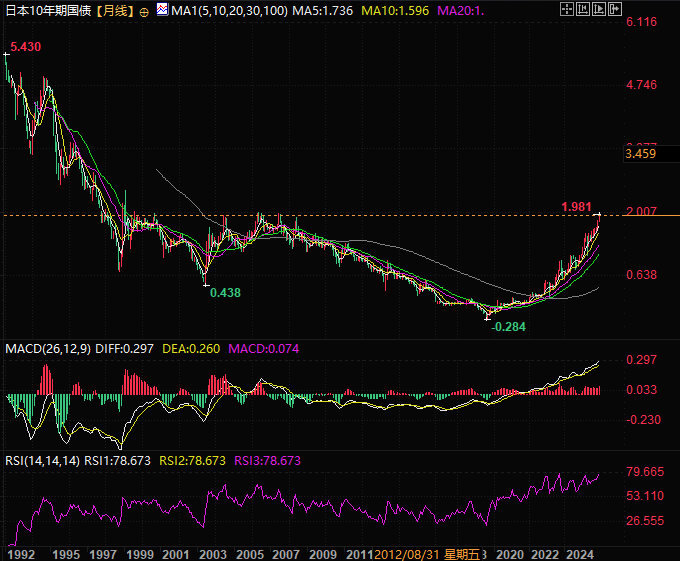
(Monthly chart of Japanese 10-year government bond yield)
The dramatic fluctuations in the Japanese bond market are intricately linked to the yen exchange rate and global carry trades.
In recent months, the interest rate differential between the US and Japan has narrowed significantly—Japanese domestic interest rates have risen sharply, while US interest rates have remained range-bound for the past few years, yet the USD/JPY exchange rate has continued to rise.
This divergence contradicts the conventional logic that "narrowing interest rate differentials should drive the yen higher," sending a contradictory market signal.
There are multiple interpretations of this divergence in the market: First, the Japanese government's spending increase plan has triggered investor concerns, causing domestic interest rates to weaken in tandem with the yen, which also makes the Bank of Japan's decision to raise interest rates all the more important.
Secondly, the foreign exchange market expects the yield on the full curve of US Treasury bonds to start rising, while Japanese interest rates are expected to enter a stabilization phase. This logic provides reasonable support for the divergence phenomenon.
But the more fundamental reason is that the attractiveness of dollar-denominated assets has not diminished, and Japanese investors continue to flock to US stocks, becoming a key force supporting the strengthening of the dollar and the weakening of the yen.
From a funding perspective, the cost of dollar funding, measured by the 5-year USD/JPY cross-currency basis swap, has fallen from a deep negative range to a slightly negative range, meaning that the current cost of borrowing dollars is lower than that of the same period last year.
The changes in financing costs are highly correlated with the S&P 500 index (and consequently Nvidia's stock price) – when Nvidia's stock price hits a high point and the S&P 500 index stagnates, the narrowing trend of the 5-year USD/JPY cross-currency basis swap also ends simultaneously.
This phenomenon indicates that investors are currently more focused on the returns of US stocks than on interest rate differentials, which also explains why the USD/JPY exchange rate continues to rise even as interest rate differentials narrow: investors continue to convert yen into dollars without taking any hedging measures.
However, this also means that once the market believes that US stock yields are starting to decline or feels a risk, the yen will appreciate rapidly, creating opportunities for hedging and currency repatriation, as seen in the recent market.
As mentioned above, the market divergence is unlikely to continue. With the recent release of the annual reports of Oracle and Broadcom, leading US tech stocks, they have been questioned from various angles, and US tech stocks have recently seen a significant correction.
Meanwhile, the 5-year forward exchange rate of the yen shows that even at the current level, the yen has depreciated excessively compared to the reasonable valuation implied by the forward exchange rate, suggesting that the weakness of the yen is difficult to sustain in the long term, and that the current depreciation of the yen is not directly driven by interest rate factors.
If the Bank of Japan raises interest rates as expected and releases further tightening policy guidance, it will mark the start of a yen appreciation cycle. This could not only directly end the current exchange rate divergence, but also further exacerbate the unwinding of yen carry trades globally. This would cut off high-risk funds seeking high market returns, and could potentially join the AI bubble narrative in besieging global risk assets.
The USD/JPY pair has formed a small head and shoulders pattern, with the moving averages starting to turn downwards. The fact that the price is trading below all short-term moving averages indicates a bearish bias. Support is currently at the lower channel line, while resistance is at the 5, 10, 20, and 30-day moving averages.

(USD/JPY daily chart, source: FX678)
At 16:06 Beijing time, the USD/JPY exchange rate is currently at 155.20/21.
The 2% level has been the iconic upper limit of Japanese government bond yields for the past 25 years. The recent surge in yields sends a clear signal to the market that Japan's "lost decades" of deflationary cycle is coming to an end. Since the bursting of Japan's "bubble economy" in the 1990s, the 10-year Japanese government bond yield has only briefly risen to 2.005% on May 10, 2006, and has remained below that level for the rest of the time.
The Bank of Japan is expected to raise interest rates for the first time in nearly 11 months, narrowing the interest rate differential between the US and Japan. Meanwhile, the yield on 10-year Japanese government bonds recently hit an 18-year high of 1.97%. The rise in yen bond yields may continue to trigger the unwinding of yen carry trades, leading to a sell-off of dollar-denominated assets and threatening the prices of risky assets. Forward exchange rates have already released a clear signal of the potential future appreciation of the yen.
The current strong rise in Japanese government bond yields is driven by two core expectations.
On the one hand, the market generally expects the Bank of Japan to raise interest rates for the first time in nearly 11 months at its monetary policy meeting to be held on December 18-19, officially restarting the monetary tightening cycle;
On the other hand, the Japanese government plans to launch an economic stimulus package of 21.3 trillion yen (approximately US$136.9 billion), which is the largest fiscal expansion measure since the pandemic. Investors are worried that in order to cover funding needs, the scale of government bond issuance will be greatly expanded, thereby pushing up yields.
Paradoxically, the policy combination of monetary tightening and fiscal expansion is becoming increasingly urgent in Japan today—the inflationary pressures from rising food and energy prices are particularly unfamiliar to a generation of Japanese who experienced seven consecutive years of deflation since 1999.
Even with the massive monetary and fiscal stimulus introduced by "Abenomics" in 2013, the Japanese economy showed little sign of recovery for many years afterward.
With both inflation and business confidence improving, the reflation cycle is accelerating.
Currently, both Japanese inflation data and business confidence indicators are showing a positive turn: economists expect core inflation to remain at 3% year-on-year in November, significantly exceeding the Bank of Japan's 2% inflation target; the Bank of Japan's quarterly Tankan survey shows that the confidence index of large manufacturers has reached a four-year high.
"The 10-year Treasury yield entering the 2%-3% range is highly symbolic and constitutes a substantial benefit to corporate operations."
Yuichi Senguchi, chief investment strategist at BlackRock Japan, emphasized, "After 30 years of deflation, we are now at a critical stage of transitioning to a reflationary environment."
He further judged that 2% would soon transform from a long-term upper limit of suppression into a bottom support level for Japanese government bond yields, and could potentially rise further to around 3% in the future.
It is worth mentioning that Yuichi Senguchi recalled the market situation when he was a bond fund manager in 1997. At that time, his predecessors generally believed that "the yield on 10-year Japanese government bonds would never fall below 2.5%", but now most bond traders find it hard to imagine a scenario where the yield is stable at 2%, highlighting the profound change in the market landscape.
(Monthly chart of Japanese 10-year government bond yield)
An Exploration of the Reasons for the Divergence Between Japanese Bonds and the Yen Exchange Rate
The dramatic fluctuations in the Japanese bond market are intricately linked to the yen exchange rate and global carry trades.
In recent months, the interest rate differential between the US and Japan has narrowed significantly—Japanese domestic interest rates have risen sharply, while US interest rates have remained range-bound for the past few years, yet the USD/JPY exchange rate has continued to rise.
This divergence contradicts the conventional logic that "narrowing interest rate differentials should drive the yen higher," sending a contradictory market signal.
There are multiple interpretations of this divergence in the market: First, the Japanese government's spending increase plan has triggered investor concerns, causing domestic interest rates to weaken in tandem with the yen, which also makes the Bank of Japan's decision to raise interest rates all the more important.
Secondly, the foreign exchange market expects the yield on the full curve of US Treasury bonds to start rising, while Japanese interest rates are expected to enter a stabilization phase. This logic provides reasonable support for the divergence phenomenon.
But the more fundamental reason is that the attractiveness of dollar-denominated assets has not diminished, and Japanese investors continue to flock to US stocks, becoming a key force supporting the strengthening of the dollar and the weakening of the yen.
From a funding perspective, the cost of dollar funding, measured by the 5-year USD/JPY cross-currency basis swap, has fallen from a deep negative range to a slightly negative range, meaning that the current cost of borrowing dollars is lower than that of the same period last year.
The changes in financing costs are highly correlated with the S&P 500 index (and consequently Nvidia's stock price) – when Nvidia's stock price hits a high point and the S&P 500 index stagnates, the narrowing trend of the 5-year USD/JPY cross-currency basis swap also ends simultaneously.
This phenomenon indicates that investors are currently more focused on the returns of US stocks than on interest rate differentials, which also explains why the USD/JPY exchange rate continues to rise even as interest rate differentials narrow: investors continue to convert yen into dollars without taking any hedging measures.
However, this also means that once the market believes that US stock yields are starting to decline or feels a risk, the yen will appreciate rapidly, creating opportunities for hedging and currency repatriation, as seen in the recent market.
Yen Outlook: Yen appreciation and increased risk of carry trade unwinding
As mentioned above, the market divergence is unlikely to continue. With the recent release of the annual reports of Oracle and Broadcom, leading US tech stocks, they have been questioned from various angles, and US tech stocks have recently seen a significant correction.
Meanwhile, the 5-year forward exchange rate of the yen shows that even at the current level, the yen has depreciated excessively compared to the reasonable valuation implied by the forward exchange rate, suggesting that the weakness of the yen is difficult to sustain in the long term, and that the current depreciation of the yen is not directly driven by interest rate factors.
If the Bank of Japan raises interest rates as expected and releases further tightening policy guidance, it will mark the start of a yen appreciation cycle. This could not only directly end the current exchange rate divergence, but also further exacerbate the unwinding of yen carry trades globally. This would cut off high-risk funds seeking high market returns, and could potentially join the AI bubble narrative in besieging global risk assets.
Technical Analysis:
The USD/JPY pair has formed a small head and shoulders pattern, with the moving averages starting to turn downwards. The fact that the price is trading below all short-term moving averages indicates a bearish bias. Support is currently at the lower channel line, while resistance is at the 5, 10, 20, and 30-day moving averages.
(USD/JPY daily chart, source: FX678)
At 16:06 Beijing time, the USD/JPY exchange rate is currently at 155.20/21.
- Risk Warning and Disclaimer
- The market involves risk, and trading may not be suitable for all investors. This article is for reference only and does not constitute personal investment advice, nor does it take into account certain users’ specific investment objectives, financial situation, or other needs. Any investment decisions made based on this information are at your own risk.