Stop focusing solely on the Federal Reserve! The real eye of the storm is quietly brewing in the Eurozone.
2025-12-15 19:52:40
Monday, December 15th. The euro continued its rebound against the dollar during Monday's European trading session, trading around 1.1745, just shy of its previous multi-month high of 1.1762. Market focus is gradually shifting from expectations of easing US monetary policy to the prospect of a possible adjustment in the European Central Bank's policy stance.

A series of recent data releases from the Eurozone have injected positive signals into the market. Data released by Eurostat on Monday showed that Eurozone industrial production rose 0.8% month-on-month in November, a significant increase from 0.2% in October and also higher than the market's previous expectation of a 0.1% increase. On a year-on-year basis, industrial output growth climbed to 2% from 1.2% in October, indicating that the Eurozone's manufacturing sector is gradually recovering. This data not only broke through previous pessimistic market expectations for the European economic outlook but also provided data support for the European Central Bank to maintain a hawkish stance at its monetary policy meeting this Thursday.
Of particular note are the recent public statements by European Central Bank (ECB) officials, which clearly signal a policy shift. Executive Board member Schnabel's previous remarks confirmed a key market assessment: the ECB's rate-cutting cycle may have ended, and the next policy adjustment is more likely to be a rate hike than a rate cut. Although the ECB Governing Council has not yet explicitly included a rate hike as a formal topic of discussion, various indicators suggest that Thursday's meeting will likely take an optimistic view of the Eurozone's economic growth prospects. ECB President Lagarde's remarks last week effectively hinted that the central bank would raise its economic growth forecast at this week's meeting. The market widely expects that the Purchasing Managers' Index (PMI) data to be released this week will also confirm the Eurozone economy's better-than-expected resilience, further solidifying the ECB's hawkish stance.
In stark contrast, monetary policy expectations across the Atlantic are evolving in the opposite direction. The market currently widely anticipates the Federal Reserve will cut interest rates at least once in 2026, and discussions surrounding a leadership change at the Fed continue to influence the dollar's trajectory. Reports last Friday indicated that former Fed Governor Warsh is considered a strong candidate to succeed current Chairman Powell, and White House economist Hassett is also on the shortlist. This potential personnel change adds further uncertainty to the dollar's outlook. From an interest rate differential perspective, the gap between short-term interest rates in Europe and the US is narrowing rapidly, a structural change that provides significant support for the euro's medium-term performance. Simultaneously, the attractiveness of Eurozone assets as an alternative to dollar assets is gradually increasing, and the trend of capital rebalancing is also providing continued support for the euro.
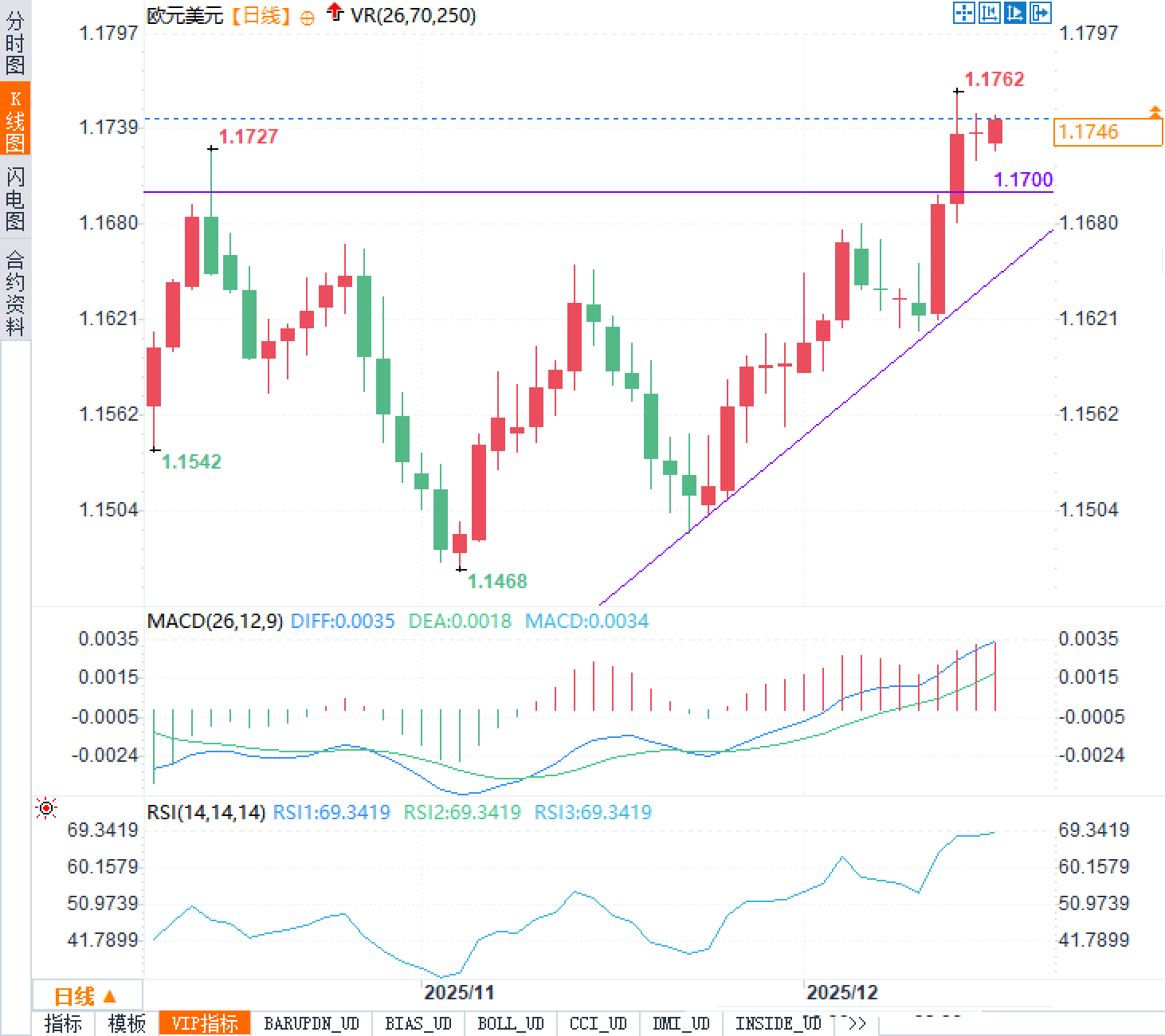
The euro has risen nearly 2% against the dollar over the past three weeks, but Monday's price action showed signs of consolidation at higher levels, remaining within Friday's trading range. Technically, the exchange rate found effective support around 1.1700, while the multi-month high of 1.1762 forms a key resistance level in the near term. The MACD indicator on the daily chart shows that bullish momentum continues, with both the DIFF and DEA values above the zero line and the histogram remaining positive, indicating a continued bullish short-term trend. The RSI reading is close to 69; although it hasn't entered overbought territory, it shows some signs of being at high levels, suggesting that the exchange rate may need to undergo a technical consolidation process before further upward movement.
Market traders are currently exhibiting a clear wait-and-see attitude, primarily due to the numerous macroeconomic events scheduled for this week. Tuesday will see the delayed release of the US October and November non-farm payrolls report, while Thursday will bring the US November consumer price index and the European Central Bank's monetary policy decision. Investors are generally unwilling to take on excessive directional risk before these key data releases and events. Furthermore, the New York Fed's manufacturing index is expected to decline from 18.7 in November to 10.6 in December, reflecting the market's assessment that the US manufacturing sector may be showing signs of marginal weakening.
The current strength of the euro against the dollar reflects the combined effect of multiple factors. First, the most significant driving force is the expectation of a divergence in monetary policy between the US and Europe. While European Central Bank officials have clearly hinted that the rate-cutting cycle has ended and the next step may be a rate hike, the Federal Reserve faces increasing pressure to cut rates. This divergence in policy prospects directly drives changes in interest rate expectations, thus supporting the euro's strength. Second, the continued improvement in Eurozone economic data provides fundamental support for the ECB's hawkish stance. Better-than-expected industrial production data indicates that the Eurozone economy remains quite resilient despite numerous challenges. Third, expectations of a change in Federal Reserve leadership have weakened the dollar's appeal to some extent, especially considering market concerns about the future independence of monetary policy.
Several key events this week will significantly impact the short-term movement of the euro against the dollar. The performance of the US non-farm payroll data will directly influence market expectations regarding the pace of Federal Reserve rate cuts. If the data shows a clear cooling in the labor market, it could further strengthen expectations of Fed easing, thus putting pressure on the dollar. The European Central Bank's policy meeting is another crucial juncture. The market will closely watch Lagarde's assessment of the economic outlook and her wording regarding future policy direction at the press conference. If the central bank raises its growth forecast as expected and maintains a hawkish tone, the euro may gain further upward momentum. Speeches by Fed officials such as Williams are also worth noting, as their comments may provide the market with more clues about the direction of US monetary policy.
A series of recent data releases from the Eurozone have injected positive signals into the market. Data released by Eurostat on Monday showed that Eurozone industrial production rose 0.8% month-on-month in November, a significant increase from 0.2% in October and also higher than the market's previous expectation of a 0.1% increase. On a year-on-year basis, industrial output growth climbed to 2% from 1.2% in October, indicating that the Eurozone's manufacturing sector is gradually recovering. This data not only broke through previous pessimistic market expectations for the European economic outlook but also provided data support for the European Central Bank to maintain a hawkish stance at its monetary policy meeting this Thursday.
Of particular note are the recent public statements by European Central Bank (ECB) officials, which clearly signal a policy shift. Executive Board member Schnabel's previous remarks confirmed a key market assessment: the ECB's rate-cutting cycle may have ended, and the next policy adjustment is more likely to be a rate hike than a rate cut. Although the ECB Governing Council has not yet explicitly included a rate hike as a formal topic of discussion, various indicators suggest that Thursday's meeting will likely take an optimistic view of the Eurozone's economic growth prospects. ECB President Lagarde's remarks last week effectively hinted that the central bank would raise its economic growth forecast at this week's meeting. The market widely expects that the Purchasing Managers' Index (PMI) data to be released this week will also confirm the Eurozone economy's better-than-expected resilience, further solidifying the ECB's hawkish stance.
In stark contrast, monetary policy expectations across the Atlantic are evolving in the opposite direction. The market currently widely anticipates the Federal Reserve will cut interest rates at least once in 2026, and discussions surrounding a leadership change at the Fed continue to influence the dollar's trajectory. Reports last Friday indicated that former Fed Governor Warsh is considered a strong candidate to succeed current Chairman Powell, and White House economist Hassett is also on the shortlist. This potential personnel change adds further uncertainty to the dollar's outlook. From an interest rate differential perspective, the gap between short-term interest rates in Europe and the US is narrowing rapidly, a structural change that provides significant support for the euro's medium-term performance. Simultaneously, the attractiveness of Eurozone assets as an alternative to dollar assets is gradually increasing, and the trend of capital rebalancing is also providing continued support for the euro.
Market performance
The euro has risen nearly 2% against the dollar over the past three weeks, but Monday's price action showed signs of consolidation at higher levels, remaining within Friday's trading range. Technically, the exchange rate found effective support around 1.1700, while the multi-month high of 1.1762 forms a key resistance level in the near term. The MACD indicator on the daily chart shows that bullish momentum continues, with both the DIFF and DEA values above the zero line and the histogram remaining positive, indicating a continued bullish short-term trend. The RSI reading is close to 69; although it hasn't entered overbought territory, it shows some signs of being at high levels, suggesting that the exchange rate may need to undergo a technical consolidation process before further upward movement.
Market traders are currently exhibiting a clear wait-and-see attitude, primarily due to the numerous macroeconomic events scheduled for this week. Tuesday will see the delayed release of the US October and November non-farm payrolls report, while Thursday will bring the US November consumer price index and the European Central Bank's monetary policy decision. Investors are generally unwilling to take on excessive directional risk before these key data releases and events. Furthermore, the New York Fed's manufacturing index is expected to decline from 18.7 in November to 10.6 in December, reflecting the market's assessment that the US manufacturing sector may be showing signs of marginal weakening.
The current strength of the euro against the dollar reflects the combined effect of multiple factors. First, the most significant driving force is the expectation of a divergence in monetary policy between the US and Europe. While European Central Bank officials have clearly hinted that the rate-cutting cycle has ended and the next step may be a rate hike, the Federal Reserve faces increasing pressure to cut rates. This divergence in policy prospects directly drives changes in interest rate expectations, thus supporting the euro's strength. Second, the continued improvement in Eurozone economic data provides fundamental support for the ECB's hawkish stance. Better-than-expected industrial production data indicates that the Eurozone economy remains quite resilient despite numerous challenges. Third, expectations of a change in Federal Reserve leadership have weakened the dollar's appeal to some extent, especially considering market concerns about the future independence of monetary policy.
Looking ahead
Several key events this week will significantly impact the short-term movement of the euro against the dollar. The performance of the US non-farm payroll data will directly influence market expectations regarding the pace of Federal Reserve rate cuts. If the data shows a clear cooling in the labor market, it could further strengthen expectations of Fed easing, thus putting pressure on the dollar. The European Central Bank's policy meeting is another crucial juncture. The market will closely watch Lagarde's assessment of the economic outlook and her wording regarding future policy direction at the press conference. If the central bank raises its growth forecast as expected and maintains a hawkish tone, the euro may gain further upward momentum. Speeches by Fed officials such as Williams are also worth noting, as their comments may provide the market with more clues about the direction of US monetary policy.
- Risk Warning and Disclaimer
- The market involves risk, and trading may not be suitable for all investors. This article is for reference only and does not constitute personal investment advice, nor does it take into account certain users’ specific investment objectives, financial situation, or other needs. Any investment decisions made based on this information are at your own risk.