Warning of 45,000 job losses! The Fed's worst fears are coming true; is the dollar about to collapse?
2025-12-15 21:29:30
Monday, December 15th. The market is currently at a crucial juncture in year-end trading, with traders digesting the results of last week's Federal Reserve interest rate meeting while closely watching upcoming key economic data releases. The US dollar index is currently trading around 98.25 in North American trading, a significant pullback from its previous high of 100.39, exhibiting an overall defensive trend.
This week, the market will see the release of the November non-farm payrolls report, delayed due to the government shutdown, as well as key data such as the Consumer Price Index. This information will provide a clearer picture of the economic fundamentals. With the Federal Reserve's policy path facing reassessment, whether the dollar can hold its current level or move further towards the lower end of its range since June is the core issue of market focus.
Dynamic changes in the US labor market are becoming a key factor influencing the dollar's trajectory. Market expectations are that Tuesday's employment data will present a complex picture. Due to the impact of the previous government shutdown, the Bureau of Labor Statistics will release both the November employment report and the October business survey data (including non-farm payrolls and average hourly earnings), but the October household survey (including the unemployment rate) will not be released as scheduled due to data collection issues. Institutional forecasts indicate that October non-farm payrolls may have decreased by approximately 60,000, but this figure may exaggerate the extent of the slowdown in the job market. October was the first month that employees participating in the federal government's extended furlough program left the payroll, and coupled with the ongoing federal hiring freeze, federal government employment is expected to decline by approximately 125,000. It is worth noting that the government shutdown itself does not affect federal employment data, as furloughed employees ultimately received back pay for the survey reference period.
The November data will provide a more timely and complete picture of the labor market. Institutions predict non-farm payrolls will increase by approximately 45,000, and the unemployment rate may rise slightly to a cyclical high of 4.5%. If this expectation materializes, it will further indicate that the Fed's "full employment" goal, part of its dual mandate, is facing challenges. This assessment echoes Fed Chairman Powell's remarks at last week's press conference—he downplayed inflation risks and instead emphasized signs of weakness in the labor market, showing that the Fed's tolerance for weak employment is lower than its tolerance for high inflation.
From an interest rate expectation perspective, the Federal Reserve cut interest rates by 25 basis points as expected last week, while simultaneously signaling a higher threshold for further rate cuts. However, Powell's remarks were interpreted by the market as relatively dovish, contrasting with the previously anticipated neutral stance. Current market pricing indicates that the Fed will have cumulatively cut rates by approximately 57 basis points by the end of 2026. This week's employment and inflation data will significantly impact this expectation: strong data, particularly regarding the labor market, could trigger a hawkish repricing of the monetary policy path, thus supporting the dollar; conversely, weak data could lead the market to pre-emptively bet on rate cuts, further pressuring the dollar.
This week, the market will also be closely watching speeches by Federal Reserve officials. New York Fed President Williams, a key figure in policymaking, was particularly noteworthy for his dovish remarks on November 21, which reignited market expectations for a December rate cut. Furthermore, discussions about potential personnel changes within the Fed continue to unfold, with the market assessing the potential impact of possible leadership shifts on future monetary policy.
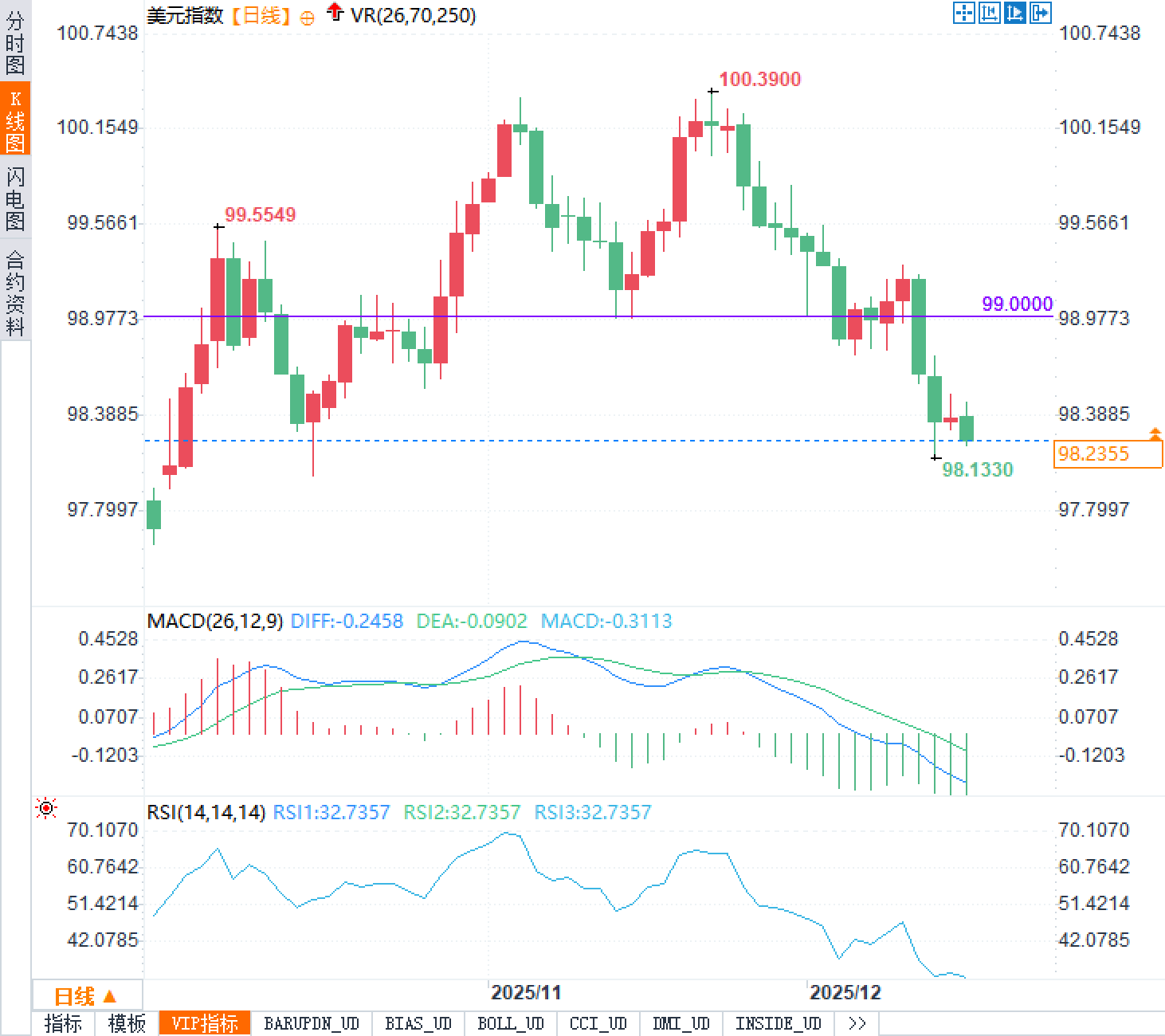
The US dollar index has continued to weaken since the Federal Reserve's decision last week, generally exhibiting a defensive stance against major currencies. Technically, the dollar index has fallen from its high of 100.39 reached in early November to around 98.23, a drop of more than two percentage points. Looking at the daily chart, the price has broken below the psychological level of 99 and the important support level of 98.97, and is currently testing the previous low support around 98.13. The MACD indicator shows a DIFF value of -0.2458 and a DEA value of -0.0902, with the histogram continuing to run below the zero line, indicating weak short-term momentum. The RSI indicator reading has fallen to around 32.73, approaching oversold territory, but no clear bullish divergence signal has yet formed.
From the perspective of market logic evolution, the core driver of the current dollar's performance is shifting from a simple carry trade logic to a more complex fundamental game. On the one hand, the Federal Reserve has begun a rate-cutting cycle, and the interest rate advantage of the United States relative to other major economies is narrowing; on the other hand, the market is reassessing the relative strength of the US economy, especially whether the labor market can remain resilient. If this week's employment data confirms the assessment of a continued cooling labor market, the market may further lower its confidence in a soft landing for the US economy, thereby exacerbating selling pressure on the dollar.
Market focus will be on the following areas: First, Tuesday's jobs report, which, delayed due to the government shutdown, will provide the market with the latest evidence on the state of the labor market; second, the Consumer Price Index (CPI), which will help the market determine whether the decline in inflation is in line with expectations; and third, speeches by Federal Reserve officials, especially key figures such as New York Fed President Williams, which may influence market expectations for the policy path in 2025.
From a technical perspective, if the US dollar index breaks below the previous low of 98.13, it could open up further downside potential to the lower end of the range established since June. However, considering that the RSI indicator is approaching oversold territory and the year-end liquidity slump could lead to a technical rebound, market uncertainty has increased. It's worth noting that if this week's economic data is stronger than expected, the US dollar may see a short-term rebound.
This week, the market will see the release of the November non-farm payrolls report, delayed due to the government shutdown, as well as key data such as the Consumer Price Index. This information will provide a clearer picture of the economic fundamentals. With the Federal Reserve's policy path facing reassessment, whether the dollar can hold its current level or move further towards the lower end of its range since June is the core issue of market focus.
Dynamic changes in the US labor market are becoming a key factor influencing the dollar's trajectory. Market expectations are that Tuesday's employment data will present a complex picture. Due to the impact of the previous government shutdown, the Bureau of Labor Statistics will release both the November employment report and the October business survey data (including non-farm payrolls and average hourly earnings), but the October household survey (including the unemployment rate) will not be released as scheduled due to data collection issues. Institutional forecasts indicate that October non-farm payrolls may have decreased by approximately 60,000, but this figure may exaggerate the extent of the slowdown in the job market. October was the first month that employees participating in the federal government's extended furlough program left the payroll, and coupled with the ongoing federal hiring freeze, federal government employment is expected to decline by approximately 125,000. It is worth noting that the government shutdown itself does not affect federal employment data, as furloughed employees ultimately received back pay for the survey reference period.
The November data will provide a more timely and complete picture of the labor market. Institutions predict non-farm payrolls will increase by approximately 45,000, and the unemployment rate may rise slightly to a cyclical high of 4.5%. If this expectation materializes, it will further indicate that the Fed's "full employment" goal, part of its dual mandate, is facing challenges. This assessment echoes Fed Chairman Powell's remarks at last week's press conference—he downplayed inflation risks and instead emphasized signs of weakness in the labor market, showing that the Fed's tolerance for weak employment is lower than its tolerance for high inflation.
From an interest rate expectation perspective, the Federal Reserve cut interest rates by 25 basis points as expected last week, while simultaneously signaling a higher threshold for further rate cuts. However, Powell's remarks were interpreted by the market as relatively dovish, contrasting with the previously anticipated neutral stance. Current market pricing indicates that the Fed will have cumulatively cut rates by approximately 57 basis points by the end of 2026. This week's employment and inflation data will significantly impact this expectation: strong data, particularly regarding the labor market, could trigger a hawkish repricing of the monetary policy path, thus supporting the dollar; conversely, weak data could lead the market to pre-emptively bet on rate cuts, further pressuring the dollar.
This week, the market will also be closely watching speeches by Federal Reserve officials. New York Fed President Williams, a key figure in policymaking, was particularly noteworthy for his dovish remarks on November 21, which reignited market expectations for a December rate cut. Furthermore, discussions about potential personnel changes within the Fed continue to unfold, with the market assessing the potential impact of possible leadership shifts on future monetary policy.
Market performance
The US dollar index has continued to weaken since the Federal Reserve's decision last week, generally exhibiting a defensive stance against major currencies. Technically, the dollar index has fallen from its high of 100.39 reached in early November to around 98.23, a drop of more than two percentage points. Looking at the daily chart, the price has broken below the psychological level of 99 and the important support level of 98.97, and is currently testing the previous low support around 98.13. The MACD indicator shows a DIFF value of -0.2458 and a DEA value of -0.0902, with the histogram continuing to run below the zero line, indicating weak short-term momentum. The RSI indicator reading has fallen to around 32.73, approaching oversold territory, but no clear bullish divergence signal has yet formed.
From the perspective of market logic evolution, the core driver of the current dollar's performance is shifting from a simple carry trade logic to a more complex fundamental game. On the one hand, the Federal Reserve has begun a rate-cutting cycle, and the interest rate advantage of the United States relative to other major economies is narrowing; on the other hand, the market is reassessing the relative strength of the US economy, especially whether the labor market can remain resilient. If this week's employment data confirms the assessment of a continued cooling labor market, the market may further lower its confidence in a soft landing for the US economy, thereby exacerbating selling pressure on the dollar.
Looking ahead to the near future
Market focus will be on the following areas: First, Tuesday's jobs report, which, delayed due to the government shutdown, will provide the market with the latest evidence on the state of the labor market; second, the Consumer Price Index (CPI), which will help the market determine whether the decline in inflation is in line with expectations; and third, speeches by Federal Reserve officials, especially key figures such as New York Fed President Williams, which may influence market expectations for the policy path in 2025.
From a technical perspective, if the US dollar index breaks below the previous low of 98.13, it could open up further downside potential to the lower end of the range established since June. However, considering that the RSI indicator is approaching oversold territory and the year-end liquidity slump could lead to a technical rebound, market uncertainty has increased. It's worth noting that if this week's economic data is stronger than expected, the US dollar may see a short-term rebound.
- Risk Warning and Disclaimer
- The market involves risk, and trading may not be suitable for all investors. This article is for reference only and does not constitute personal investment advice, nor does it take into account certain users’ specific investment objectives, financial situation, or other needs. Any investment decisions made based on this information are at your own risk.