Fed Chair Walter's dovish comments weakened the dollar.
2025-12-18 19:52:56
Christopher Waller's dovish comments halted the euro's bearish run against the dollar in the foreign exchange market. Slower inflation in the UK pressured the pound lower, while the Bank of Japan is preparing to raise interest rates.

Christopher Waller's remarks have an impact on the dollar's trajectory no less significant than US labor market data. The US unemployment rate climbed to 4.6%, and the three-month average of private sector job growth surged from 13,000 in the summer to 75,000 in the fall—a series of data points that forced investors to adjust their expectations. They began to believe that the Federal Reserve would maintain current interest rates for an extended period and would lower the federal funds rate to 3.75% by 2026. However, this senior official of the Federal Open Market Committee (FOMC) holds a different view.
Waller is one of the candidates for the position of Federal Reserve Chair. He believes the neutral interest rate should be 2.75%, 100 basis points lower than the current rate, a figure significantly lower than futures market forecasts. Once real interest rates fall to this level, US Treasury yields will decline accordingly, and the dollar index will suffer a sharp drop.
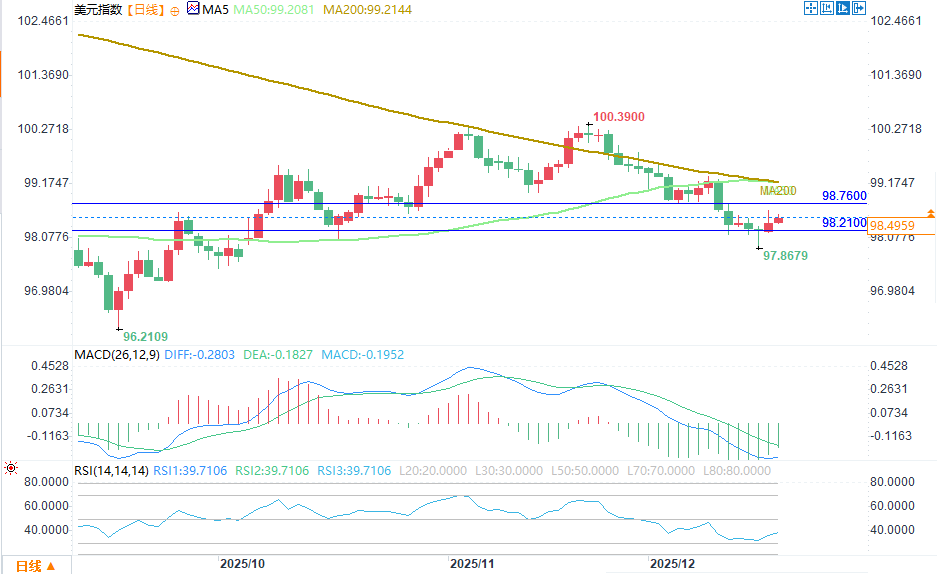
(US Dollar Index Daily Chart Source: FX678)
Furthermore, the futures market generally believes that the European Central Bank's monetary tightening cycle is nearing its end. However, puzzlingly, investors are already pricing in expectations of deposit rate hikes—such bets typically only occur when the risk of accelerating inflation rises or monetary policy becomes overly loose. Neither of these scenarios currently applies in the Eurozone. It is premature to assert that the euro has found a new trump card for appreciation against the dollar.
Conversely, weak sentiment in the Eurozone's manufacturing and service sectors, coupled with a poor performance in Germany's IFO Business Climate Index, disappointed hawkish officials at the European Central Bank and put downward pressure on the euro's exchange rate. The current valuation of the euro already shows clear signs of being overvalued.
Japan faces a completely different predicament. For the Japanese government, which is currently battling inflation, the yen is significantly undervalued. Therefore, Prime Minister Sanae Takaichi is unlikely to obstruct the Bank of Japan's interest rate hike plans. Investors are closely watching signals from Bank of Japan Governor Kazuo Ueda to gauge the central bank's policy direction in 2026. The market widely expects the Bank of Japan to normalize monetary policy at an extremely slow pace. This expectation has provided support for the USD/JPY bulls.
The UK's inflation rate fell to 3.2% in November from 3.6%, a figure that directly triggered a sharp drop in the pound. The futures market expects the Bank of England to cut its benchmark interest rate by 50 basis points to 3.5% by April next year. Investors generally doubt that the Bank of England will release a hawkish signal at its December policy meeting, instead expecting Governor Andrew Bailey to hint that the monetary easing cycle will continue.
Christopher Waller's remarks have an impact on the dollar's trajectory no less significant than US labor market data. The US unemployment rate climbed to 4.6%, and the three-month average of private sector job growth surged from 13,000 in the summer to 75,000 in the fall—a series of data points that forced investors to adjust their expectations. They began to believe that the Federal Reserve would maintain current interest rates for an extended period and would lower the federal funds rate to 3.75% by 2026. However, this senior official of the Federal Open Market Committee (FOMC) holds a different view.
Waller is one of the candidates for the position of Federal Reserve Chair. He believes the neutral interest rate should be 2.75%, 100 basis points lower than the current rate, a figure significantly lower than futures market forecasts. Once real interest rates fall to this level, US Treasury yields will decline accordingly, and the dollar index will suffer a sharp drop.
(US Dollar Index Daily Chart Source: FX678)
Furthermore, the futures market generally believes that the European Central Bank's monetary tightening cycle is nearing its end. However, puzzlingly, investors are already pricing in expectations of deposit rate hikes—such bets typically only occur when the risk of accelerating inflation rises or monetary policy becomes overly loose. Neither of these scenarios currently applies in the Eurozone. It is premature to assert that the euro has found a new trump card for appreciation against the dollar.
Conversely, weak sentiment in the Eurozone's manufacturing and service sectors, coupled with a poor performance in Germany's IFO Business Climate Index, disappointed hawkish officials at the European Central Bank and put downward pressure on the euro's exchange rate. The current valuation of the euro already shows clear signs of being overvalued.
Japan faces a completely different predicament. For the Japanese government, which is currently battling inflation, the yen is significantly undervalued. Therefore, Prime Minister Sanae Takaichi is unlikely to obstruct the Bank of Japan's interest rate hike plans. Investors are closely watching signals from Bank of Japan Governor Kazuo Ueda to gauge the central bank's policy direction in 2026. The market widely expects the Bank of Japan to normalize monetary policy at an extremely slow pace. This expectation has provided support for the USD/JPY bulls.
The UK's inflation rate fell to 3.2% in November from 3.6%, a figure that directly triggered a sharp drop in the pound. The futures market expects the Bank of England to cut its benchmark interest rate by 50 basis points to 3.5% by April next year. Investors generally doubt that the Bank of England will release a hawkish signal at its December policy meeting, instead expecting Governor Andrew Bailey to hint that the monetary easing cycle will continue.
- Risk Warning and Disclaimer
- The market involves risk, and trading may not be suitable for all investors. This article is for reference only and does not constitute personal investment advice, nor does it take into account certain users’ specific investment objectives, financial situation, or other needs. Any investment decisions made based on this information are at your own risk.