Crude oil trading alert: Oversupply concerns pressured oil prices lower again; be wary of a potential acceleration in the downward trend.
2026-01-07 09:20:14
International oil prices came under short-term pressure and fell due to news that Venezuela might increase crude oil exports. The WTI crude oil futures contract fell by more than 1.6% at one point during the session and is currently trading around $56.40 per barrel. Brent and WTI futures prices fell in tandem, indicating that the market reacted directly to the new supply.
Market sentiment is more focused on the medium- to long-term supply and demand structure than on short-term event disturbances. Venezuelan crude oil variables: limited in the short term, but with a greater long-term impact. The US has stated that tens of millions of barrels of Venezuelan crude oil will enter the circulation system through market mechanisms in the future, driving the repair and investment of related infrastructure.
This statement reinforced market expectations for a gradual recovery in Venezuelan production. Goldman Sachs analyst Daan Struyven stated that the short-term impact of Venezuelan crude oil on the market remains unclear, but if the sanctions environment improves and infrastructure is gradually repaired, production could continue to rise.

Goldman Sachs expects Venezuelan crude oil production to gradually increase over the next few years under a relatively favorable scenario, which will put downward pressure on the average Brent crude oil price in 2026, with the price center potentially lower than the previous benchmark forecast.
Supply-demand imbalance: The core logic behind the downward pressure on oil prices. From a global perspective, the mismatch between supply and demand is becoming a key factor suppressing oil prices. Morgan Stanley points out that global crude oil demand growth has fallen significantly below historical averages, while supply increases from OPEC and non-OPEC countries continue to expand.
Data shows that demand growth is slowing while supply remains at a high level, which could lead to a significant oversupply in the global crude oil market in early 2026. Some institutions even predict that the potential oversupply in the first half of the year could reach 3 million barrels per day.
Institutional Divergence: Recovery Pace Remains a Key Uncertainty. Despite heightened market concerns, some research institutions remain cautious about the pace of Venezuelan production recovery. Energy analyst Janiv Shah believes that with limited investment, the scale of new production in the next two to three years will be relatively limited, and a full recovery will still depend on long-term international capital investment.
This means that the Venezuelan factor is more likely to put pressure on oil prices in the medium to long term, rather than immediately changing the current supply and demand pattern.
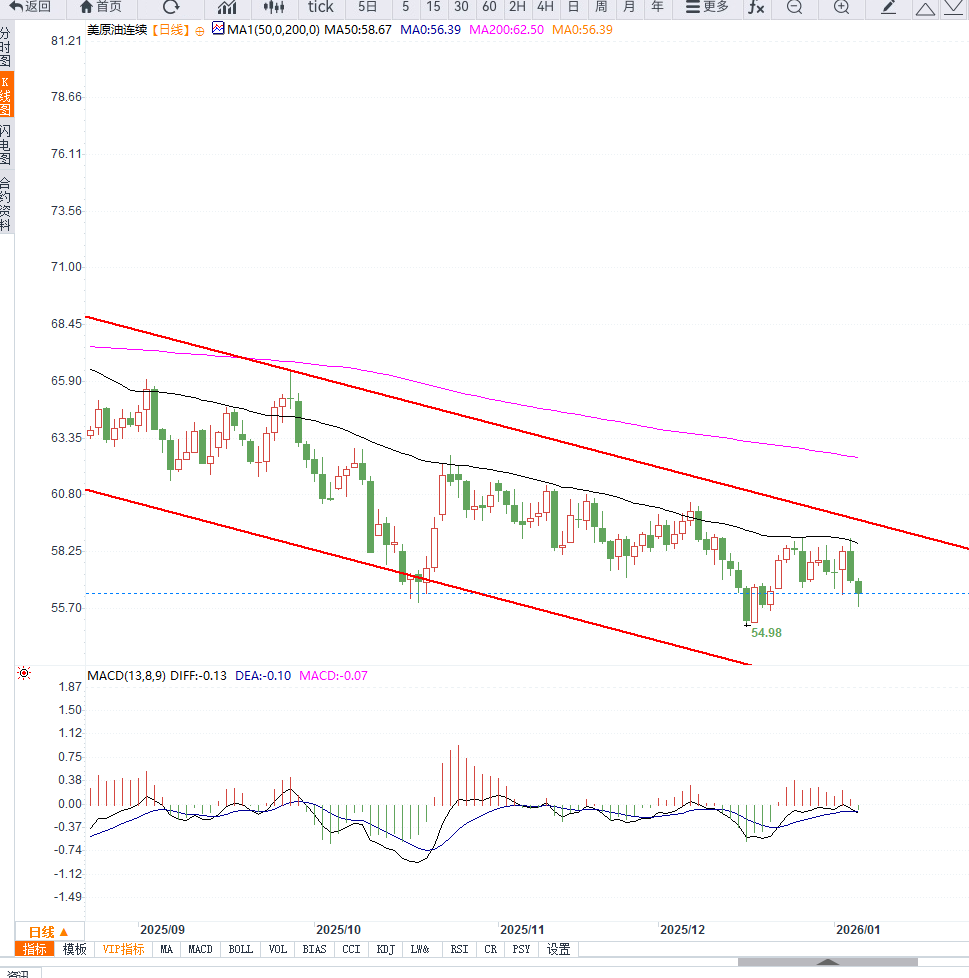
From a technical perspective, US crude oil remains within a downward channel on the daily chart. After its previous rebound was capped at the $60 level, prices have fallen back, indicating that this area has become a clear resistance level.
In terms of moving average structure, the short-term moving average has crossed below the medium-term moving average and continues to diverge downwards, reflecting that the downtrend has not yet reversed. Momentum indicators show that the RSI is still running below 50, and there has been no obvious oversold signal, indicating that the downside potential has not yet been fully released.
If the price falls below the $57 support level, a further drop to the previous low cannot be ruled out; conversely, only by regaining a foothold above $60 can the current weak technical situation be alleviated.
The latest industry data shows a decline in crude oil inventories, but an increase in refined product inventories, a neutral signal. The market generally believes that a single week's inventory change is unlikely to reverse the overall loose supply-demand trend, and investors are more focused on the supply expansion path over the next one to two years.
Editor's Note:
In summary, the current decline in oil prices is not driven by a single event, but rather by a combination of slowing global demand, continued supply expansion, and expectations of new production capacity. The potential return of Venezuelan crude oil prices further reinforces the market's consensus on a medium- to long-term supply easing environment.
Without a significant improvement in demand, international oil prices are likely to remain weak and volatile, and the risk of a downward shift in the price center warrants continued attention.
Market sentiment is more focused on the medium- to long-term supply and demand structure than on short-term event disturbances. Venezuelan crude oil variables: limited in the short term, but with a greater long-term impact. The US has stated that tens of millions of barrels of Venezuelan crude oil will enter the circulation system through market mechanisms in the future, driving the repair and investment of related infrastructure.
This statement reinforced market expectations for a gradual recovery in Venezuelan production. Goldman Sachs analyst Daan Struyven stated that the short-term impact of Venezuelan crude oil on the market remains unclear, but if the sanctions environment improves and infrastructure is gradually repaired, production could continue to rise.
Goldman Sachs expects Venezuelan crude oil production to gradually increase over the next few years under a relatively favorable scenario, which will put downward pressure on the average Brent crude oil price in 2026, with the price center potentially lower than the previous benchmark forecast.
Supply-demand imbalance: The core logic behind the downward pressure on oil prices. From a global perspective, the mismatch between supply and demand is becoming a key factor suppressing oil prices. Morgan Stanley points out that global crude oil demand growth has fallen significantly below historical averages, while supply increases from OPEC and non-OPEC countries continue to expand.
Data shows that demand growth is slowing while supply remains at a high level, which could lead to a significant oversupply in the global crude oil market in early 2026. Some institutions even predict that the potential oversupply in the first half of the year could reach 3 million barrels per day.
Institutional Divergence: Recovery Pace Remains a Key Uncertainty. Despite heightened market concerns, some research institutions remain cautious about the pace of Venezuelan production recovery. Energy analyst Janiv Shah believes that with limited investment, the scale of new production in the next two to three years will be relatively limited, and a full recovery will still depend on long-term international capital investment.
This means that the Venezuelan factor is more likely to put pressure on oil prices in the medium to long term, rather than immediately changing the current supply and demand pattern.
From a technical perspective, US crude oil remains within a downward channel on the daily chart. After its previous rebound was capped at the $60 level, prices have fallen back, indicating that this area has become a clear resistance level.
In terms of moving average structure, the short-term moving average has crossed below the medium-term moving average and continues to diverge downwards, reflecting that the downtrend has not yet reversed. Momentum indicators show that the RSI is still running below 50, and there has been no obvious oversold signal, indicating that the downside potential has not yet been fully released.
If the price falls below the $57 support level, a further drop to the previous low cannot be ruled out; conversely, only by regaining a foothold above $60 can the current weak technical situation be alleviated.
The latest industry data shows a decline in crude oil inventories, but an increase in refined product inventories, a neutral signal. The market generally believes that a single week's inventory change is unlikely to reverse the overall loose supply-demand trend, and investors are more focused on the supply expansion path over the next one to two years.
Editor's Note:
In summary, the current decline in oil prices is not driven by a single event, but rather by a combination of slowing global demand, continued supply expansion, and expectations of new production capacity. The potential return of Venezuelan crude oil prices further reinforces the market's consensus on a medium- to long-term supply easing environment.
Without a significant improvement in demand, international oil prices are likely to remain weak and volatile, and the risk of a downward shift in the price center warrants continued attention.
- Risk Warning and Disclaimer
- The market involves risk, and trading may not be suitable for all investors. This article is for reference only and does not constitute personal investment advice, nor does it take into account certain users’ specific investment objectives, financial situation, or other needs. Any investment decisions made based on this information are at your own risk.