Gold Trading Alert: Gold Prices Plunge Nearly 1% from Highs! Amid Trump's oil spree and geopolitical turmoil, is this a top or a new beginning?
2026-01-08 07:45:41
At the start of 2026, the gold market experienced significant volatility. On Thursday (January 8th) in early Asian trading, spot gold saw a slight upward trend, currently trading around $4460 per ounce. On Wednesday (January 7th), spot gold plunged over 1.6%, hitting a low of $4423.49 per ounce, before ultimately closing down 0.9% at around $4456.32, while US gold futures also fell 0.7%. This correction, seemingly sudden, actually reflects a complex interplay of forces: profit-taking by investors, weak US employment data, escalating geopolitical tensions, and the People's Bank of China's continued gold hoarding. As the eternal king of safe-haven assets, is gold's movement in this turbulent environment merely a short-term adjustment, or is it poised for a new round of upward movement? Let's delve into this dramatic gold market development.

The recent decline in the gold market was primarily driven by profit-taking after a significant recent surge. David Meger, head of metals trading at Gaoling Futures, stated that this was a typical correction, a normal pullback after the previous rally. After all, gold reached a historical high of $4,550 at the end of 2025, and although it retreated somewhat in early 2026, it remained at an extremely high level overall. Spot gold fell as low as $4,422.89 during the session, a drop of 1.7%, reflecting that some funds chose to lock in profits and avoid the risks associated with uncertainty.
However, the decline narrowed significantly towards the end of the trading day, which was no coincidence. Unexpectedly weak US employment data became a key support for gold price stabilization. November job openings fell more than expected, and December's ADP private sector job growth was far below expectations, showing only slight increase. This series of data indicates that the US labor market is cooling, reinforcing market expectations for further easing policies from the Federal Reserve.
According to LSEG data, investors are currently betting that the Federal Reserve will cut interest rates by a total of 61 basis points by 2026. Friday's non-farm payroll report will be the next focus; if it remains weak, gold prices are likely to rebound quickly. Weak economic signals are often beneficial for gold as a non-interest-bearing asset, as a low-interest-rate environment reduces the opportunity cost of holding gold.
While economic data provides short-term support, geopolitical uncertainty is a powerful engine for gold's medium- to long-term rise. The rapidly deteriorating situation in Venezuela has become the biggest variable in the current gold market. The US launched military action over the weekend, arresting Venezuelan President Maduro and subsequently seizing several oil tankers linked to Venezuela, including a vessel flying the Russian flag. This series of actions signifies an escalation of the Trump administration's strong control over oil resources. The White House has clearly stated its intention to refine and sell Venezuelan crude oil, and the increased supply is expected to depress global oil prices, but it has also triggered strong backlash from other countries. Several nations have strongly condemned the US's "bullying behavior," further escalating great power confrontation.
Meanwhile, the White House confirmed that it is actively discussing the acquisition of Greenland, even not ruling out military options. While this has caused tension among NATO allies, Trump emphasized that it is for Arctic strategic security and to contain the influence of Russia and China. The Venezuelan crisis, coupled with the Greenland discussions, has sharply increased global geopolitical risks. In such turmoil, demand for gold as a classic safe-haven asset is bound to be ignited. Historical experience shows that whenever geopolitical conflicts escalate, gold prices often experience a significant surge, and this time is no exception—although short-term profit-taking has suppressed prices, uncertainty is quietly accumulating upward momentum.
On the demand side, the People's Bank of China (PBOC) performed particularly well. Official data shows that in December, the PBOC increased its gold holdings for the 14th consecutive month, marking a steady buying trend that has continued for over a year.
As the world's largest consumer of gold and one of the largest buyers of central bank gold, China's actions often lead trends in emerging markets. Against the backdrop of challenges to the dollar's hegemony and frequent geopolitical risks, the need for central banks to diversify their reserves is growing stronger. Gold, without credit risk, is becoming the preferred hedge against uncertainty. This round of gold hoarding by China has not only boosted physical demand but also sent a strong signal to the global market: the strategic value of gold is being reassessed.
Other precious metals performed even weaker. Spot silver fell 3.7% to $78.16, while platinum and palladium dropped 6% and 4.2% respectively. HSBC raised its 2026 silver price forecast to $68.25, but warned that easing supply could lead to volatility. Goldman Sachs pointed out that tight inventories could trigger a short squeeze, but the risk of a subsequent pullback is significant. In contrast, gold's safe-haven appeal is more prominent, making it the most popular precious metal.
In summary, this gold price decline is largely a technical correction, driven by profit-taking and short-term selling pressure, but fundamental support remains solid. Weak US employment data reinforces expectations of interest rate cuts, geopolitical turmoil boosts safe-haven demand, and continued buying by the People's Bank of China provides physical support. These intertwined factors ensure that the medium- to long-term upward trend for gold remains intact. Market focus shifts to Friday's non-farm payroll data; if it continues to show a cooling labor market, gold prices could quickly recover lost ground and even challenge previous highs.
Under Trump's hardline geopolitical policies, global uncertainty is likely to continue to escalate, making gold, as the "king of turbulent times," shine even brighter. Investors may consider this pullback an opportunity to position themselves; holding gold long-term remains the best choice for navigating volatile market conditions. The next breakout in gold prices may be just around the corner.
Today's trading session will also see the release of the US Challenger job cuts for December, the US initial jobless claims for the week ending January 3, and the US New York Fed's 1-year inflation forecast for December, which investors should pay attention to.
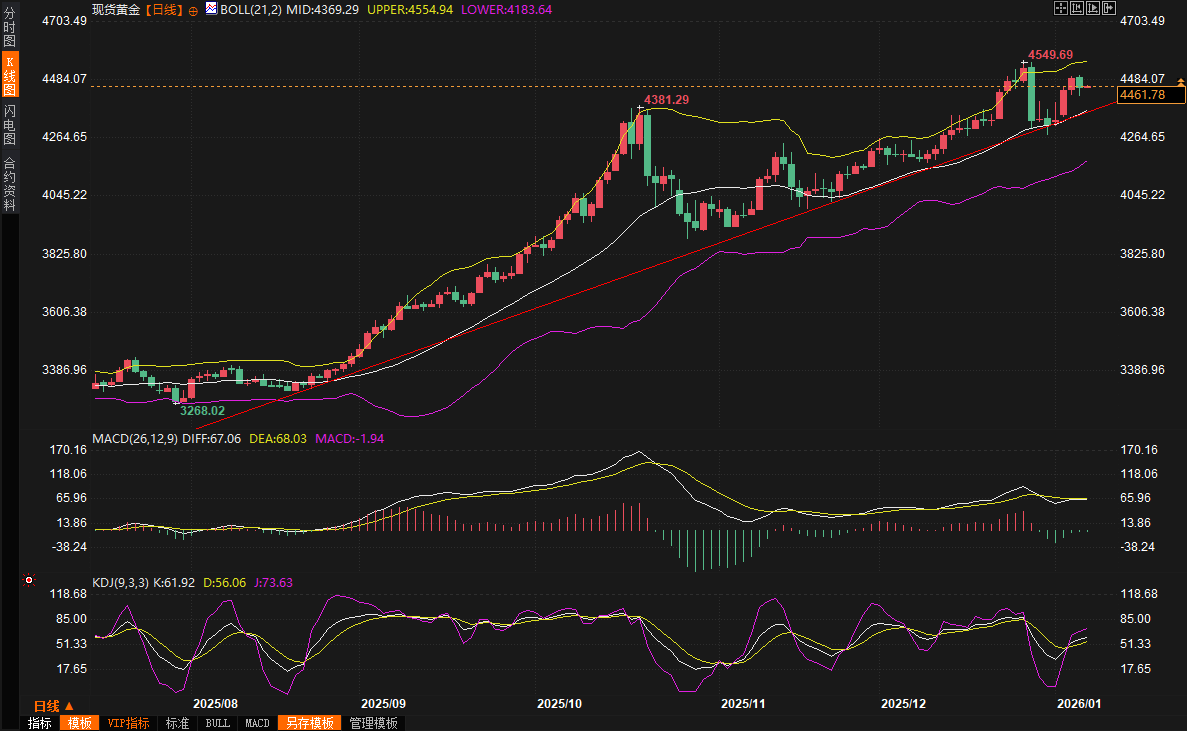
(Spot gold daily chart, source: FX678)
At 07:42 Beijing time, spot gold was trading at $4462.31 per ounce.
Gold price pullback: Profit-taking dominates short-term pressure
The recent decline in the gold market was primarily driven by profit-taking after a significant recent surge. David Meger, head of metals trading at Gaoling Futures, stated that this was a typical correction, a normal pullback after the previous rally. After all, gold reached a historical high of $4,550 at the end of 2025, and although it retreated somewhat in early 2026, it remained at an extremely high level overall. Spot gold fell as low as $4,422.89 during the session, a drop of 1.7%, reflecting that some funds chose to lock in profits and avoid the risks associated with uncertainty.
However, the decline narrowed significantly towards the end of the trading day, which was no coincidence. Unexpectedly weak US employment data became a key support for gold price stabilization. November job openings fell more than expected, and December's ADP private sector job growth was far below expectations, showing only slight increase. This series of data indicates that the US labor market is cooling, reinforcing market expectations for further easing policies from the Federal Reserve.
According to LSEG data, investors are currently betting that the Federal Reserve will cut interest rates by a total of 61 basis points by 2026. Friday's non-farm payroll report will be the next focus; if it remains weak, gold prices are likely to rebound quickly. Weak economic signals are often beneficial for gold as a non-interest-bearing asset, as a low-interest-rate environment reduces the opportunity cost of holding gold.
Geopolitical storm escalates: Trump's forceful intervention fuels uncertainty
While economic data provides short-term support, geopolitical uncertainty is a powerful engine for gold's medium- to long-term rise. The rapidly deteriorating situation in Venezuela has become the biggest variable in the current gold market. The US launched military action over the weekend, arresting Venezuelan President Maduro and subsequently seizing several oil tankers linked to Venezuela, including a vessel flying the Russian flag. This series of actions signifies an escalation of the Trump administration's strong control over oil resources. The White House has clearly stated its intention to refine and sell Venezuelan crude oil, and the increased supply is expected to depress global oil prices, but it has also triggered strong backlash from other countries. Several nations have strongly condemned the US's "bullying behavior," further escalating great power confrontation.
Meanwhile, the White House confirmed that it is actively discussing the acquisition of Greenland, even not ruling out military options. While this has caused tension among NATO allies, Trump emphasized that it is for Arctic strategic security and to contain the influence of Russia and China. The Venezuelan crisis, coupled with the Greenland discussions, has sharply increased global geopolitical risks. In such turmoil, demand for gold as a classic safe-haven asset is bound to be ignited. Historical experience shows that whenever geopolitical conflicts escalate, gold prices often experience a significant surge, and this time is no exception—although short-term profit-taking has suppressed prices, uncertainty is quietly accumulating upward momentum.
Central banks continue to hoard gold: Strong demand for safe haven in emerging markets
On the demand side, the People's Bank of China (PBOC) performed particularly well. Official data shows that in December, the PBOC increased its gold holdings for the 14th consecutive month, marking a steady buying trend that has continued for over a year.
As the world's largest consumer of gold and one of the largest buyers of central bank gold, China's actions often lead trends in emerging markets. Against the backdrop of challenges to the dollar's hegemony and frequent geopolitical risks, the need for central banks to diversify their reserves is growing stronger. Gold, without credit risk, is becoming the preferred hedge against uncertainty. This round of gold hoarding by China has not only boosted physical demand but also sent a strong signal to the global market: the strategic value of gold is being reassessed.
Other precious metals performed even weaker. Spot silver fell 3.7% to $78.16, while platinum and palladium dropped 6% and 4.2% respectively. HSBC raised its 2026 silver price forecast to $68.25, but warned that easing supply could lead to volatility. Goldman Sachs pointed out that tight inventories could trigger a short squeeze, but the risk of a subsequent pullback is significant. In contrast, gold's safe-haven appeal is more prominent, making it the most popular precious metal.
Looking ahead: The pullback is just a temporary setback; the upward trend remains unchanged.
In summary, this gold price decline is largely a technical correction, driven by profit-taking and short-term selling pressure, but fundamental support remains solid. Weak US employment data reinforces expectations of interest rate cuts, geopolitical turmoil boosts safe-haven demand, and continued buying by the People's Bank of China provides physical support. These intertwined factors ensure that the medium- to long-term upward trend for gold remains intact. Market focus shifts to Friday's non-farm payroll data; if it continues to show a cooling labor market, gold prices could quickly recover lost ground and even challenge previous highs.
Under Trump's hardline geopolitical policies, global uncertainty is likely to continue to escalate, making gold, as the "king of turbulent times," shine even brighter. Investors may consider this pullback an opportunity to position themselves; holding gold long-term remains the best choice for navigating volatile market conditions. The next breakout in gold prices may be just around the corner.
Today's trading session will also see the release of the US Challenger job cuts for December, the US initial jobless claims for the week ending January 3, and the US New York Fed's 1-year inflation forecast for December, which investors should pay attention to.
(Spot gold daily chart, source: FX678)
At 07:42 Beijing time, spot gold was trading at $4462.31 per ounce.
- Risk Warning and Disclaimer
- The market involves risk, and trading may not be suitable for all investors. This article is for reference only and does not constitute personal investment advice, nor does it take into account certain users’ specific investment objectives, financial situation, or other needs. Any investment decisions made based on this information are at your own risk.