The $2026 Dilemma: AI and Fiscal Stimulus Support, Tariffs and Political Risks Drag It Down
2026-01-13 10:11:58
One of the biggest risks facing the U.S. economy in 2025 is the uncertainty caused by the Trump administration's tariff policies. However, exceptionally strong growth in data center investment related to the artificial intelligence boom has offset the negative impact of high tariff uncertainty, saving the economy from a crisis.
In many respects, the economic environment in 2026 will be clearer, as some of the Trump administration's new policies will become a thing of the past. While the U.S. economy is expected to grow in 2026, as always, numerous risks remain. Overall, parts of the Big and Beautiful Act (OBBBA)—including some upfront fiscal stimulus measures—will support economic activity throughout the year.
The market projects economic growth of 2.2% in 2026 and 2.3% in 2027. The 2026 growth will be a result of provisions of the OBBBA (Online Business Environment) Act, which will subsidize investment through accelerated depreciation. This, combined with continued AI-driven investment, is expected to maintain strong momentum in real investment within the economy.
While further acceleration in AI investment growth is not expected in the near term, it is anticipated to remain relatively strong and support robust overall real investment performance in the coming quarters.
While a strong rebound in residential investment is not expected, a slight recovery is anticipated, driven by a slight decrease in mortgage rates compared to 2025. Mortgage rates are projected to decline in 2026, based on a steady decline in inflation following the fading impact of tariffs.
Due to rising tariffs, advance purchases of durable goods in 2025 will continue to constrain durable goods growth in 2026. Meanwhile, growth in disposable consumption is not expected to be significant, especially if income growth continues to be hampered by a weak labor market.
Employment is not expected to improve significantly in 2026; therefore, income and consumer demand will continue to face challenges compared to recent years. Furthermore, large-scale unemployment is not anticipated, and the unemployment rate is expected to remain relatively low, thus supporting growth in consumer demand.
The Trump administration's immigration policies will continue to put pressure on the labor supply. However, this pressure is unevenly distributed across industries. While investments in artificial intelligence have the potential to reduce labor demand in many sectors, some industries will benefit little from the AI productivity revolution. Industries such as construction, leisure and hospitality, and retail will continue to face labor shortages.
While part of the justification for cracking down on immigration is the claim that it benefits American workers, American workers are extremely unlikely to take the jobs that these immigrant groups do, most likely because of low wages and poor working conditions.
Furthermore, the decrease in immigration and the increase in deportations mean that these people will no longer consume or rent housing, so businesses will not need to hire more workers to meet the higher consumption in these economic sectors.
Inflation is expected to remain somewhat sticky throughout 2026, continuing to rise above the Federal Reserve's target due to pressure from increased tariffs. While the deflator process is still expected to continue, above-potential economic growth, excluding the impact of tariffs, will limit the ability of inflation to fall more quickly.
In other words, the potential deinflation process is expected to continue, driven by further declines in housing costs and virtually no pricing pressures in the services sector. While housing costs were initially anticipated to continue supporting the deinflation process, it is now expected to accelerate later in 2026 due to declining housing demand caused by slower immigration and increased deportations.
Given the backdrop of high economic growth, tight labor supply and demand, positive but weaker-than-recent consumer demand growth, and relatively strong investment, it is believed that the Federal Reserve may postpone its interest rate cut in 2026. This is because further interest rate cuts by the Fed in the short term could boost economic growth and lead to higher inflation.
The Federal Reserve's independence may be eroded. On Monday (January 12), U.S. federal prosecutors launched a criminal investigation into Federal Reserve Chairman Jerome Powell. The investigation, led by prosecutors appointed by Trump, is widely seen as political pressure exerted on the Fed by the Trump administration over interest rate disagreements.
The US dollar's trajectory in 2025-2026 is likely to exhibit a pattern of "short-term volatility with a slight upward bias, and increased uncertainty in the medium term." On one hand, the Federal Reserve may postpone interest rate cuts, providing interest rate support for the dollar. On the other hand, risks such as fiscal stimulus leading to increased deficits, tariff policies suppressing exports, and political challenges to the Fed's independence may constrain the dollar's upward momentum and increase volatility.
Overall, the US dollar is expected to fluctuate amid a tug-of-war between "stagflationary strength" and "policy uncertainty." Its upside potential is limited by long-term structural risks, while its safe-haven status provides a floor. On Tuesday in Asian trading, the US dollar index traded in a narrow range around 98.95.
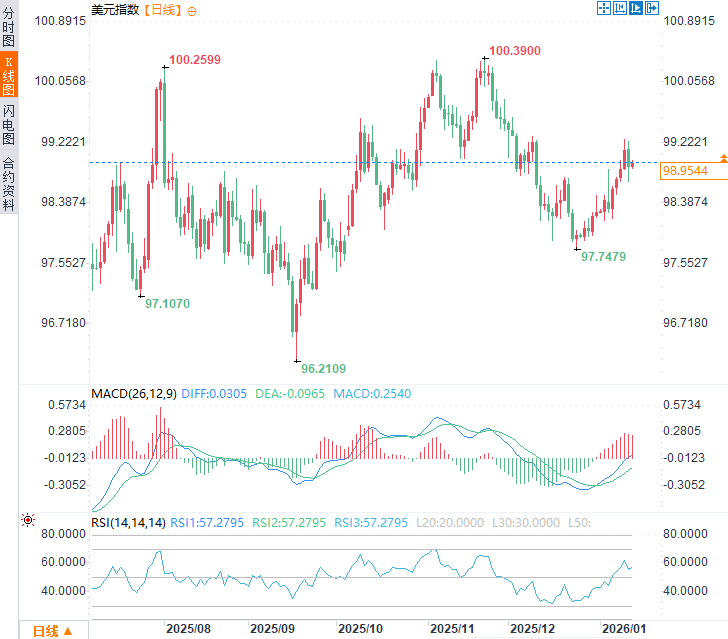
(US Dollar Index Daily Chart, Source: FX678)
At 10:11 Beijing time, the US dollar index is currently at 98.96.
In many respects, the economic environment in 2026 will be clearer, as some of the Trump administration's new policies will become a thing of the past. While the U.S. economy is expected to grow in 2026, as always, numerous risks remain. Overall, parts of the Big and Beautiful Act (OBBBA)—including some upfront fiscal stimulus measures—will support economic activity throughout the year.
Economic growth
The market projects economic growth of 2.2% in 2026 and 2.3% in 2027. The 2026 growth will be a result of provisions of the OBBBA (Online Business Environment) Act, which will subsidize investment through accelerated depreciation. This, combined with continued AI-driven investment, is expected to maintain strong momentum in real investment within the economy.
While further acceleration in AI investment growth is not expected in the near term, it is anticipated to remain relatively strong and support robust overall real investment performance in the coming quarters.
While a strong rebound in residential investment is not expected, a slight recovery is anticipated, driven by a slight decrease in mortgage rates compared to 2025. Mortgage rates are projected to decline in 2026, based on a steady decline in inflation following the fading impact of tariffs.
Due to rising tariffs, advance purchases of durable goods in 2025 will continue to constrain durable goods growth in 2026. Meanwhile, growth in disposable consumption is not expected to be significant, especially if income growth continues to be hampered by a weak labor market.
Employment and income growth
Employment is not expected to improve significantly in 2026; therefore, income and consumer demand will continue to face challenges compared to recent years. Furthermore, large-scale unemployment is not anticipated, and the unemployment rate is expected to remain relatively low, thus supporting growth in consumer demand.
The Trump administration's immigration policies will continue to put pressure on the labor supply. However, this pressure is unevenly distributed across industries. While investments in artificial intelligence have the potential to reduce labor demand in many sectors, some industries will benefit little from the AI productivity revolution. Industries such as construction, leisure and hospitality, and retail will continue to face labor shortages.
While part of the justification for cracking down on immigration is the claim that it benefits American workers, American workers are extremely unlikely to take the jobs that these immigrant groups do, most likely because of low wages and poor working conditions.
Furthermore, the decrease in immigration and the increase in deportations mean that these people will no longer consume or rent housing, so businesses will not need to hire more workers to meet the higher consumption in these economic sectors.
inflation
Inflation is expected to remain somewhat sticky throughout 2026, continuing to rise above the Federal Reserve's target due to pressure from increased tariffs. While the deflator process is still expected to continue, above-potential economic growth, excluding the impact of tariffs, will limit the ability of inflation to fall more quickly.
In other words, the potential deinflation process is expected to continue, driven by further declines in housing costs and virtually no pricing pressures in the services sector. While housing costs were initially anticipated to continue supporting the deinflation process, it is now expected to accelerate later in 2026 due to declining housing demand caused by slower immigration and increased deportations.
Federal Reserve and Interest Rates
Given the backdrop of high economic growth, tight labor supply and demand, positive but weaker-than-recent consumer demand growth, and relatively strong investment, it is believed that the Federal Reserve may postpone its interest rate cut in 2026. This is because further interest rate cuts by the Fed in the short term could boost economic growth and lead to higher inflation.
Predicting the risks faced
The Federal Reserve's independence may be eroded. On Monday (January 12), U.S. federal prosecutors launched a criminal investigation into Federal Reserve Chairman Jerome Powell. The investigation, led by prosecutors appointed by Trump, is widely seen as political pressure exerted on the Fed by the Trump administration over interest rate disagreements.
US Dollar Trends
The US dollar's trajectory in 2025-2026 is likely to exhibit a pattern of "short-term volatility with a slight upward bias, and increased uncertainty in the medium term." On one hand, the Federal Reserve may postpone interest rate cuts, providing interest rate support for the dollar. On the other hand, risks such as fiscal stimulus leading to increased deficits, tariff policies suppressing exports, and political challenges to the Fed's independence may constrain the dollar's upward momentum and increase volatility.
Overall, the US dollar is expected to fluctuate amid a tug-of-war between "stagflationary strength" and "policy uncertainty." Its upside potential is limited by long-term structural risks, while its safe-haven status provides a floor. On Tuesday in Asian trading, the US dollar index traded in a narrow range around 98.95.
(US Dollar Index Daily Chart, Source: FX678)
At 10:11 Beijing time, the US dollar index is currently at 98.96.
- Risk Warning and Disclaimer
- The market involves risk, and trading may not be suitable for all investors. This article is for reference only and does not constitute personal investment advice, nor does it take into account certain users’ specific investment objectives, financial situation, or other needs. Any investment decisions made based on this information are at your own risk.