Global markets are focused on the retreat of gold after hitting a record high, the sudden geopolitical premium in crude oil, and how tonight's data will trigger market movements.
2026-01-13 20:31:02
On Tuesday (January 14), global markets remained cautious ahead of key US inflation data releases, but asset classes diverged after sharp overnight volatility. The US dollar index traded in a narrow range around 98.97, while the yen struggled against the dollar around 158.88, just shy of its more than 18-month low reached overnight. The oil market was supported by geopolitical risk premiums, with Brent crude and WTI crude holding steady above $65 and $60.50 respectively. Spot gold retreated slightly from its record high to around $4584, while the bond market was sold off amid political uncertainty in Japan. The US December CPI data, to be released tonight at 21:30 Beijing time, will be a key catalyst in determining short-term market direction.

The crude oil market strengthened significantly overnight, with Brent crude futures closing at $64.92 per barrel, up 0.72% on the day; WTI crude futures closed at $60.59 per barrel, up 1.09% on the day. The strong performance was mainly driven by supply concerns stemming from the turmoil in Iran. Iran has seen its largest anti-government demonstrations in recent years, with the government's crackdown resulting in hundreds of deaths and thousands of arrests, raising concerns about the stability of the country's crude oil production and exports. The United States has stated that any country trading with Iran will face tariff barriers on trade with the US, directly targeting China, a major buyer of Iranian crude oil, increasing the risk of disruptions to Iranian oil exports.
Meanwhile, geopolitical tensions in the Black Sea region also provided additional support for oil prices. The attack on four Greek-managed oil tankers en route to the CPC terminal near the Russian coast by unidentified drones further highlighted the vulnerability of regional supply routes. Barclays, a well-known institution, pointed out that the turmoil in Iran has already injected a geopolitical risk premium of approximately $3-4 per barrel into oil prices. This premium is already reflected in the price spread structure, with the premium of Brent crude over the Middle Eastern benchmark Dubai crude reaching its highest level since July of last year.
From a technical perspective, Brent crude oil has broken through the upper edge of its previous trading range and is currently trading in the key resistance area of $64.50-$65.50. The upper resistance level of $65.80 is formed by the high point in mid-November last year, while the lower support level of $63.20-$63.50 is where recent breakout levels and short-term moving averages converge. Intraday focus should be on whether it can hold above the psychological level of $65. If tonight's US CPI data reinforces expectations of "higher and longer" interest rates, it could put pressure on oil prices through the dollar channel, but geopolitical risk premiums may partially offset this pressure. On the other hand, the potential for increased supply due to the political changes in Venezuela—the country may transfer up to 50 million barrels of sanctioned crude oil to the US—remains a potential bearish factor for the market, but traders seem to have temporarily shelved its pricing.
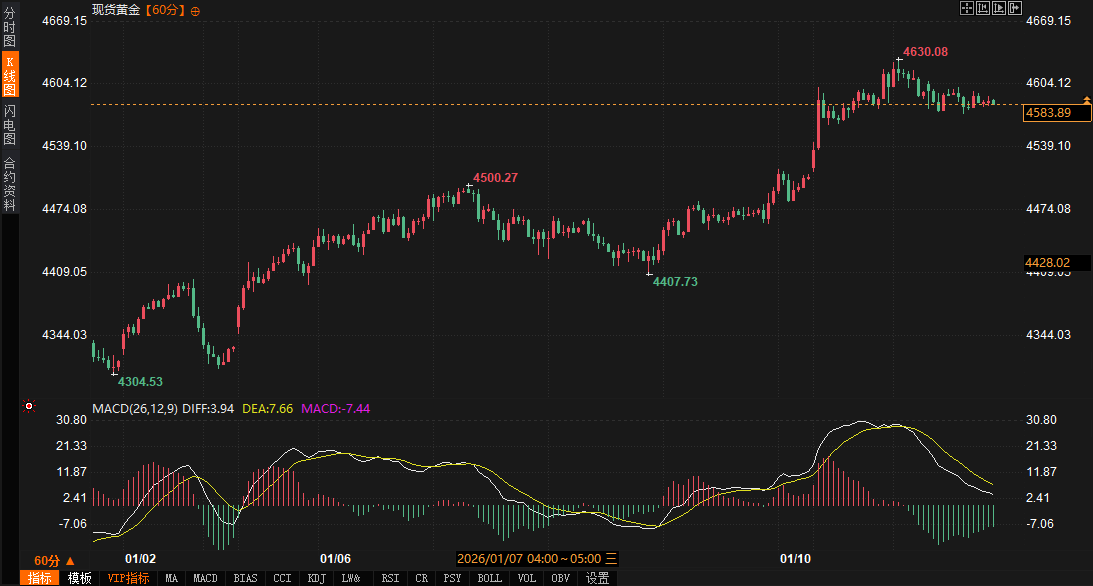
After hitting a record high of $4,629.94 per ounce, spot gold has retreated to around $4,584, a slight decrease of 0.28% on the day. Market caution stems primarily from two factors: position adjustments ahead of key US inflation data releases and a slight rebound in the US dollar. Overnight, the New York Fed president's remarks downplayed the urgency of recent monetary policy adjustments, boosting the dollar and putting pressure on dollar-denominated gold. However, the multiple outbreaks of geopolitical risks provide solid fundamental support for gold. Regarding the Russia-Ukraine situation, Russian forces launched their most concentrated missile attacks this year; US tariff rhetoric targeting Iran further escalated tensions in the Middle East. These uncertainties reinforce gold's value as a safe-haven asset.
Another noteworthy market change is that the Chicago Mercantile Exchange (CME) announced it will adjust the margin calculation method for precious metals such as gold and silver after today's market close, changing from a fixed dollar amount to a notional percentage of principal. This adjustment aims to make margin requirements more sensitive to price fluctuations and avoid the frequent margin adjustments needed due to rapid price increases recently (which have already been adjusted three times in the past month). Analysts believe that this institutional change is beneficial to market stability in the long run and has not significantly affected market sentiment in the short term. Gold and silver only slightly retreated from their highs after the announcement, still up 0.6% and 0.1% respectively compared to yesterday's closing price.
From a technical perspective, after breaking through the key psychological level of $4,500, gold has transformed that level into a significant support level. Currently, the price is consolidating within the $4,580-$4,620 range, with short-term resistance at the $4,600 psychological level and the historical high of $4,630. A decisive break above $4,630 could target $4,700, with some analysts even suggesting a possible test of the $5,000 mark in the first half of the year. However, if tonight's US CPI data is unexpectedly strong, reinforcing expectations that the Federal Reserve will maintain high interest rates for an extended period, it could push the dollar further higher, potentially putting downward pressure on gold. Initial support is at $4,550, with stronger support in the $4,500-$4,520 area. Silver is showing relatively stronger performance, holding steady above $85.50 after reaching a record high of $86.22 per ounce.
The US dollar index is currently trading around 98.97, up slightly by 0.07% on the day. Market focus is heavily on the upcoming US CPI data, which could further clarify the Federal Reserve's interest rate path. Since last week's non-farm payroll data release, market expectations for a Fed rate cut have somewhat subsided, with only one more 25 basis point cut anticipated this year, and the expected end-point rate for the rate-cutting cycle shifted upward from 3.0% to 3.25%. If tonight's CPI year-on-year increase exceeds economists' forecast of 2.7% (with a forecast range of 2.5%-2.9%), it could further reinforce this hawkish repricing.
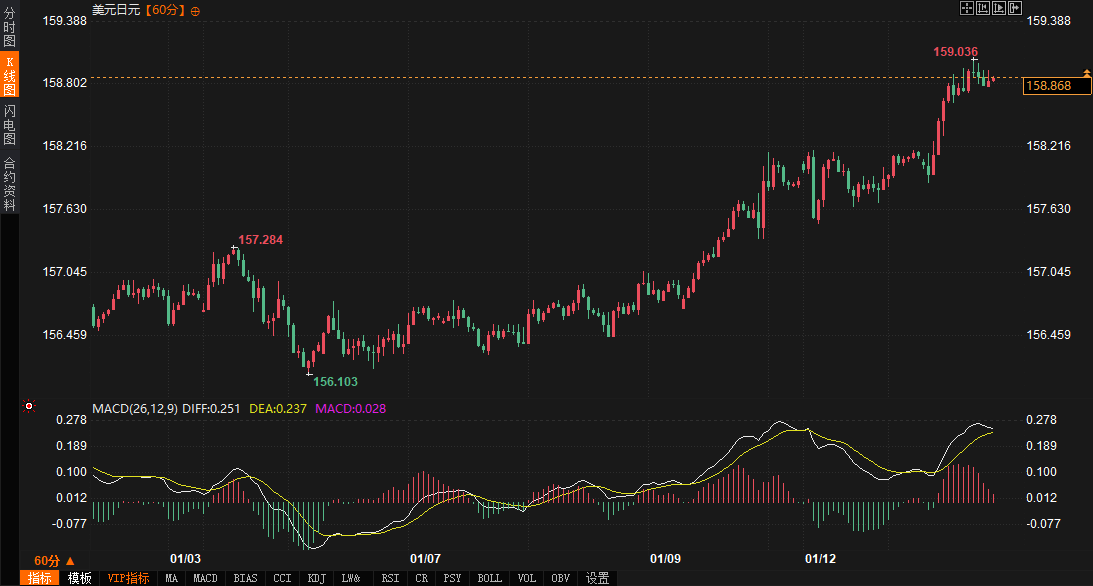
The USD/JPY exchange rate is undoubtedly the eye of the storm in the current foreign exchange market. The exchange rate is currently trading at 158.88, up 0.46% on the day, having touched 158.96 overnight, its highest level since the Japanese Ministry of Finance intervened in July 2024. The yen's weakness is mainly driven by two factors: First, market expectations of a possible early general election in Japan have intensified. According to Japanese media reports, Prime Minister Sanae Takaichi is considering dissolving the House of Representatives and calling a general election to consolidate her political position and further promote her "responsible and proactive fiscal policy." This prospect has sparked concerns about Japanese fiscal discipline, leading to a sell-off in government bonds and a weaker yen. Second, expectations of a divergence in US-Japan monetary policy have been amplified in the lead-up to data releases.
Japanese authorities' tolerance for yen depreciation appears to be nearing its limit. Finance Minister Satsuki Katayama has expressed shared concern with the US Treasury Secretary regarding a "one-way depreciation" of the yen and has intensified its threat of intervention. Notably, a significant technical gap exists on the chart: the gap between the closing price of 147.45 on October 3rd and the opening price of 149.02 on October 6th remains unfilled. This gap stems from the major event of Sanae Takashi winning the Liberal Democratic Party presidential election on October 5th. From a technical analysis perspective, gaps created by major events are typically filled in subsequent price movements. Therefore, if Japanese authorities decide to intervene and push the yen stronger, the likelihood of filling this gap will increase significantly.
Regarding key thresholds, several analysts point out that the psychological level of 160 is a crucial line of defense for potential intervention by Japanese authorities. If the USD/JPY exchange rate rapidly breaks through 160, the risk of intervention will increase dramatically. However, intervention itself faces a contradiction: there are currently no significant speculative short positions in the yen (net positions of approximately $200 million), and exchange rate volatility has decreased significantly over the past year. Intervention at this time might artificially create volatility rather than suppress it. However, given past intervention history in similar situations, the possibility of Japanese authorities taking action if US CPI data further strengthens the dollar cannot be ignored.
Global bond markets experienced selling pressure overnight, primarily driven by a sharp drop in Japanese government bonds (JGBs). Market expectations of a potential snap election in Japan fueled concerns about a more accommodative fiscal policy, causing yields on JGBs to surge across the board. The 30-year JGB yield jumped as much as 8 basis points to 3.49%, while the 10-year yield rose to 2.167%. Despite relatively light trading volume, the price movements clearly reflected the market's anxiety.
This selling pressure also spread to other major bond markets. German government bond prices fell by more than a third, but the yield spread between US and German bonds narrowed slightly to around 136.5 basis points. In US Treasury futures, the March contract fluctuated between 112-01.5 and 112-08, last quoted at 112-02. The overall performance of the bond market reflects that, against the backdrop of uncertainty surrounding the monetary policy paths of major central banks worldwide, a potential shift in fiscal policy has become a new variable in market pricing. If Japan moves towards a more aggressive fiscal stimulus path, it could not only affect its domestic bond market but also exert upward pressure on bond yields in other developed economies through global capital flows and inflation expectations.
The US December CPI data, released at 21:30 Beijing time tonight, is undoubtedly the core event determining the market's direction today and even this week. The significance of the data lies not only in its content but also in how it will influence the Federal Reserve's policy expectations, and subsequently, through interest rates and the dollar, transmit to all asset classes.
For the foreign exchange market, higher-than-expected CPI data could provide new upward momentum for the US dollar, particularly against the Japanese yen. This would further test the Japanese authorities' resolve to intervene and could push the USD/JPY pair towards the dangerous zone of 159.50-160.00. Conversely, if the data falls short of expectations, it could ease downward pressure on the yen and potentially trigger profit-taking by dollar bulls.
For precious metals and crude oil, the impact of data will be more complex. Strong CPI data is generally bearish for gold, as it boosts real interest rates and the US dollar. However, if the data triggers market concerns about stagflation (i.e., high inflation accompanied by economic growth risks), gold's safe-haven appeal may resurface. For crude oil, a strong dollar exerts downward pressure, but if the data reinforces expectations of economic resilience, it could provide support from the demand side.
The bond market will react most directly to CPI data. Higher-than-expected figures will reinforce the narrative of "higher and longer interest rates," pushing global bond yields, particularly short-term yields, further upward. This could exacerbate the sell-off in the Japanese government bond market and test the effectiveness of the Bank of Japan's yield curve control policy.
Overall, the market is currently at a juncture where multiple narratives intertwine: geopolitical risks and monetary policy, fiscal concerns and inflationary tensions, key technical levels and the risk of policy intervention. Before the data release, the market may maintain relatively narrow price fluctuations; after the data release, volatility is likely to increase significantly. Traders need to closely monitor the differentiated reactions of various asset classes to the data, as well as the possibility of cross-market correlations, especially between the Japanese yen and US Treasuries, and between the US dollar and gold. The market is already pricing in potential policy shifts and risk events, and tonight's data may provide a clear directional choice.
Crude oil: Geopolitical risk premium provides new price support
The crude oil market strengthened significantly overnight, with Brent crude futures closing at $64.92 per barrel, up 0.72% on the day; WTI crude futures closed at $60.59 per barrel, up 1.09% on the day. The strong performance was mainly driven by supply concerns stemming from the turmoil in Iran. Iran has seen its largest anti-government demonstrations in recent years, with the government's crackdown resulting in hundreds of deaths and thousands of arrests, raising concerns about the stability of the country's crude oil production and exports. The United States has stated that any country trading with Iran will face tariff barriers on trade with the US, directly targeting China, a major buyer of Iranian crude oil, increasing the risk of disruptions to Iranian oil exports.
Meanwhile, geopolitical tensions in the Black Sea region also provided additional support for oil prices. The attack on four Greek-managed oil tankers en route to the CPC terminal near the Russian coast by unidentified drones further highlighted the vulnerability of regional supply routes. Barclays, a well-known institution, pointed out that the turmoil in Iran has already injected a geopolitical risk premium of approximately $3-4 per barrel into oil prices. This premium is already reflected in the price spread structure, with the premium of Brent crude over the Middle Eastern benchmark Dubai crude reaching its highest level since July of last year.
From a technical perspective, Brent crude oil has broken through the upper edge of its previous trading range and is currently trading in the key resistance area of $64.50-$65.50. The upper resistance level of $65.80 is formed by the high point in mid-November last year, while the lower support level of $63.20-$63.50 is where recent breakout levels and short-term moving averages converge. Intraday focus should be on whether it can hold above the psychological level of $65. If tonight's US CPI data reinforces expectations of "higher and longer" interest rates, it could put pressure on oil prices through the dollar channel, but geopolitical risk premiums may partially offset this pressure. On the other hand, the potential for increased supply due to the political changes in Venezuela—the country may transfer up to 50 million barrels of sanctioned crude oil to the US—remains a potential bearish factor for the market, but traders seem to have temporarily shelved its pricing.
Precious metals: Cautious consolidation near historical highs
After hitting a record high of $4,629.94 per ounce, spot gold has retreated to around $4,584, a slight decrease of 0.28% on the day. Market caution stems primarily from two factors: position adjustments ahead of key US inflation data releases and a slight rebound in the US dollar. Overnight, the New York Fed president's remarks downplayed the urgency of recent monetary policy adjustments, boosting the dollar and putting pressure on dollar-denominated gold. However, the multiple outbreaks of geopolitical risks provide solid fundamental support for gold. Regarding the Russia-Ukraine situation, Russian forces launched their most concentrated missile attacks this year; US tariff rhetoric targeting Iran further escalated tensions in the Middle East. These uncertainties reinforce gold's value as a safe-haven asset.
Another noteworthy market change is that the Chicago Mercantile Exchange (CME) announced it will adjust the margin calculation method for precious metals such as gold and silver after today's market close, changing from a fixed dollar amount to a notional percentage of principal. This adjustment aims to make margin requirements more sensitive to price fluctuations and avoid the frequent margin adjustments needed due to rapid price increases recently (which have already been adjusted three times in the past month). Analysts believe that this institutional change is beneficial to market stability in the long run and has not significantly affected market sentiment in the short term. Gold and silver only slightly retreated from their highs after the announcement, still up 0.6% and 0.1% respectively compared to yesterday's closing price.
From a technical perspective, after breaking through the key psychological level of $4,500, gold has transformed that level into a significant support level. Currently, the price is consolidating within the $4,580-$4,620 range, with short-term resistance at the $4,600 psychological level and the historical high of $4,630. A decisive break above $4,630 could target $4,700, with some analysts even suggesting a possible test of the $5,000 mark in the first half of the year. However, if tonight's US CPI data is unexpectedly strong, reinforcing expectations that the Federal Reserve will maintain high interest rates for an extended period, it could push the dollar further higher, potentially putting downward pressure on gold. Initial support is at $4,550, with stronger support in the $4,500-$4,520 area. Silver is showing relatively stronger performance, holding steady above $85.50 after reaching a record high of $86.22 per ounce.
Foreign Exchange Market: Yen Approaches Intervention Threshold, Dollar Awaits Data Guidance
The US dollar index is currently trading around 98.97, up slightly by 0.07% on the day. Market focus is heavily on the upcoming US CPI data, which could further clarify the Federal Reserve's interest rate path. Since last week's non-farm payroll data release, market expectations for a Fed rate cut have somewhat subsided, with only one more 25 basis point cut anticipated this year, and the expected end-point rate for the rate-cutting cycle shifted upward from 3.0% to 3.25%. If tonight's CPI year-on-year increase exceeds economists' forecast of 2.7% (with a forecast range of 2.5%-2.9%), it could further reinforce this hawkish repricing.
The USD/JPY exchange rate is undoubtedly the eye of the storm in the current foreign exchange market. The exchange rate is currently trading at 158.88, up 0.46% on the day, having touched 158.96 overnight, its highest level since the Japanese Ministry of Finance intervened in July 2024. The yen's weakness is mainly driven by two factors: First, market expectations of a possible early general election in Japan have intensified. According to Japanese media reports, Prime Minister Sanae Takaichi is considering dissolving the House of Representatives and calling a general election to consolidate her political position and further promote her "responsible and proactive fiscal policy." This prospect has sparked concerns about Japanese fiscal discipline, leading to a sell-off in government bonds and a weaker yen. Second, expectations of a divergence in US-Japan monetary policy have been amplified in the lead-up to data releases.
Japanese authorities' tolerance for yen depreciation appears to be nearing its limit. Finance Minister Satsuki Katayama has expressed shared concern with the US Treasury Secretary regarding a "one-way depreciation" of the yen and has intensified its threat of intervention. Notably, a significant technical gap exists on the chart: the gap between the closing price of 147.45 on October 3rd and the opening price of 149.02 on October 6th remains unfilled. This gap stems from the major event of Sanae Takashi winning the Liberal Democratic Party presidential election on October 5th. From a technical analysis perspective, gaps created by major events are typically filled in subsequent price movements. Therefore, if Japanese authorities decide to intervene and push the yen stronger, the likelihood of filling this gap will increase significantly.
Regarding key thresholds, several analysts point out that the psychological level of 160 is a crucial line of defense for potential intervention by Japanese authorities. If the USD/JPY exchange rate rapidly breaks through 160, the risk of intervention will increase dramatically. However, intervention itself faces a contradiction: there are currently no significant speculative short positions in the yen (net positions of approximately $200 million), and exchange rate volatility has decreased significantly over the past year. Intervention at this time might artificially create volatility rather than suppress it. However, given past intervention history in similar situations, the possibility of Japanese authorities taking action if US CPI data further strengthens the dollar cannot be ignored.
Bond Market: Political Uncertainty in Japan Triggers Global Bond Market Sell-off
Global bond markets experienced selling pressure overnight, primarily driven by a sharp drop in Japanese government bonds (JGBs). Market expectations of a potential snap election in Japan fueled concerns about a more accommodative fiscal policy, causing yields on JGBs to surge across the board. The 30-year JGB yield jumped as much as 8 basis points to 3.49%, while the 10-year yield rose to 2.167%. Despite relatively light trading volume, the price movements clearly reflected the market's anxiety.
This selling pressure also spread to other major bond markets. German government bond prices fell by more than a third, but the yield spread between US and German bonds narrowed slightly to around 136.5 basis points. In US Treasury futures, the March contract fluctuated between 112-01.5 and 112-08, last quoted at 112-02. The overall performance of the bond market reflects that, against the backdrop of uncertainty surrounding the monetary policy paths of major central banks worldwide, a potential shift in fiscal policy has become a new variable in market pricing. If Japan moves towards a more aggressive fiscal stimulus path, it could not only affect its domestic bond market but also exert upward pressure on bond yields in other developed economies through global capital flows and inflation expectations.
Evening Market Focus: The Multi-Dimensional Impact of US CPI Data
The US December CPI data, released at 21:30 Beijing time tonight, is undoubtedly the core event determining the market's direction today and even this week. The significance of the data lies not only in its content but also in how it will influence the Federal Reserve's policy expectations, and subsequently, through interest rates and the dollar, transmit to all asset classes.
For the foreign exchange market, higher-than-expected CPI data could provide new upward momentum for the US dollar, particularly against the Japanese yen. This would further test the Japanese authorities' resolve to intervene and could push the USD/JPY pair towards the dangerous zone of 159.50-160.00. Conversely, if the data falls short of expectations, it could ease downward pressure on the yen and potentially trigger profit-taking by dollar bulls.
For precious metals and crude oil, the impact of data will be more complex. Strong CPI data is generally bearish for gold, as it boosts real interest rates and the US dollar. However, if the data triggers market concerns about stagflation (i.e., high inflation accompanied by economic growth risks), gold's safe-haven appeal may resurface. For crude oil, a strong dollar exerts downward pressure, but if the data reinforces expectations of economic resilience, it could provide support from the demand side.
The bond market will react most directly to CPI data. Higher-than-expected figures will reinforce the narrative of "higher and longer interest rates," pushing global bond yields, particularly short-term yields, further upward. This could exacerbate the sell-off in the Japanese government bond market and test the effectiveness of the Bank of Japan's yield curve control policy.
Overall, the market is currently at a juncture where multiple narratives intertwine: geopolitical risks and monetary policy, fiscal concerns and inflationary tensions, key technical levels and the risk of policy intervention. Before the data release, the market may maintain relatively narrow price fluctuations; after the data release, volatility is likely to increase significantly. Traders need to closely monitor the differentiated reactions of various asset classes to the data, as well as the possibility of cross-market correlations, especially between the Japanese yen and US Treasuries, and between the US dollar and gold. The market is already pricing in potential policy shifts and risk events, and tonight's data may provide a clear directional choice.
- Risk Warning and Disclaimer
- The market involves risk, and trading may not be suitable for all investors. This article is for reference only and does not constitute personal investment advice, nor does it take into account certain users’ specific investment objectives, financial situation, or other needs. Any investment decisions made based on this information are at your own risk.