Another new high! Silver breaks $91, is the next target $100?
2026-01-14 20:45:33
Spot silver continued its strong performance this week, trading above $91 in pre-market trading on Wednesday (January 14th), marking its fourth consecutive day of gains, with a single-day increase of over 5%, and hitting a new all-time high during the session. This rapid rise was not accidental, but rather the result of multiple factors converging. Against the backdrop of global geopolitical tensions and rising uncertainty in the financial system, funds are flowing into assets with safe-haven attributes, and silver, as a commodity with both industrial uses and precious metal status, is becoming the focus of market attention.
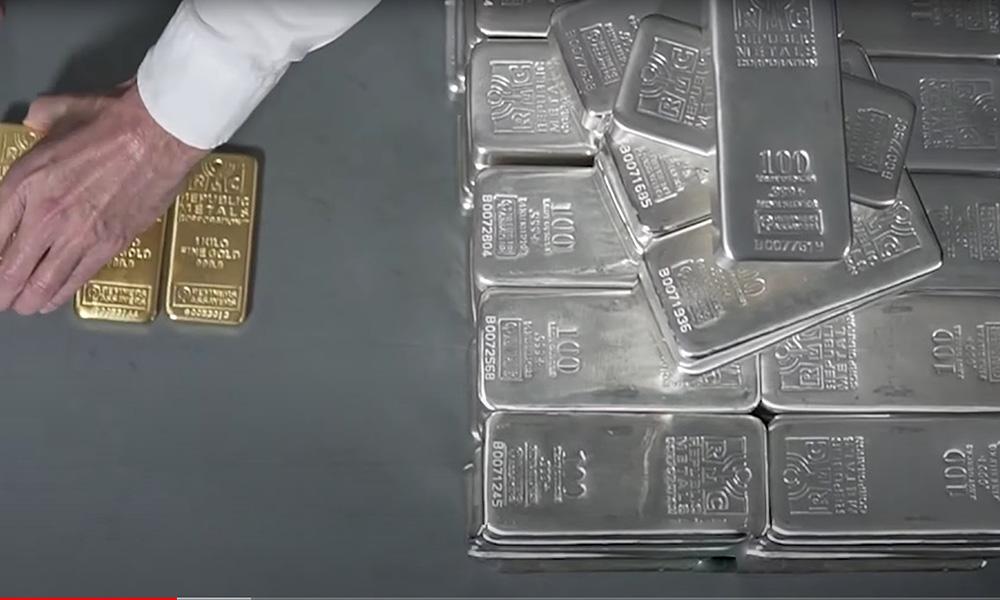
One of the core drivers of this round of price increases is the heightened risk aversion stemming from the situation in the Middle East. The volatile situation in Iran has fueled market concerns about potential military conflict. US President Trump has publicly stated that he does not rule out military intervention. Such rhetoric has exacerbated the anxiety of global traders, prompting capital to flow more rapidly into traditional safe-haven assets such as gold and silver. Silver has not only strengthened in price but also experienced significantly increased market volatility, with frequent short-term chasing of rising prices, forming a typical "consecutive-day" upward trend.
In this environment, silver is no longer just a simple industrial metal, but has also been given the role of a "safe haven." Whenever unexpected events occur, assets with high liquidity and easy conversion to cash are often the first to be sought after, and silver happens to meet these characteristics. Therefore, at a time when geopolitical risks are rising temporarily, its price is more likely to experience a rapid acceleration in the short term.
Beyond external conflicts, another deep-seated force is quietly influencing the market landscape—a crisis of confidence in the monetary credit system. Recently, Federal Reserve Chairman Jerome Powell faced criminal charges related to fund management issues during renovations at the Washington headquarters. Although he denied all charges, claiming the move was politically motivated and intended to interfere with the independence of monetary policy, the incident itself has already stirred up the financial markets.
This controversy is significant because it touches upon a crucial question: can the Federal Reserve maintain its policy autonomy? Once central bank independence is questioned, market predictability and financial stability suffer, impacting global capital flows and risk pricing. Under these concerns, the dollar initially came under downward pressure, reflecting waning confidence among traders in the fiat currency system. Although subsequent statements from the European Central Bank and the Bank of England supporting Powell stabilized the dollar somewhat, this did not reverse the overall strength of precious metals.
Analysts point out that the rise in silver prices is not driven by a single variable, but rather by a combination of declining risk appetite, lower real interest rate expectations, and tight supply and demand in the spot market. In the current environment, even if the US dollar stabilizes temporarily, as long as market doubts about the "credit anchor" continue to fester, non-interest-bearing assets like silver will remain attractive. Especially during periods of increased policy uncertainty, holding physical precious metals is seen as an effective way to hedge against institutional risks.
From a macroeconomic perspective, the market is still actively digesting signals of a potential future interest rate cut by the Federal Reserve. Following the conventional framework, when real interest rates are expected to decline, the opportunity cost of holding non-interest-bearing precious metals decreases, thereby attracting more allocation funds. Simultaneously, if the US dollar faces structural pressure or increased volatility, it will also enhance the hedging value of precious metals. Currently, these two paths are unfolding simultaneously, providing strong support for silver.
More importantly, silver is not only a financial asset but also an important industrial raw material, widely used in photovoltaics, electronics, and medical fields. This means its demand is cyclically elastic. Recent data shows that the spot market is characterized by a tight balance between supply and demand, further strengthening bullish sentiment. Price pullbacks are often seen as buying opportunities rather than signals of trend reversal. This consensus creates strong buying support, driving prices higher.
Previously, the CME Group raised margin requirements for precious metals futures twice in the last week of December 2025. While this would increase the cost of leveraged trading and potentially lead to some speculative funds reducing their positions, especially during periods of low liquidity, it would not change the fundamental trend. Analysts believe that margin adjustments affect trading rhythm and position structure more than a fundamental bearish signal. On the contrary, it may act as a catalyst for short-term profit-taking, resulting in a "fall first, then stabilize" volatility path, thus providing a new window for long-term funds to position themselves.
From a technical perspective, the daily chart of spot silver shows a clear upward trend. After successfully breaking through the key resistance level of $85,000, the price has entered an acceleration mode and entered the historical high range. The current price is in a sensitive area of bullish and bearish struggle; on the one hand, the MACD indicator shows that the trend momentum is still strong: DIFF is 6.810, DEA is 5.788, and the MACD histogram is 2.044, which is in the strong range; but on the other hand, RSI (14) has risen to 74.937, indicating that there are signs of overbought conditions in the short term.
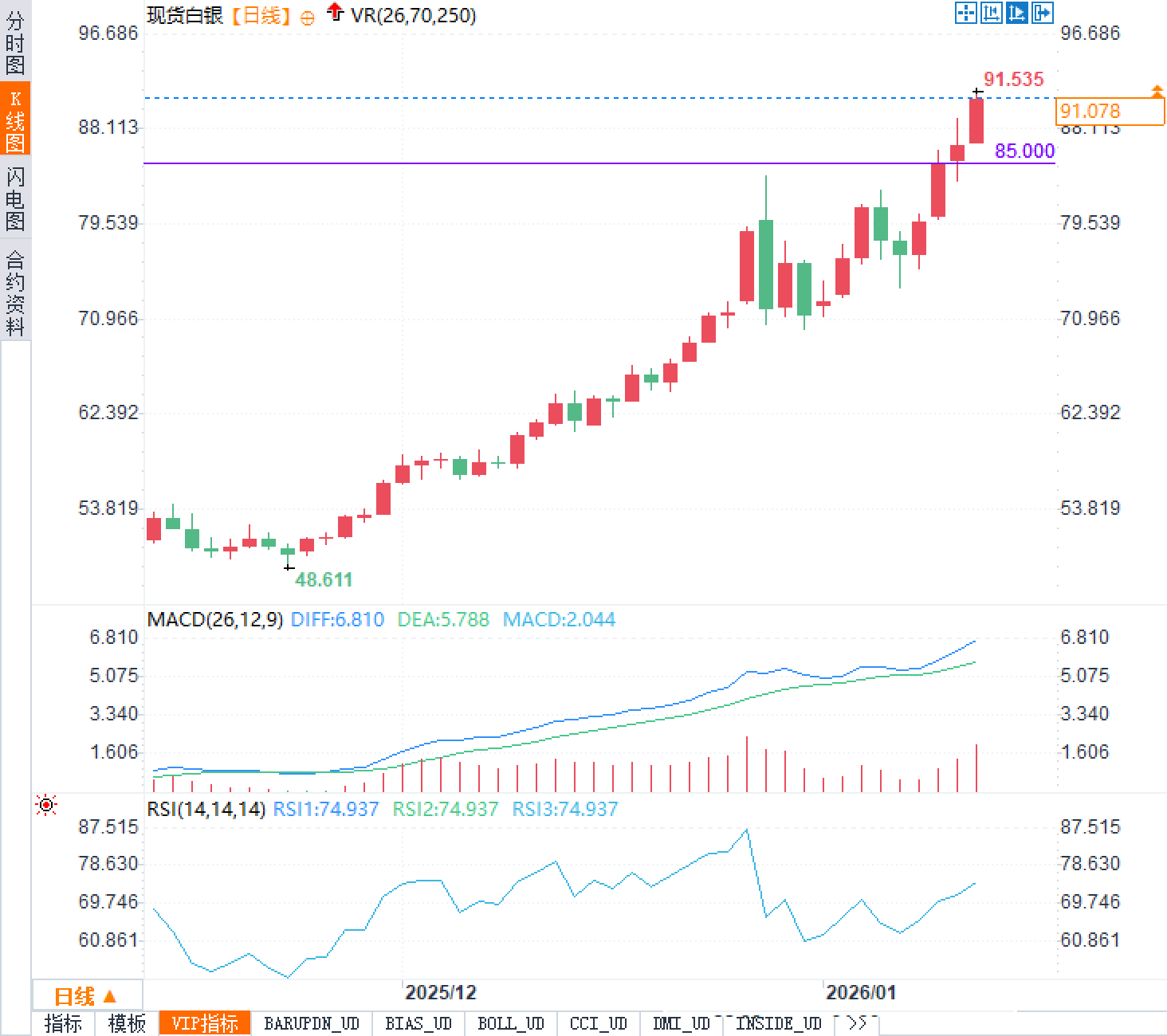
In this combination of "maintaining a healthy trend but localized overheating," the subsequent price action may follow two typical paths: one is to consolidate at high levels, using time to repair technical indicators; the other is to retest key support levels before launching another upward attack. Regardless of the scenario, the key observation points are the strength of buying support and changes in trading volume during the pullback—if trading volume shrinks and buying interest emerges rapidly during the decline, it indicates strong reluctance to sell in the market, making a continuation of the trend more likely.
Looking ahead, whether silver can hold above $91 will primarily depend on the evolution of three variables: First, whether geopolitical risks will escalate further, especially whether the situation in the Middle East will spill over; second, whether the controversy surrounding the independence of the Federal Reserve's policies will deepen, thereby affecting the credibility of the US dollar and expectations of real interest rates; and third, whether the tight supply-demand balance in the spot market can be maintained. If these three aspects continue to develop in a favorable direction, silver will likely maintain its pattern of "limited pullbacks followed by new highs"; conversely, if the risk premium dissipates rapidly, coupled with concentrated deleveraging triggered by the margin mechanism, short-term volatility may be significantly amplified.
One of the core drivers of this round of price increases is the heightened risk aversion stemming from the situation in the Middle East. The volatile situation in Iran has fueled market concerns about potential military conflict. US President Trump has publicly stated that he does not rule out military intervention. Such rhetoric has exacerbated the anxiety of global traders, prompting capital to flow more rapidly into traditional safe-haven assets such as gold and silver. Silver has not only strengthened in price but also experienced significantly increased market volatility, with frequent short-term chasing of rising prices, forming a typical "consecutive-day" upward trend.
In this environment, silver is no longer just a simple industrial metal, but has also been given the role of a "safe haven." Whenever unexpected events occur, assets with high liquidity and easy conversion to cash are often the first to be sought after, and silver happens to meet these characteristics. Therefore, at a time when geopolitical risks are rising temporarily, its price is more likely to experience a rapid acceleration in the short term.
With institutional trust eroded, silver is poised for an opportunity to "replace credit."
Beyond external conflicts, another deep-seated force is quietly influencing the market landscape—a crisis of confidence in the monetary credit system. Recently, Federal Reserve Chairman Jerome Powell faced criminal charges related to fund management issues during renovations at the Washington headquarters. Although he denied all charges, claiming the move was politically motivated and intended to interfere with the independence of monetary policy, the incident itself has already stirred up the financial markets.
This controversy is significant because it touches upon a crucial question: can the Federal Reserve maintain its policy autonomy? Once central bank independence is questioned, market predictability and financial stability suffer, impacting global capital flows and risk pricing. Under these concerns, the dollar initially came under downward pressure, reflecting waning confidence among traders in the fiat currency system. Although subsequent statements from the European Central Bank and the Bank of England supporting Powell stabilized the dollar somewhat, this did not reverse the overall strength of precious metals.
Analysts point out that the rise in silver prices is not driven by a single variable, but rather by a combination of declining risk appetite, lower real interest rate expectations, and tight supply and demand in the spot market. In the current environment, even if the US dollar stabilizes temporarily, as long as market doubts about the "credit anchor" continue to fester, non-interest-bearing assets like silver will remain attractive. Especially during periods of increased policy uncertainty, holding physical precious metals is seen as an effective way to hedge against institutional risks.
Expectations of interest rate cuts coupled with a tight supply-demand balance provided a macroeconomic tailwind that boosted silver prices.
From a macroeconomic perspective, the market is still actively digesting signals of a potential future interest rate cut by the Federal Reserve. Following the conventional framework, when real interest rates are expected to decline, the opportunity cost of holding non-interest-bearing precious metals decreases, thereby attracting more allocation funds. Simultaneously, if the US dollar faces structural pressure or increased volatility, it will also enhance the hedging value of precious metals. Currently, these two paths are unfolding simultaneously, providing strong support for silver.
More importantly, silver is not only a financial asset but also an important industrial raw material, widely used in photovoltaics, electronics, and medical fields. This means its demand is cyclically elastic. Recent data shows that the spot market is characterized by a tight balance between supply and demand, further strengthening bullish sentiment. Price pullbacks are often seen as buying opportunities rather than signals of trend reversal. This consensus creates strong buying support, driving prices higher.
Previously, the CME Group raised margin requirements for precious metals futures twice in the last week of December 2025. While this would increase the cost of leveraged trading and potentially lead to some speculative funds reducing their positions, especially during periods of low liquidity, it would not change the fundamental trend. Analysts believe that margin adjustments affect trading rhythm and position structure more than a fundamental bearish signal. On the contrary, it may act as a catalyst for short-term profit-taking, resulting in a "fall first, then stabilize" volatility path, thus providing a new window for long-term funds to position themselves.
With prices remaining high, the future market trend depends on three major variables.
From a technical perspective, the daily chart of spot silver shows a clear upward trend. After successfully breaking through the key resistance level of $85,000, the price has entered an acceleration mode and entered the historical high range. The current price is in a sensitive area of bullish and bearish struggle; on the one hand, the MACD indicator shows that the trend momentum is still strong: DIFF is 6.810, DEA is 5.788, and the MACD histogram is 2.044, which is in the strong range; but on the other hand, RSI (14) has risen to 74.937, indicating that there are signs of overbought conditions in the short term.
In this combination of "maintaining a healthy trend but localized overheating," the subsequent price action may follow two typical paths: one is to consolidate at high levels, using time to repair technical indicators; the other is to retest key support levels before launching another upward attack. Regardless of the scenario, the key observation points are the strength of buying support and changes in trading volume during the pullback—if trading volume shrinks and buying interest emerges rapidly during the decline, it indicates strong reluctance to sell in the market, making a continuation of the trend more likely.
Looking ahead, whether silver can hold above $91 will primarily depend on the evolution of three variables: First, whether geopolitical risks will escalate further, especially whether the situation in the Middle East will spill over; second, whether the controversy surrounding the independence of the Federal Reserve's policies will deepen, thereby affecting the credibility of the US dollar and expectations of real interest rates; and third, whether the tight supply-demand balance in the spot market can be maintained. If these three aspects continue to develop in a favorable direction, silver will likely maintain its pattern of "limited pullbacks followed by new highs"; conversely, if the risk premium dissipates rapidly, coupled with concentrated deleveraging triggered by the margin mechanism, short-term volatility may be significantly amplified.
- Risk Warning and Disclaimer
- The market involves risk, and trading may not be suitable for all investors. This article is for reference only and does not constitute personal investment advice, nor does it take into account certain users’ specific investment objectives, financial situation, or other needs. Any investment decisions made based on this information are at your own risk.