Three Deadly Vortexes in the Countdown to 160 Yen Exchange Rate Storm
2026-01-14 20:20:45
On Wednesday (January 14), the USD/JPY exchange rate accelerated toward a key level not seen since July 2024, currently reaching a high of 159.43, just a step away from the market's closely watched target of 160.
Since Japanese Prime Minister Sanae Takaichi was elected leader of the Liberal Democratic Party last October, this currency pair has appreciated by 8.25%. The yen has remained weak among major currencies, and the pressure to depreciate has not yet peaked.

The root cause of the yen's weakness lies in the inherent conflicts within Japan's domestic policy mix and the escalating political risks.
On the one hand, the Sanae Takaichi government plans to implement a large-scale fiscal stimulus policy, but investors generally question whether this measure can be translated into sustainable GDP growth—especially given that the Bank of Japan has already begun tightening monetary policy, this "one foot on the gas, one foot on the brake" approach is completely unsustainable.
Market concerns that loose fiscal policy would further push up Japan's already high debt-to-GDP ratio, while tightening monetary policy would be difficult to directly reverse the yen's decline, ultimately reflected in the market as the 10-year Japanese government bond yield rose to a ten-year high of 2.178%, and the yen fell across the board.
On the other hand, political uncertainty has further exacerbated the fragility of the yen. Although Sanae Takashi's personal approval rating has risen to 78.1%, the Liberal Democratic Party's approval rating is still below 30%, which is a source of risk. This has prompted her to hold an early general election in February, even if it would delay the budget bill originally scheduled for March. This way, she can use the peak of public support to reorganize the House of Representatives and clear obstacles for subsequent governance.
The market generally believes that if Sanae Takashi is successfully re-elected, she will continue to implement policies with even higher fiscal deficits, which will undoubtedly further weaken the demand for the yen. The current trends of the yen and Japanese bonds also indicate that off-market funds are betting on Takashi's victory and the smooth implementation of Abenomics.
Faced with the depreciation of the yen, investors have repeatedly called on the government to strengthen fiscal discipline, but so far they have only received empty verbal warnings. Confidence in the yen continues to be undermined. US Treasury Secretary Bessenter is also anxious, as the depreciation of the yen will lead to a deterioration in the terms of trade between the US and Japan, completely offsetting the remaining gains of the trade war launched by the US.
The continued depreciation of the yen is also inseparable from the continued strength of the US dollar, which has recently shown unexpected resilience despite multiple potential negative factors.
The fact that the US core CPI remained unchanged month-on-month but declined year-on-year in December indicates that overall US inflation was lower than expected, which is conducive to interest rate cuts, but the US dollar did not depreciate significantly.
Meanwhile, the U.S. Department of Justice's investigation into Federal Reserve Chairman Jerome Powell eased market concerns about the Fed's independence due to swift resistance from several Republican lawmakers, and the dollar, contrary to expectations, did not fall.
More importantly, the US economy is performing strongly, with robust employment and services PMI data reducing the probability of a Fed rate cut in March from 48.5% to 25.7%, with the market widely expecting rates to remain unchanged until June. Meanwhile, the dollar's rebound and rising oil prices are working in tandem—tensions in Iran and escalating geopolitical risks in Venezuela and Greenland are driving up oil prices and further solidifying the dollar's safe-haven appeal, providing double support for the dollar's rise against the yen.
The most critical point of contention in the market right now is whether the Japanese authorities will intervene in the foreign exchange market.
Referring to the "textbook operation" in July 2024, the Japanese government will most likely wait for a clear global catalyst that would negatively impact the US dollar before taking action. At that time, the spot price of USD/JPY was close to 162.00 when the intervention was initiated. At the current price of 158.55, there is still about 350 points of room to move away from that threshold.
However, the 160 mark is regarded by most institutions as the Japanese government's "unofficial red line," and this level may become a resistance level in the short term.
It is worth noting that weak demand at the auction of Japanese five-year government bonds has further exacerbated the pressure on the yen to depreciate. If the exchange rate breaks through 160 and the rate of depreciation accelerates, the possibility of early intervention by the Japanese authorities cannot be ruled out.
In addition, the Bank of Japan also has the option of raising interest rates to deal with the depreciation of the yen, but the market expects the neutral interest rate range to be 1.5%-2.5%. Raising interest rates may trigger the unwinding of yen carry trades, which may bring new market volatility.
Looking ahead to this week, the USD/JPY exchange rate will be influenced by multiple key events. On Wednesday, the US will release PPI and retail sales data, and on Thursday, initial jobless claims data will be released. At the same time, several Federal Reserve officials will make public speeches. These data and statements will directly affect market expectations for Fed policy, thereby influencing the direction of the foreign exchange market.
Another potential trigger is the US Supreme Court's ruling on Trump's tariff policies. If an unfavorable ruling is issued this week, it could actually be a "contrarian positive" for the dollar, providing additional support.
For the Japanese yen, short-term depreciation pressure has not yet been released, and it is only a matter of time before the USD/JPY exchange rate breaks through the 160 mark. However, its subsequent trend will depend heavily on Japan's political direction and intervention decisions. This currency market transformation, driven by policy contradictions, political games and geopolitical risks, is still unfolding.
From a technical perspective, the USD/JPY pair is challenging the upper boundary of a large upward channel.
Although the challenge failed, the exchange rate is still above the 5-day moving average. As long as the 5-day moving average can be held, the USD/JPY exchange rate will remain in a very strong range.
The resistance levels are at the upper rail of the upward channel and the psychological level of 160, while the support levels are at the 5-day moving average and around 157.57.
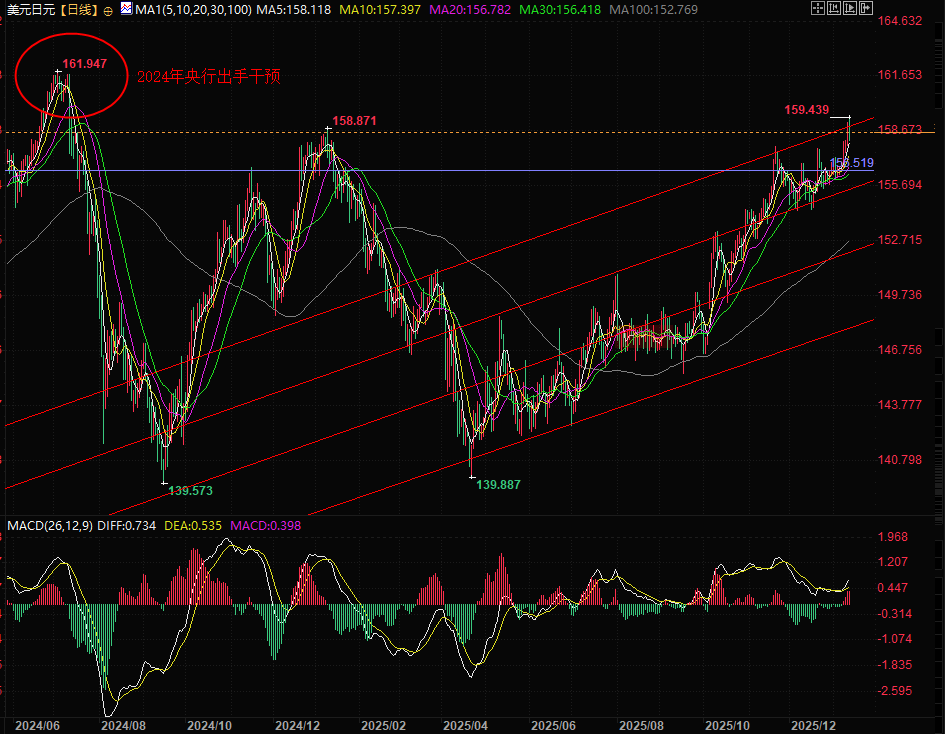
(USD/JPY daily chart, source: FX678)
At 20:17 Beijing time, the USD/JPY exchange rate is currently at 158.64/65.
Since Japanese Prime Minister Sanae Takaichi was elected leader of the Liberal Democratic Party last October, this currency pair has appreciated by 8.25%. The yen has remained weak among major currencies, and the pressure to depreciate has not yet peaked.
Core driver: The dual impact of policy contradictions and political uncertainty
The root cause of the yen's weakness lies in the inherent conflicts within Japan's domestic policy mix and the escalating political risks.
On the one hand, the Sanae Takaichi government plans to implement a large-scale fiscal stimulus policy, but investors generally question whether this measure can be translated into sustainable GDP growth—especially given that the Bank of Japan has already begun tightening monetary policy, this "one foot on the gas, one foot on the brake" approach is completely unsustainable.
Market concerns that loose fiscal policy would further push up Japan's already high debt-to-GDP ratio, while tightening monetary policy would be difficult to directly reverse the yen's decline, ultimately reflected in the market as the 10-year Japanese government bond yield rose to a ten-year high of 2.178%, and the yen fell across the board.
On the other hand, political uncertainty has further exacerbated the fragility of the yen. Although Sanae Takashi's personal approval rating has risen to 78.1%, the Liberal Democratic Party's approval rating is still below 30%, which is a source of risk. This has prompted her to hold an early general election in February, even if it would delay the budget bill originally scheduled for March. This way, she can use the peak of public support to reorganize the House of Representatives and clear obstacles for subsequent governance.
The market generally believes that if Sanae Takashi is successfully re-elected, she will continue to implement policies with even higher fiscal deficits, which will undoubtedly further weaken the demand for the yen. The current trends of the yen and Japanese bonds also indicate that off-market funds are betting on Takashi's victory and the smooth implementation of Abenomics.
Faced with the depreciation of the yen, investors have repeatedly called on the government to strengthen fiscal discipline, but so far they have only received empty verbal warnings. Confidence in the yen continues to be undermined. US Treasury Secretary Bessenter is also anxious, as the depreciation of the yen will lead to a deterioration in the terms of trade between the US and Japan, completely offsetting the remaining gains of the trade war launched by the US.
The US dollar's resilience is supported by both fundamental factors and geopolitical risks.
The continued depreciation of the yen is also inseparable from the continued strength of the US dollar, which has recently shown unexpected resilience despite multiple potential negative factors.
The fact that the US core CPI remained unchanged month-on-month but declined year-on-year in December indicates that overall US inflation was lower than expected, which is conducive to interest rate cuts, but the US dollar did not depreciate significantly.
Meanwhile, the U.S. Department of Justice's investigation into Federal Reserve Chairman Jerome Powell eased market concerns about the Fed's independence due to swift resistance from several Republican lawmakers, and the dollar, contrary to expectations, did not fall.
More importantly, the US economy is performing strongly, with robust employment and services PMI data reducing the probability of a Fed rate cut in March from 48.5% to 25.7%, with the market widely expecting rates to remain unchanged until June. Meanwhile, the dollar's rebound and rising oil prices are working in tandem—tensions in Iran and escalating geopolitical risks in Venezuela and Greenland are driving up oil prices and further solidifying the dollar's safe-haven appeal, providing double support for the dollar's rise against the yen.
Key focus: When will Japan's window for intervention open?
The most critical point of contention in the market right now is whether the Japanese authorities will intervene in the foreign exchange market.
Referring to the "textbook operation" in July 2024, the Japanese government will most likely wait for a clear global catalyst that would negatively impact the US dollar before taking action. At that time, the spot price of USD/JPY was close to 162.00 when the intervention was initiated. At the current price of 158.55, there is still about 350 points of room to move away from that threshold.
However, the 160 mark is regarded by most institutions as the Japanese government's "unofficial red line," and this level may become a resistance level in the short term.
It is worth noting that weak demand at the auction of Japanese five-year government bonds has further exacerbated the pressure on the yen to depreciate. If the exchange rate breaks through 160 and the rate of depreciation accelerates, the possibility of early intervention by the Japanese authorities cannot be ruled out.
In addition, the Bank of Japan also has the option of raising interest rates to deal with the depreciation of the yen, but the market expects the neutral interest rate range to be 1.5%-2.5%. Raising interest rates may trigger the unwinding of yen carry trades, which may bring new market volatility.
Summary and Technical Analysis:
Looking ahead to this week, the USD/JPY exchange rate will be influenced by multiple key events. On Wednesday, the US will release PPI and retail sales data, and on Thursday, initial jobless claims data will be released. At the same time, several Federal Reserve officials will make public speeches. These data and statements will directly affect market expectations for Fed policy, thereby influencing the direction of the foreign exchange market.
Another potential trigger is the US Supreme Court's ruling on Trump's tariff policies. If an unfavorable ruling is issued this week, it could actually be a "contrarian positive" for the dollar, providing additional support.
For the Japanese yen, short-term depreciation pressure has not yet been released, and it is only a matter of time before the USD/JPY exchange rate breaks through the 160 mark. However, its subsequent trend will depend heavily on Japan's political direction and intervention decisions. This currency market transformation, driven by policy contradictions, political games and geopolitical risks, is still unfolding.
From a technical perspective, the USD/JPY pair is challenging the upper boundary of a large upward channel.
Although the challenge failed, the exchange rate is still above the 5-day moving average. As long as the 5-day moving average can be held, the USD/JPY exchange rate will remain in a very strong range.
The resistance levels are at the upper rail of the upward channel and the psychological level of 160, while the support levels are at the 5-day moving average and around 157.57.
(USD/JPY daily chart, source: FX678)
At 20:17 Beijing time, the USD/JPY exchange rate is currently at 158.64/65.
- Risk Warning and Disclaimer
- The market involves risk, and trading may not be suitable for all investors. This article is for reference only and does not constitute personal investment advice, nor does it take into account certain users’ specific investment objectives, financial situation, or other needs. Any investment decisions made based on this information are at your own risk.