The risk of an upcoming Japanese election persists, and verbal intervention by the finance minister has proven insufficient to prevent further events, pushing the yen near a one-and-a-half-year low.
2026-01-15 14:36:53
On Thursday (January 15), during the Asian and European sessions, the USD/JPY pair held onto the previous day's losses, fluctuating narrowly around 158.55. The USD/JPY pair had touched a near one-and-a-half-year high of 159.44 in the previous session, but retreated overnight as Japanese Finance Minister Satsuki Katayama issued another verbal warning, which to some extent slowed the yen's depreciation.
Despite finding short-term support, the dollar/yen pair remains near the 18-month high reached the previous day, highlighting the fragility of this yen rally.

Since Prime Minister Sanae Takaichi took office in October 2025, the yen has depreciated by nearly 5%. This decline coincides with growing investor anxiety over its fiscal agenda, demonstrating a close link between political leadership changes and currency sentiment, even before specific policies are implemented.
Reports indicate that Kaohsiung City plans to dissolve the House of Representatives and hold a snap election next week, exacerbating market anxiety. Given the already heavy public debt burden, the prospect of early voting has reignited speculation about increased fiscal spending. These expectations have put pressure not only on the yen but also on Japanese government bonds, both of which have recently faced renewed selling pressure.
Expectations of loose fiscal policy have complicated the Bank of Japan's outlook. Market concerns about additional government spending, coupled with uncertainty about the central bank's interest rate path, have further exacerbated downward pressure on the currency. The correlation between the election timing and the yen's weakness reflects a causal mechanism driven by expectations of higher borrowing and fiscal expansion, rather than current economic data.
With yen trading near historical levels associated with official intervention, traders remain wary of potential direct action from Japanese authorities. DBS Bank FX strategists noted that verbal warnings have so far helped limit further losses, but investors may test whether policymakers are prepared to go beyond mere rhetoric.
For the yen to achieve a more sustainable recovery, markets are looking for clearer signals. A more assertive stance from the Bank of Japan and greater transparency regarding Japan's fiscal and political direction are seen as necessary. Without these, any appreciation driven solely by warnings is likely to be temporary, highlighting the limitations of communication-based measures.
In global currency markets, the US dollar stabilized near a one-month high (99.27) after earlier volatility triggered by concerns about the Federal Reserve's independence, fluctuating around 99.15 during Thursday's Asian and European sessions. The dollar had briefly weakened earlier this week following criticism from Federal Reserve Chairman Jerome Powell of the Trump administration's decision to subpoena him, which he described as pressure to ease monetary policy.
Since then, the dollar has recovered some ground and is flat this week as investors appear to have downplayed the immediate impact of the dispute. Support for Powell from global central bank governors and most Federal Reserve policymakers has helped reassure markets that institutional independence remains intact, a factor closely linked to monetary stability.
Attention is increasingly shifting back to the fundamentals of the U.S. economy. Recent data showed that producer prices rose modestly in November, partly due to higher gasoline costs, while retail sales exceeded expectations. This data reinforces market expectations that the Federal Reserve will keep interest rates unchanged in January.
The market continues to anticipate two rate cuts later in 2026, and expects this to happen before Powell's term ends. This outlook provides a stable backdrop for the dollar, limiting its spillover effects on major currency pairs.
The daily chart shows that USD/JPY is still trading steadily above the upward trend line, and both the 14-day Relative Strength Index (RSI) and the MACD oscillator are in positive territory, indicating a bullish bias in the future. This means that the bearish pressure on the yen still exists significantly.
On the upside, the previous day's high of 159.44 will become a short-term resistance level. If this resistance level is broken, the next resistance level to watch is the key psychological level of 160.00.
On the downside, the upward trendline around 156.70 forms the first line of support, while the 100-day moving average (MA, 152.88) forms a key support level. A break below this support level could reverse the bullish trend and push the exchange rate downward.
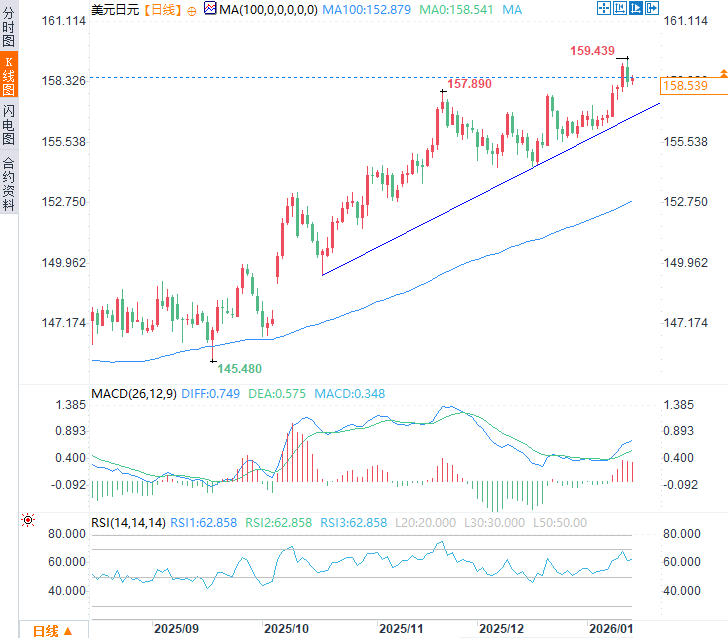
(USD/JPY daily chart, source: FX678)
Conclusion : The yen's balance remains fragile. Election-related fiscal uncertainty and the unresolved risk of intervention continue to anchor the currency near its lows, keeping traders cautious and highly sensitive to any shifts in tone from Japanese policymakers or the central bank.
At 14:36 Beijing time, the US dollar was trading at 158.56/57 against the Japanese yen.
Despite finding short-term support, the dollar/yen pair remains near the 18-month high reached the previous day, highlighting the fragility of this yen rally.
Since Prime Minister Sanae Takaichi took office in October 2025, the yen has depreciated by nearly 5%. This decline coincides with growing investor anxiety over its fiscal agenda, demonstrating a close link between political leadership changes and currency sentiment, even before specific policies are implemented.
Early elections raise concerns about fiscal and policy issues.
Reports indicate that Kaohsiung City plans to dissolve the House of Representatives and hold a snap election next week, exacerbating market anxiety. Given the already heavy public debt burden, the prospect of early voting has reignited speculation about increased fiscal spending. These expectations have put pressure not only on the yen but also on Japanese government bonds, both of which have recently faced renewed selling pressure.
Expectations of loose fiscal policy have complicated the Bank of Japan's outlook. Market concerns about additional government spending, coupled with uncertainty about the central bank's interest rate path, have further exacerbated downward pressure on the currency. The correlation between the election timing and the yen's weakness reflects a causal mechanism driven by expectations of higher borrowing and fiscal expansion, rather than current economic data.
Intervention Risks and Market Skepticism
With yen trading near historical levels associated with official intervention, traders remain wary of potential direct action from Japanese authorities. DBS Bank FX strategists noted that verbal warnings have so far helped limit further losses, but investors may test whether policymakers are prepared to go beyond mere rhetoric.
For the yen to achieve a more sustainable recovery, markets are looking for clearer signals. A more assertive stance from the Bank of Japan and greater transparency regarding Japan's fiscal and political direction are seen as necessary. Without these, any appreciation driven solely by warnings is likely to be temporary, highlighting the limitations of communication-based measures.
The debate over the Fed's independence has cooled, and the dollar remains strong.
In global currency markets, the US dollar stabilized near a one-month high (99.27) after earlier volatility triggered by concerns about the Federal Reserve's independence, fluctuating around 99.15 during Thursday's Asian and European sessions. The dollar had briefly weakened earlier this week following criticism from Federal Reserve Chairman Jerome Powell of the Trump administration's decision to subpoena him, which he described as pressure to ease monetary policy.
Since then, the dollar has recovered some ground and is flat this week as investors appear to have downplayed the immediate impact of the dispute. Support for Powell from global central bank governors and most Federal Reserve policymakers has helped reassure markets that institutional independence remains intact, a factor closely linked to monetary stability.
US data reinforces interest rate expectations.
Attention is increasingly shifting back to the fundamentals of the U.S. economy. Recent data showed that producer prices rose modestly in November, partly due to higher gasoline costs, while retail sales exceeded expectations. This data reinforces market expectations that the Federal Reserve will keep interest rates unchanged in January.
The market continues to anticipate two rate cuts later in 2026, and expects this to happen before Powell's term ends. This outlook provides a stable backdrop for the dollar, limiting its spillover effects on major currency pairs.
Technical Analysis
The daily chart shows that USD/JPY is still trading steadily above the upward trend line, and both the 14-day Relative Strength Index (RSI) and the MACD oscillator are in positive territory, indicating a bullish bias in the future. This means that the bearish pressure on the yen still exists significantly.
On the upside, the previous day's high of 159.44 will become a short-term resistance level. If this resistance level is broken, the next resistance level to watch is the key psychological level of 160.00.
On the downside, the upward trendline around 156.70 forms the first line of support, while the 100-day moving average (MA, 152.88) forms a key support level. A break below this support level could reverse the bullish trend and push the exchange rate downward.
(USD/JPY daily chart, source: FX678)
Conclusion : The yen's balance remains fragile. Election-related fiscal uncertainty and the unresolved risk of intervention continue to anchor the currency near its lows, keeping traders cautious and highly sensitive to any shifts in tone from Japanese policymakers or the central bank.
At 14:36 Beijing time, the US dollar was trading at 158.56/57 against the Japanese yen.
- Risk Warning and Disclaimer
- The market involves risk, and trading may not be suitable for all investors. This article is for reference only and does not constitute personal investment advice, nor does it take into account certain users’ specific investment objectives, financial situation, or other needs. Any investment decisions made based on this information are at your own risk.