As geopolitical tensions between Venezuela and the United States stabilize and supply expectations recover, international oil prices have fallen sharply.
2026-01-15 15:48:43
On Thursday (January 15), during the Asian and European sessions, the international crude oil market experienced a sharp drop, with both benchmark contracts falling by about 3% simultaneously. The core trigger for the market reversal was the signal released by US President Trump that expectations for military action against Iran had cooled down.
As of press time, WTI crude oil prices plummeted by $2.06, or 3.31%, to $59.83 per barrel; Brent crude oil also fell by $2.32, or 3.49%, to $64.19 per barrel.
Earlier this week, Middle East geopolitical risk premiums continued to push oil prices higher, but Trump's latest remarks directly cut off this upward trend, causing market bulls to flee in panic and completely reversing the short-term trend.
Trump publicly stated that the crackdown on protesters in Iran had eased and that the Iranian authorities had no plans for mass executions. This statement significantly reduced the likelihood of an immediate US military strike against Iran, and the geopolitical risk premium that had previously been supporting oil prices contracted sharply.

With the geopolitical premium fading, crude oil traders were forced to refocus their attention on bearish fundamental factors.
On the one hand, the increase in US crude oil inventories last week far exceeded market expectations, highlighting the current loose supply pressure in the market;
On the other hand, the United States completed its first sale of Venezuelan crude oil on Wednesday, sending a clear signal that the return of Venezuelan crude oil to the international market is imminent, and the subsequent increase in global crude oil supply warrants attention.
In fact, industry consulting firm Ampherus had already released a forecast report regarding the prospects for the recovery of Venezuelan crude oil production capacity.
The report points out that after the Trump administration took control of Venezuela's long-time leader Nicolás Maduro, the country's crude oil production will increase by 50%, reaching 1.5 million barrels per day by 2035; in the most optimistic scenario, Venezuela's crude oil production is expected to triple in the next decade, reaching 3 million barrels per day.
However, Anfluus also offered a sober prediction: the 30 to 50 million barrels of crude oil ordered by the Trump administration from Venezuela to be transferred to the United States will not have a substantial impact on the global crude oil market.
In a public statement, the head of the organization’s macro research department, Al Salazar, emphasized: “Even if the pace of sanctions easing accelerates, we still predict that the global crude oil market will face a supply surplus of 1 million to 2 million barrels per day in the first half of 2026, and the incremental crude oil that Venezuela can release will be very limited.”
This assessment is well-founded given the current state of Venezuela's oil industry. Despite possessing the world's largest proven oil reserves, totaling approximately 303 billion barrels, Venezuela's oil production has shrunk dramatically from over 3 million barrels per day in the late 1990s to less than 1 million barrels per day currently, hampered by a long-term lack of investment, mismanagement, and international sanctions.
The country's existing crude oil infrastructure, including pipelines, wellhead facilities, and refineries, is severely aging and in disrepair. Restoring it would require not only hundreds of billions of dollars in capital injection but also several years of work. Currently, many oil wells are shut down and idle, and no large-scale exploration drilling operations have been conducted in the country for many years.
Many market analysts estimate that to boost Venezuela's crude oil production to its historical peak of 3.5 million barrels per day in the 1970s, it would require not only the entry of over $100 billion in international capital and the comprehensive reconstruction of infrastructure, but also the removal of a series of political and legal uncertainties.
Last week, US President Trump lobbied executives of oil industry giants, urging them to invest huge sums of capital to revitalize Venezuela's sluggish oil industry, but this investment effort ultimately had little effect.
ExxonMobil CEO Darren Woods offered the most incisive assessment, stating bluntly that under the country's current business operating framework and oil and gas resource regulations, this South American country is "completely not a viable investment."
ConocoPhillips CEO Ryan Lance also issued an objective risk warning to the Trump administration, stating that his company suffered billions of dollars in losses during the withdrawal of Venezuela from the market under Chavez's administration.
In stark contrast, some energy companies remain positive about the Venezuelan market.
Hilco Energy CEO Jeff Hildebrand stated that his company is ready to participate in the reconstruction of Venezuela's energy infrastructure; Chevron said it could "almost immediately increase" its 240,000 barrels per day crude oil production capacity in Venezuela by 100%.
For the crude oil trading market, the core logic of the current battle between bulls and bears has shifted from geopolitical conflicts to supply and demand fundamentals.
Although Trump's remarks have temporarily cooled the market, protests in Iran have not subsided, and the future development of the situation remains highly uncertain. Meanwhile, the recovery process of Venezuela's oil production capacity will be a key variable affecting the medium- to long-term oil supply pattern.
As mentioned in yesterday's article, crude oil prices have risen too quickly recently due to bets on geopolitical risks. After reaching the upper limit of the trading range, if there are no additional negative geopolitical factors, oil prices will show that the positive factors have been priced in and will easily pull back.
In the short term, after this sharp drop, the oil market may enter a period of consolidation. Traders need to pay close attention to the dual guidance of geopolitical situation and inventory data.
Currently, support is found at the 5-day moving average and around 58.43 below, while resistance is at the upper edge of the trading range.
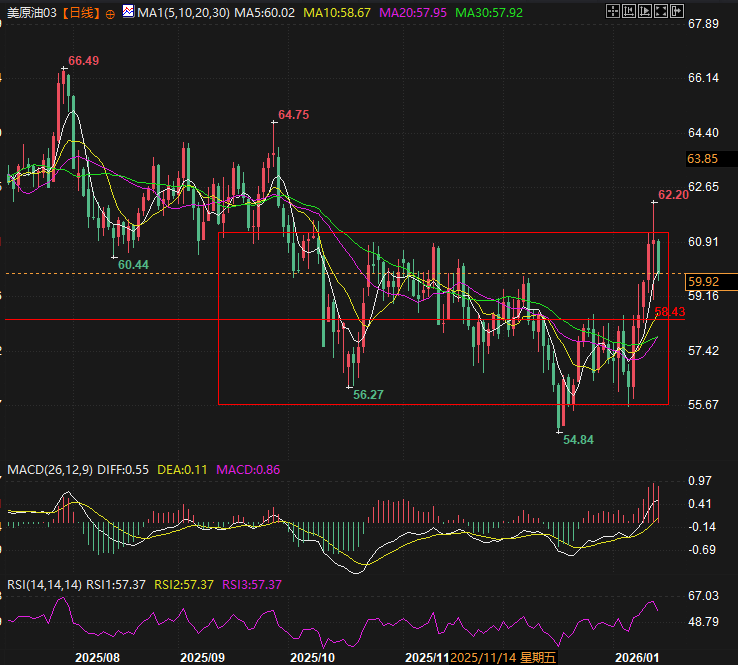
(Daily chart of US crude oil March futures contract, source: FX678)
At 15:47 Beijing time, the March futures contract for US crude oil was trading at $59.96 per barrel.
As of press time, WTI crude oil prices plummeted by $2.06, or 3.31%, to $59.83 per barrel; Brent crude oil also fell by $2.32, or 3.49%, to $64.19 per barrel.
Earlier this week, Middle East geopolitical risk premiums continued to push oil prices higher, but Trump's latest remarks directly cut off this upward trend, causing market bulls to flee in panic and completely reversing the short-term trend.
Trump publicly stated that the crackdown on protesters in Iran had eased and that the Iranian authorities had no plans for mass executions. This statement significantly reduced the likelihood of an immediate US military strike against Iran, and the geopolitical risk premium that had previously been supporting oil prices contracted sharply.
Negative fundamentals have resurfaced, highlighting the pressure of loose supply and demand.
With the geopolitical premium fading, crude oil traders were forced to refocus their attention on bearish fundamental factors.
On the one hand, the increase in US crude oil inventories last week far exceeded market expectations, highlighting the current loose supply pressure in the market;
On the other hand, the United States completed its first sale of Venezuelan crude oil on Wednesday, sending a clear signal that the return of Venezuelan crude oil to the international market is imminent, and the subsequent increase in global crude oil supply warrants attention.
Venezuela's production capacity outlook: Optimistic targets cannot mask the constraints of reality.
In fact, industry consulting firm Ampherus had already released a forecast report regarding the prospects for the recovery of Venezuelan crude oil production capacity.
The report points out that after the Trump administration took control of Venezuela's long-time leader Nicolás Maduro, the country's crude oil production will increase by 50%, reaching 1.5 million barrels per day by 2035; in the most optimistic scenario, Venezuela's crude oil production is expected to triple in the next decade, reaching 3 million barrels per day.
However, Anfluus also offered a sober prediction: the 30 to 50 million barrels of crude oil ordered by the Trump administration from Venezuela to be transferred to the United States will not have a substantial impact on the global crude oil market.
In a public statement, the head of the organization’s macro research department, Al Salazar, emphasized: “Even if the pace of sanctions easing accelerates, we still predict that the global crude oil market will face a supply surplus of 1 million to 2 million barrels per day in the first half of 2026, and the incremental crude oil that Venezuela can release will be very limited.”
This assessment is well-founded given the current state of Venezuela's oil industry. Despite possessing the world's largest proven oil reserves, totaling approximately 303 billion barrels, Venezuela's oil production has shrunk dramatically from over 3 million barrels per day in the late 1990s to less than 1 million barrels per day currently, hampered by a long-term lack of investment, mismanagement, and international sanctions.
The country's existing crude oil infrastructure, including pipelines, wellhead facilities, and refineries, is severely aging and in disrepair. Restoring it would require not only hundreds of billions of dollars in capital injection but also several years of work. Currently, many oil wells are shut down and idle, and no large-scale exploration drilling operations have been conducted in the country for many years.
Many market analysts estimate that to boost Venezuela's crude oil production to its historical peak of 3.5 million barrels per day in the 1970s, it would require not only the entry of over $100 billion in international capital and the comprehensive reconstruction of infrastructure, but also the removal of a series of political and legal uncertainties.
Oil companies are divided, and the prospects for investing in Venezuela remain uncertain.
Last week, US President Trump lobbied executives of oil industry giants, urging them to invest huge sums of capital to revitalize Venezuela's sluggish oil industry, but this investment effort ultimately had little effect.
ExxonMobil CEO Darren Woods offered the most incisive assessment, stating bluntly that under the country's current business operating framework and oil and gas resource regulations, this South American country is "completely not a viable investment."
ConocoPhillips CEO Ryan Lance also issued an objective risk warning to the Trump administration, stating that his company suffered billions of dollars in losses during the withdrawal of Venezuela from the market under Chavez's administration.
In stark contrast, some energy companies remain positive about the Venezuelan market.
Hilco Energy CEO Jeff Hildebrand stated that his company is ready to participate in the reconstruction of Venezuela's energy infrastructure; Chevron said it could "almost immediately increase" its 240,000 barrels per day crude oil production capacity in Venezuela by 100%.
Summary and Technical Analysis:
For the crude oil trading market, the core logic of the current battle between bulls and bears has shifted from geopolitical conflicts to supply and demand fundamentals.
Although Trump's remarks have temporarily cooled the market, protests in Iran have not subsided, and the future development of the situation remains highly uncertain. Meanwhile, the recovery process of Venezuela's oil production capacity will be a key variable affecting the medium- to long-term oil supply pattern.
As mentioned in yesterday's article, crude oil prices have risen too quickly recently due to bets on geopolitical risks. After reaching the upper limit of the trading range, if there are no additional negative geopolitical factors, oil prices will show that the positive factors have been priced in and will easily pull back.
In the short term, after this sharp drop, the oil market may enter a period of consolidation. Traders need to pay close attention to the dual guidance of geopolitical situation and inventory data.
Currently, support is found at the 5-day moving average and around 58.43 below, while resistance is at the upper edge of the trading range.
(Daily chart of US crude oil March futures contract, source: FX678)
At 15:47 Beijing time, the March futures contract for US crude oil was trading at $59.96 per barrel.
- Risk Warning and Disclaimer
- The market involves risk, and trading may not be suitable for all investors. This article is for reference only and does not constitute personal investment advice, nor does it take into account certain users’ specific investment objectives, financial situation, or other needs. Any investment decisions made based on this information are at your own risk.