The euro has plummeted to the point of despair; is the rebound just an illusion?
2026-01-19 16:39:31
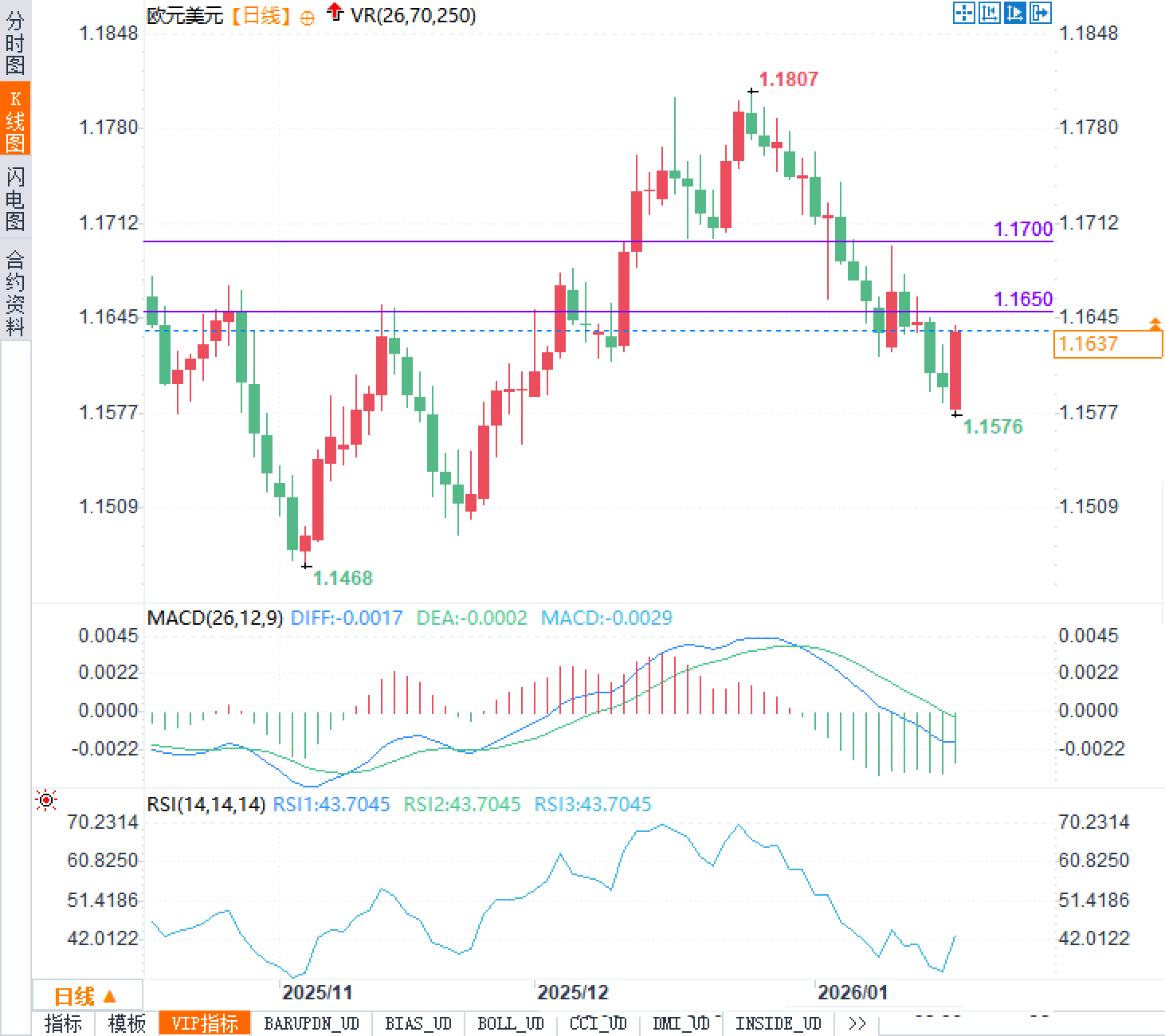
The euro has been generally weak against the US dollar recently, hitting a new low for the year at one point. It began to rebound on Monday (January 19th), trading around 1.1630 during the European session. The exchange rate encountered significant resistance when attempting to break through 1.1700, indicating strong selling pressure in that area.

From a daily chart perspective, the previous high was at 1.1807, after which the price gradually fell and broke through the key support level of 1.1650. Currently, the short-term direction of the exchange rate is unclear. Technically, the MACD indicator is still running below the zero line, with the current DIFF at -0.0017, DEA at -0.0002, and MACD histogram at -0.0029, indicating that although the bearish momentum has not expanded significantly, the trend remains bearish. The RSI indicator is approximately 43.7, in the neutral to weak range, indicating that the bears still dominate, but it has not yet entered an extremely oversold state, meaning that the price may fluctuate around the support level.
If the price can regain a foothold above 1.1650, it may retest 1.1700 in the short term; a break above this level could alleviate downward pressure and shift the target to the previous high around 1.1807. Conversely, if 1.1600 is breached, the price could quickly slide towards the support level of 1.1576, and further down, it could challenge the previous low around 1.1468.
Recent news about geopolitics has been emerging in the market, with US President Donald Trump sending signals on issues such as Greenland and Iran, raising concerns about international tensions.
Analysts believe that such geopolitical news is currently more like "emotional noise," which may disrupt market sentiment in the short term but is unlikely to change the fundamental trend of exchange rates. What truly determines the euro's direction remains the comparison between interest rate expectations and economic fundamentals. Especially under the current trading logic dominated by interest rate differentials, the attractiveness of dollar assets remains a core variable, while the lack of sufficiently strong growth or inflation signals from Europe makes it difficult for the euro to escape its passive position.
More noteworthy are the internal dynamics within the Federal Reserve. The U.S. Department of Justice recently subpoenaed the Fed, demanding Chairman Jerome Powell provide further explanation to Congress regarding the headquarters renovation project, exacerbating market concerns about its independence. Meanwhile, Powell's term ends this May, with his successor still unclear and the possibility of a policy shift uncertain. These factors combined have made investors' judgments on the future path of interest rates even more blurred.
Currently, Federal Reserve officials generally suggest that there may only be one rate cut in 2026, and that the Fed will most likely hold rates steady at its annual meeting; however, traders still tend to bet on at least two rate cuts throughout the year. This divergence in expectations makes it difficult for trading to form a unified direction, resulting in a peculiar state in the foreign exchange market: "news is abundant, but volatility is lacking"—news keeps coming, but the market remains calm.
The series of macroeconomic data released last week failed to deliver a significant enough shock to reverse the trend. The US Consumer Price Index (CPI) rose 2.7% year-on-year in December, while the core CPI was 2.6%, both unchanged from the previous month at 0.3%, indicating that the decline in inflation is not smooth and price pressures are quite persistent. This means that the Federal Reserve is unlikely to cut interest rates in the short term, providing some support for the US dollar.
On the demand side, US retail sales rose 0.6% month-on-month in November, a significant improvement from the revised -0.1% in October. However, the controlled retail sales group, which better reflects consumption trends, only grew by 0.4%, lower than the previous value of 0.6%, indicating that the consumption recovery is not comprehensive and its momentum is limited. Furthermore, the core producer price index (PPI) reached 3% year-on-year, which also dampened market expectations for rapid monetary easing to some extent.
In summary, this data was neither strong enough to make the Federal Reserve turn hawkish, nor weak enough to prompt the market to immediately price in a significant rate cut; its overall impact was neutral. This also explains why the dollar failed to surge, and why the euro lacked the momentum to break through against the dollar.
In contrast, while European data showed some improvement, the gains were limited. Germany's final harmonized CPI for December was confirmed at 2% year-on-year, with real GDP growth of 0.2% (previous figure -0.5%, revised). The Eurozone's Sentix investor confidence index for January rose to -1.8 (previous value -6.2), and industrial production grew 0.7% month-on-month in November. These figures indicate marginal signs of improvement in the European economy, but are far from sufficient to propel the euro out of its current independent trend. In the current pricing system centered on interest rate differentials, unless European inflation rebounds or growth accelerates significantly, the euro's rebound will remain highly dependent on the weakness of the US dollar itself or a systemic recovery in global risk appetite.
Looking ahead to the next few days, the market will be bombarded with a series of important data releases, which may break the current stalemate. In the Eurozone, the final Harmonized CPI for December, Germany's December PPI, the ZEW economic sentiment survey, and preliminary consumer confidence figures will be released. Meanwhile, the World Economic Forum in Davos officially opens, and speeches by ECB President Christine Lagarde and other high-ranking officials may trigger a reassessment of the ECB's policy pace.
The US data rollout is even more packed: Thursday will see the release of revised third-quarter GDP figures, weekly jobless claims, and the closely watched October and November Personal Consumption Expenditures (PCE) price index—the Federal Reserve's preferred inflation gauge. Friday will also see the release of the preliminary January Markit Purchasing Managers' Index (PMI), covering both manufacturing and services, a crucial window into economic momentum.
If subsequent inflation data continue to show a slow decline, especially with PCE remaining high, it could strengthen expectations that the Federal Reserve will maintain high interest rates for a longer period, thus supporting the dollar and limiting the euro's upside potential below 1.1650. Conversely, if the data weakens significantly, particularly if the PMI falls below the 50-point mark or PCE cools considerably, it could reignite expectations of interest rate cuts, providing the euro with an opportunity for upward correction.
Even with positive news, for the euro to truly reverse its downward trend, it must first recover the psychological level of 1.1650 and successfully challenge the strong resistance zone of 1.1700. Otherwise, any rebound could be seen as a short-term technical bounce, hardly indicating a trend reversal.
From a daily chart perspective, the previous high was at 1.1807, after which the price gradually fell and broke through the key support level of 1.1650. Currently, the short-term direction of the exchange rate is unclear. Technically, the MACD indicator is still running below the zero line, with the current DIFF at -0.0017, DEA at -0.0002, and MACD histogram at -0.0029, indicating that although the bearish momentum has not expanded significantly, the trend remains bearish. The RSI indicator is approximately 43.7, in the neutral to weak range, indicating that the bears still dominate, but it has not yet entered an extremely oversold state, meaning that the price may fluctuate around the support level.
If the price can regain a foothold above 1.1650, it may retest 1.1700 in the short term; a break above this level could alleviate downward pressure and shift the target to the previous high around 1.1807. Conversely, if 1.1600 is breached, the price could quickly slide towards the support level of 1.1576, and further down, it could challenge the previous low around 1.1468.
Amidst a flurry of rumors, it is the "invisible hand" that truly influences the market.
Recent news about geopolitics has been emerging in the market, with US President Donald Trump sending signals on issues such as Greenland and Iran, raising concerns about international tensions.
Analysts believe that such geopolitical news is currently more like "emotional noise," which may disrupt market sentiment in the short term but is unlikely to change the fundamental trend of exchange rates. What truly determines the euro's direction remains the comparison between interest rate expectations and economic fundamentals. Especially under the current trading logic dominated by interest rate differentials, the attractiveness of dollar assets remains a core variable, while the lack of sufficiently strong growth or inflation signals from Europe makes it difficult for the euro to escape its passive position.
More noteworthy are the internal dynamics within the Federal Reserve. The U.S. Department of Justice recently subpoenaed the Fed, demanding Chairman Jerome Powell provide further explanation to Congress regarding the headquarters renovation project, exacerbating market concerns about its independence. Meanwhile, Powell's term ends this May, with his successor still unclear and the possibility of a policy shift uncertain. These factors combined have made investors' judgments on the future path of interest rates even more blurred.
Currently, Federal Reserve officials generally suggest that there may only be one rate cut in 2026, and that the Fed will most likely hold rates steady at its annual meeting; however, traders still tend to bet on at least two rate cuts throughout the year. This divergence in expectations makes it difficult for trading to form a unified direction, resulting in a peculiar state in the foreign exchange market: "news is abundant, but volatility is lacking"—news keeps coming, but the market remains calm.
The data was "neither good nor bad," and the market entered a wait-and-see stalemate.
The series of macroeconomic data released last week failed to deliver a significant enough shock to reverse the trend. The US Consumer Price Index (CPI) rose 2.7% year-on-year in December, while the core CPI was 2.6%, both unchanged from the previous month at 0.3%, indicating that the decline in inflation is not smooth and price pressures are quite persistent. This means that the Federal Reserve is unlikely to cut interest rates in the short term, providing some support for the US dollar.
On the demand side, US retail sales rose 0.6% month-on-month in November, a significant improvement from the revised -0.1% in October. However, the controlled retail sales group, which better reflects consumption trends, only grew by 0.4%, lower than the previous value of 0.6%, indicating that the consumption recovery is not comprehensive and its momentum is limited. Furthermore, the core producer price index (PPI) reached 3% year-on-year, which also dampened market expectations for rapid monetary easing to some extent.
In summary, this data was neither strong enough to make the Federal Reserve turn hawkish, nor weak enough to prompt the market to immediately price in a significant rate cut; its overall impact was neutral. This also explains why the dollar failed to surge, and why the euro lacked the momentum to break through against the dollar.
In contrast, while European data showed some improvement, the gains were limited. Germany's final harmonized CPI for December was confirmed at 2% year-on-year, with real GDP growth of 0.2% (previous figure -0.5%, revised). The Eurozone's Sentix investor confidence index for January rose to -1.8 (previous value -6.2), and industrial production grew 0.7% month-on-month in November. These figures indicate marginal signs of improvement in the European economy, but are far from sufficient to propel the euro out of its current independent trend. In the current pricing system centered on interest rate differentials, unless European inflation rebounds or growth accelerates significantly, the euro's rebound will remain highly dependent on the weakness of the US dollar itself or a systemic recovery in global risk appetite.
Where's the next market move? Key data is coming soon.
Looking ahead to the next few days, the market will be bombarded with a series of important data releases, which may break the current stalemate. In the Eurozone, the final Harmonized CPI for December, Germany's December PPI, the ZEW economic sentiment survey, and preliminary consumer confidence figures will be released. Meanwhile, the World Economic Forum in Davos officially opens, and speeches by ECB President Christine Lagarde and other high-ranking officials may trigger a reassessment of the ECB's policy pace.
The US data rollout is even more packed: Thursday will see the release of revised third-quarter GDP figures, weekly jobless claims, and the closely watched October and November Personal Consumption Expenditures (PCE) price index—the Federal Reserve's preferred inflation gauge. Friday will also see the release of the preliminary January Markit Purchasing Managers' Index (PMI), covering both manufacturing and services, a crucial window into economic momentum.
If subsequent inflation data continue to show a slow decline, especially with PCE remaining high, it could strengthen expectations that the Federal Reserve will maintain high interest rates for a longer period, thus supporting the dollar and limiting the euro's upside potential below 1.1650. Conversely, if the data weakens significantly, particularly if the PMI falls below the 50-point mark or PCE cools considerably, it could reignite expectations of interest rate cuts, providing the euro with an opportunity for upward correction.
Even with positive news, for the euro to truly reverse its downward trend, it must first recover the psychological level of 1.1650 and successfully challenge the strong resistance zone of 1.1700. Otherwise, any rebound could be seen as a short-term technical bounce, hardly indicating a trend reversal.
- Risk Warning and Disclaimer
- The market involves risk, and trading may not be suitable for all investors. This article is for reference only and does not constitute personal investment advice, nor does it take into account certain users’ specific investment objectives, financial situation, or other needs. Any investment decisions made based on this information are at your own risk.