A crossroads has emerged: How long can this yen rebound last?
2026-01-19 19:52:48
On Monday (January 19), the USD/JPY pair traded around 158.00 during the European session, consolidating in a range. It briefly dipped to 157.42 before quickly rebounding back to the 158 level. This price action reflects market hesitation: there is neither sufficient momentum to push prices higher nor a clear downtrend has formed.

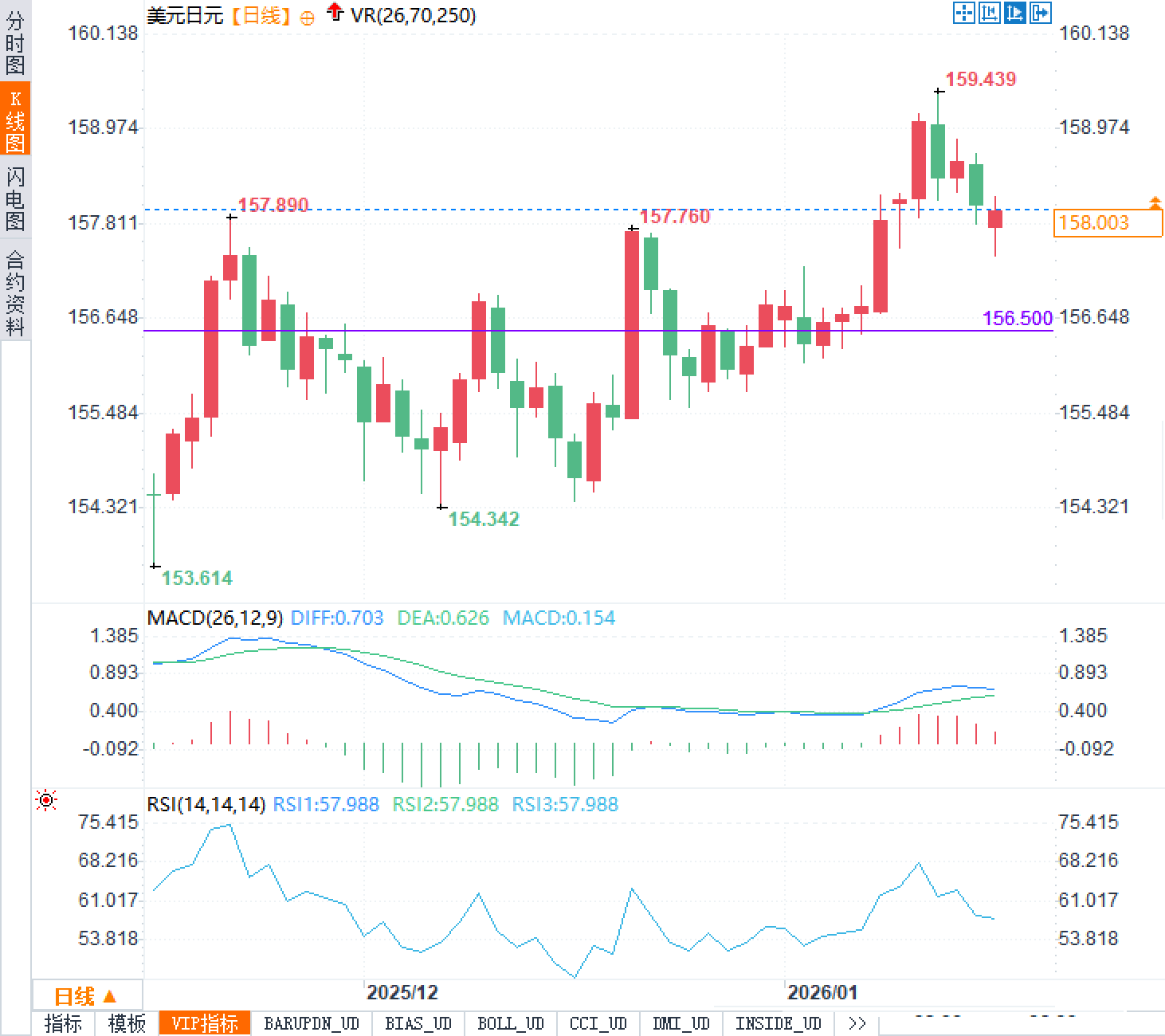
From a technical chart perspective, the exchange rate encountered resistance after reaching a high of 159.439, indicating increased selling pressure. The current key support level is around 156.500. If the price can hold this area, it can still be considered a normal correction within an uptrend. The 157.760 and 157.890 range has been repeatedly verified as important volatility points; a breakout with significant volume could lead to another challenge of 159.439. Currently, the MACD indicator shows DIFF at 0.703, DEA at 0.626, and the MACD histogram at 0.154, indicating an overall bullish bias, but with weak momentum. The RSI is at 57.988, at a neutral-to-strong level, neither overbought nor bearish, further confirming the characteristics of "slowing uptrend and entering a period of consolidation."
Recently, market focus has shifted to external risk factors, particularly Trump's proposal to impose a 10% tariff on some European countries starting February 1st, and to raise it to 25% in June if no agreement is reached regarding Greenland. This news has triggered concerns about escalating global trade tensions, leading to a temporary cooling of risk sentiment. Historical experience shows that tariff uncertainty often shakes economic growth expectations, thereby increasing market risk aversion. When traders become cautious, funds flow to more defensive assets, and interest rate expectations may be lowered due to a deteriorating growth outlook.
Lower interest rates will weaken the dollar's interest rate advantage, thus putting pressure on the dollar. The market is currently pricing in a cumulative 48 basis point rate cut by the Federal Reserve this year. Although Fed officials continue to emphasize "relying on data and remaining patient," a rate cut is not a certainty given that economic data has not yet shown significant weakness. This means the dollar does not have a basis for a unilateral decline, but its upward momentum, driven by risk sentiment, depends more on actual data rather than sentiment. In other words, whether the dollar can resume its upward trend depends on whether upcoming labor and inflation data support expectations of a later rate cut.
Meanwhile, support for the yen is quietly strengthening. On the one hand, Japan has recently made frequent statements regarding the exchange rate, emphasizing vigilance against "speculative fluctuations" and stating that it will take appropriate action if necessary. Although no specific intervention points have been disclosed, this verbal guidance has effectively increased the trading cost of shorting the yen, making the market more cautious as the USD/JPY pair approaches the 160 mark, objectively suppressing the speed of further upward movement in the exchange rate.
Beyond verbal intervention, the strengthening of the yen is driven by a deeper shift in underlying logic—a marginal turning point in expectations regarding the Bank of Japan's policy. Previously, the market had pushed the probability of a March rate hike to 22%, although this has since receded somewhat, but the possibility of an earlier rate hike by the Bank of Japan has been raised. Currently, the market expects a cumulative rate hike of approximately 46 basis points by the end of the year. This shift is significant: for many years, the core reason for the yen's weakness has been extremely low interest rates and the large interest rate differential between the US and Japan. Now, as long as the market begins to believe that the Bank of Japan may move towards monetary policy normalization more quickly, even if it's just an expectation, it will add a foothold to the yen's interest rate differential logic, making it difficult for the USD/JPY exchange rate to experience a one-sided upward trend.
Furthermore, political events are also disrupting market sentiment. Japanese Prime Minister Takaichi announced a snap election on February 8th, following her earlier confirmation that the House of Representatives would be dissolved on the 23rd. Political uncertainty often triggers discussions about the continuity of fiscal policy and debt management. In her speech, she mentioned that she would pay attention to foreign exchange and interest rate changes when considering the source of funds for the consumption tax cut, and emphasized the importance of reducing the debt-to-GDP ratio. If these statements are interpreted as a possible increase in fiscal expansion in the future, theoretically, this would exert long-term downward pressure on the yen. However, in the short term, the policy uncertainty brought about by the election is more likely to trigger adjustments in trading positions, especially when the market has accumulated a large number of short yen positions. Once the wind changes, a typical volatility pattern of "buy on rumors, sell on the results" may occur—that is, expectations drive the yen to rebound, but profit-taking occurs after the results are announced.
Looking ahead, the USD/JPY exchange rate may follow one of three paths. The first is a scenario of continued risk aversion: if the tariff issue continues to escalate, dampening global growth expectations and leading to a downward revision of the interest rate outlook, the dollar will come under pressure, while safe-haven funds will flow into the yen. The exchange rate may continue to approach 157.42, and may even test the key support level of 156.500. In this case, the yen's strength would be primarily driven by sentiment and positioning, rather than a fundamental improvement in the Japanese economic fundamentals.
The second path is a renewed rise in expectations for a Bank of Japan interest rate hike. If the market re-escalates the probability of a March rate hike, or if year-end rate hike expectations rise further from the current 46 basis points, the yen will receive stronger support. In that case, even if the dollar stabilizes, the USD/JPY pair will face stronger resistance above 158.00, potentially experiencing a "rise and fall" consolidation pattern, or even initiating a high-level correction.
The third scenario is that the US dollar regains dominance. If subsequent US economic data is strong, significantly lowering market expectations for a 48-basis-point rate cut by the Federal Reserve, the dollar's interest rate advantage will return, and the exchange rate may resume its upward trend and challenge the previous high of 159.439 again. However, it should be noted that even in this scenario, Japan's wary attitude towards excessive exchange rate volatility will make the upward process fraught with twists and turns, frequently resulting in a "rise-fall" pattern.
From a technical chart perspective, the exchange rate encountered resistance after reaching a high of 159.439, indicating increased selling pressure. The current key support level is around 156.500. If the price can hold this area, it can still be considered a normal correction within an uptrend. The 157.760 and 157.890 range has been repeatedly verified as important volatility points; a breakout with significant volume could lead to another challenge of 159.439. Currently, the MACD indicator shows DIFF at 0.703, DEA at 0.626, and the MACD histogram at 0.154, indicating an overall bullish bias, but with weak momentum. The RSI is at 57.988, at a neutral-to-strong level, neither overbought nor bearish, further confirming the characteristics of "slowing uptrend and entering a period of consolidation."
Driver Logic Reassessment: The Struggle Between Risk and Interest Rate Spreads
Recently, market focus has shifted to external risk factors, particularly Trump's proposal to impose a 10% tariff on some European countries starting February 1st, and to raise it to 25% in June if no agreement is reached regarding Greenland. This news has triggered concerns about escalating global trade tensions, leading to a temporary cooling of risk sentiment. Historical experience shows that tariff uncertainty often shakes economic growth expectations, thereby increasing market risk aversion. When traders become cautious, funds flow to more defensive assets, and interest rate expectations may be lowered due to a deteriorating growth outlook.
Lower interest rates will weaken the dollar's interest rate advantage, thus putting pressure on the dollar. The market is currently pricing in a cumulative 48 basis point rate cut by the Federal Reserve this year. Although Fed officials continue to emphasize "relying on data and remaining patient," a rate cut is not a certainty given that economic data has not yet shown significant weakness. This means the dollar does not have a basis for a unilateral decline, but its upward momentum, driven by risk sentiment, depends more on actual data rather than sentiment. In other words, whether the dollar can resume its upward trend depends on whether upcoming labor and inflation data support expectations of a later rate cut.
Meanwhile, support for the yen is quietly strengthening. On the one hand, Japan has recently made frequent statements regarding the exchange rate, emphasizing vigilance against "speculative fluctuations" and stating that it will take appropriate action if necessary. Although no specific intervention points have been disclosed, this verbal guidance has effectively increased the trading cost of shorting the yen, making the market more cautious as the USD/JPY pair approaches the 160 mark, objectively suppressing the speed of further upward movement in the exchange rate.
Is the yen staging a comeback? Policy expectations and political variables are at play.
Beyond verbal intervention, the strengthening of the yen is driven by a deeper shift in underlying logic—a marginal turning point in expectations regarding the Bank of Japan's policy. Previously, the market had pushed the probability of a March rate hike to 22%, although this has since receded somewhat, but the possibility of an earlier rate hike by the Bank of Japan has been raised. Currently, the market expects a cumulative rate hike of approximately 46 basis points by the end of the year. This shift is significant: for many years, the core reason for the yen's weakness has been extremely low interest rates and the large interest rate differential between the US and Japan. Now, as long as the market begins to believe that the Bank of Japan may move towards monetary policy normalization more quickly, even if it's just an expectation, it will add a foothold to the yen's interest rate differential logic, making it difficult for the USD/JPY exchange rate to experience a one-sided upward trend.
Furthermore, political events are also disrupting market sentiment. Japanese Prime Minister Takaichi announced a snap election on February 8th, following her earlier confirmation that the House of Representatives would be dissolved on the 23rd. Political uncertainty often triggers discussions about the continuity of fiscal policy and debt management. In her speech, she mentioned that she would pay attention to foreign exchange and interest rate changes when considering the source of funds for the consumption tax cut, and emphasized the importance of reducing the debt-to-GDP ratio. If these statements are interpreted as a possible increase in fiscal expansion in the future, theoretically, this would exert long-term downward pressure on the yen. However, in the short term, the policy uncertainty brought about by the election is more likely to trigger adjustments in trading positions, especially when the market has accumulated a large number of short yen positions. Once the wind changes, a typical volatility pattern of "buy on rumors, sell on the results" may occur—that is, expectations drive the yen to rebound, but profit-taking occurs after the results are announced.
Three paths ahead: the direction is just one trigger point away.
Looking ahead, the USD/JPY exchange rate may follow one of three paths. The first is a scenario of continued risk aversion: if the tariff issue continues to escalate, dampening global growth expectations and leading to a downward revision of the interest rate outlook, the dollar will come under pressure, while safe-haven funds will flow into the yen. The exchange rate may continue to approach 157.42, and may even test the key support level of 156.500. In this case, the yen's strength would be primarily driven by sentiment and positioning, rather than a fundamental improvement in the Japanese economic fundamentals.
The second path is a renewed rise in expectations for a Bank of Japan interest rate hike. If the market re-escalates the probability of a March rate hike, or if year-end rate hike expectations rise further from the current 46 basis points, the yen will receive stronger support. In that case, even if the dollar stabilizes, the USD/JPY pair will face stronger resistance above 158.00, potentially experiencing a "rise and fall" consolidation pattern, or even initiating a high-level correction.
The third scenario is that the US dollar regains dominance. If subsequent US economic data is strong, significantly lowering market expectations for a 48-basis-point rate cut by the Federal Reserve, the dollar's interest rate advantage will return, and the exchange rate may resume its upward trend and challenge the previous high of 159.439 again. However, it should be noted that even in this scenario, Japan's wary attitude towards excessive exchange rate volatility will make the upward process fraught with twists and turns, frequently resulting in a "rise-fall" pattern.
- Risk Warning and Disclaimer
- The market involves risk, and trading may not be suitable for all investors. This article is for reference only and does not constitute personal investment advice, nor does it take into account certain users’ specific investment objectives, financial situation, or other needs. Any investment decisions made based on this information are at your own risk.