Gold is surging! $4,700 is just around the corner, should you chase it or run?
2026-01-19 20:30:45
On Monday (January 19), spot gold opened strongly, briefly hitting a record high of $4,690.46. Although it subsequently retreated, it remained firmly above its previous highs, trading around $4,670 during the European session. Amidst escalating global uncertainty, traders' confidence in risk assets has begun to waver, turning their attention to traditional safe-haven assets like gold. Particularly during the Davos World Economic Forum week in Europe, the market did not see the expected signs of easing; instead, renewed tensions in transatlantic relations exacerbated concerns.

The EU has made it clear that there are currently no plans for a meeting between European Commission President Ursula von der Leyen and US President Donald Trump in Davos. Although the two sides are still in contact at different levels, the lack of communication is enough to raise market concerns.
What's even more nerve-wracking for the market is Trump's recent tariff threats. He announced a 10% tariff increase on goods from some European countries starting February 1st, and warned that if negotiations regarding Greenland fail, the tariff rate could rise to 25% on June 1st. While these statements haven't yet materialized into policy, they've been enough to stir up global trade expectations. Businesses are reassessing supply chain costs, and traders are divided on future inflation paths and growth prospects. This uncertainty is precisely the kind of environment gold thrives on—when reality is unclear and the future uncertain, funds always prioritize "safe havens" with high liquidity and low credit risk. Therefore, even without actual conflict, the rising expectations alone can provide trend-based support for gold.
Meanwhile, geopolitical tensions are quietly driving up safe-haven premiums. Ukraine has revealed that key facilities at its nuclear power plant face potential threats, further straining regional security; tensions in the Middle East also show no signs of abating, with repeated localized clashes.
While safe-haven demand has provided strong support for gold, its upside potential is not without limitations. The market's ongoing debate over the monetary policy paths of major central banks continues, particularly regarding changes in expectations regarding the pace of future interest rate cuts by the Federal Reserve, which has become a key variable influencing gold prices. This year, market sentiment towards premature or significant rate cuts by the Fed has become more conservative, and some economic data have shown strong resilience, leading to a growing preference for higher and longer-lasting interest rates. This backdrop has supported a temporary strengthening of the US dollar and has also led some funds to continue favoring highly liquid assets such as US Treasury bonds, thus diminishing the attractiveness of gold to some extent.
However, this interest rate advantage is not stable. When tariff disputes escalate and the global trade outlook becomes clouded, the stability of the US dollar itself will be challenged. Historically, it has been shown that during periods of heightened external shocks, the dollar may experience a short-term correction, while gold benefits from its safe-haven and non-credit characteristics. Currently, there is a trend of a weakening dollar combined with strengthening safe-haven assets, which is another force driving gold prices to new highs. However, analysts point out that as long as the Federal Reserve does not release clear easing signals, real interest rate expectations will remain high, which will naturally suppress gold, a non-interest-bearing asset.
Next, the market will closely watch the U.S. Personal Consumption Expenditures Price Index (PCE) and the final reading of third-quarter GDP, both to be released on Thursday. If inflation data shows stronger stickiness, it will further solidify expectations of high interest rates, and gold may face volatility or even downward pressure. Conversely, if inflation shows marginal cooling and economic growth is weak, expectations of easing and safe-haven sentiment may resonate, pushing gold prices towards $4,700.
From a technical chart perspective, although spot gold experienced a surge followed by a pullback, the overall bullish trend remains intact. Currently, the price is hovering around $4670, not far from the previous high of $4690.46, and only a step away from the psychologically important $4700 level. This position holds significant psychological and technical importance. A successful breakout and hold above this level, accompanied by strong trading volume, could trigger algorithmic buying and entry by technical traders, further opening up upward potential. Conversely, multiple failed attempts to break through, coupled with negative news or data releases, could lead to a concentrated exit of profits, causing a rapid price pullback.
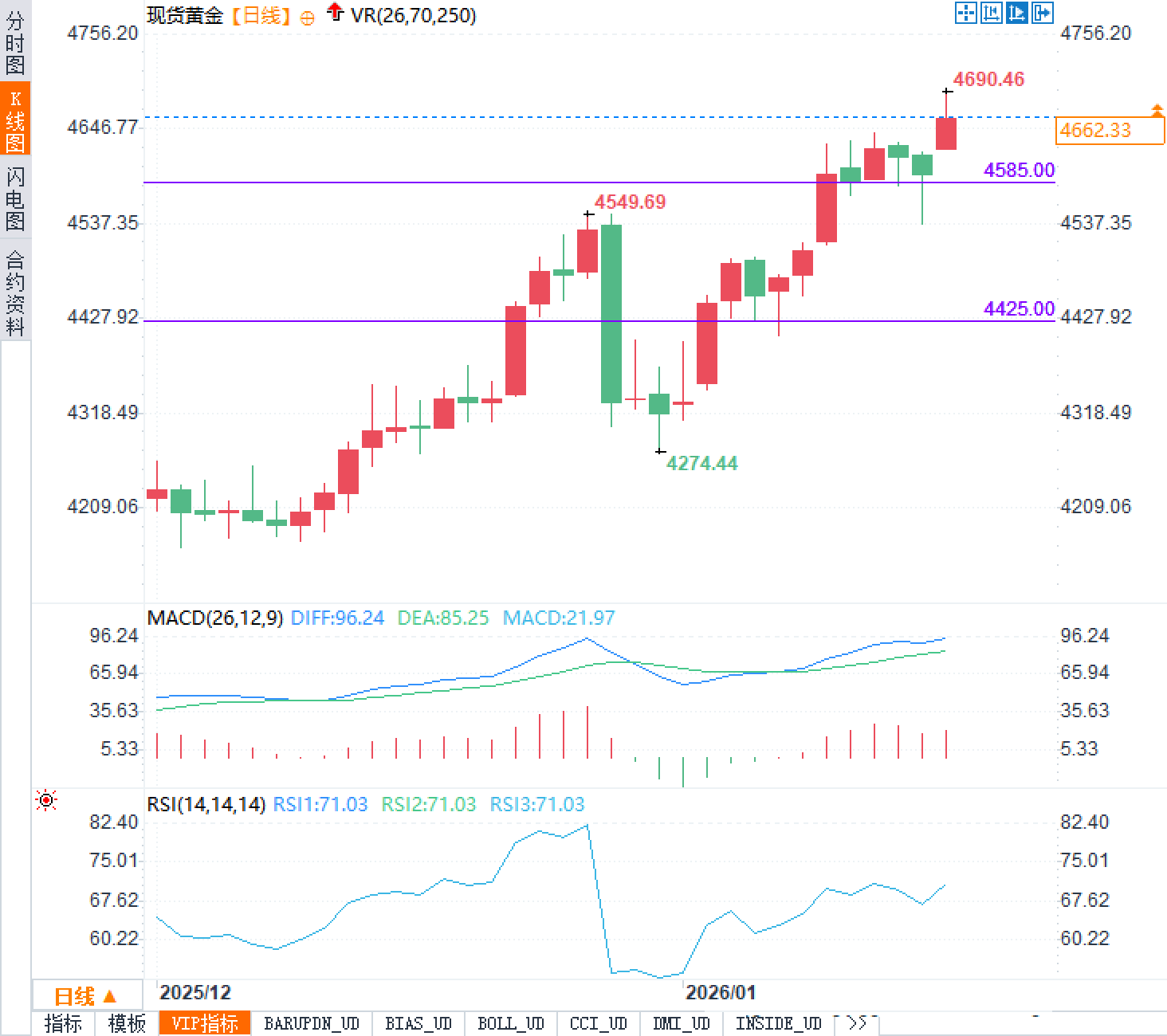
Two key support levels to watch are $4585.00 and $4425.00. These levels have acted as support multiple times in the past. If a pullback can stabilize within this range, it will likely be considered a strong consolidation rather than a trend reversal. However, if it breaks below these levels with increased volume, it's worth noting the possibility of a short-term shift from strength to weakness, and the market may be entering a repricing phase. In terms of indicators, the daily MACD remains in a relatively strong zone, indicating that upward momentum has not yet exhausted; while the RSI reading has reached 71.03, entering a slightly overbought zone, suggesting that the risk of chasing the rally in the short term is increasing.
Overall, the current logic behind gold price movements is both clear and complex: on the one hand, escalating trade frictions, frequent geopolitical risks, and rising global uncertainty have collectively built a solid safe-haven foundation; on the other hand, monetary policy expectations have not fully shifted towards easing, and the suppression of real interest rates remains, limiting the upward slope of gold prices. The core short-term contradiction lies in whether safe-haven sentiment can continue to outweigh interest rate constraints. If Trump's tariff rhetoric continues to escalate, geopolitical conflicts show no signs of easing, and key economic data does not significantly reinforce expectations of "high interest rates for a longer period," then gold still has a considerable probability of challenging the $4,700 mark.
Conversely, if risk sentiment cools, data is strong, and the Federal Reserve releases hawkish signals, then a sharp pullback due to concentrated profit-taking at high levels should be anticipated. Regardless of how things unfold, market volatility is bound to intensify at prices near historical peaks.
The EU has made it clear that there are currently no plans for a meeting between European Commission President Ursula von der Leyen and US President Donald Trump in Davos. Although the two sides are still in contact at different levels, the lack of communication is enough to raise market concerns.
What's even more nerve-wracking for the market is Trump's recent tariff threats. He announced a 10% tariff increase on goods from some European countries starting February 1st, and warned that if negotiations regarding Greenland fail, the tariff rate could rise to 25% on June 1st. While these statements haven't yet materialized into policy, they've been enough to stir up global trade expectations. Businesses are reassessing supply chain costs, and traders are divided on future inflation paths and growth prospects. This uncertainty is precisely the kind of environment gold thrives on—when reality is unclear and the future uncertain, funds always prioritize "safe havens" with high liquidity and low credit risk. Therefore, even without actual conflict, the rising expectations alone can provide trend-based support for gold.
Meanwhile, geopolitical tensions are quietly driving up safe-haven premiums. Ukraine has revealed that key facilities at its nuclear power plant face potential threats, further straining regional security; tensions in the Middle East also show no signs of abating, with repeated localized clashes.
The tug-of-war over monetary policy limits gold's rise but does not reverse course.
While safe-haven demand has provided strong support for gold, its upside potential is not without limitations. The market's ongoing debate over the monetary policy paths of major central banks continues, particularly regarding changes in expectations regarding the pace of future interest rate cuts by the Federal Reserve, which has become a key variable influencing gold prices. This year, market sentiment towards premature or significant rate cuts by the Fed has become more conservative, and some economic data have shown strong resilience, leading to a growing preference for higher and longer-lasting interest rates. This backdrop has supported a temporary strengthening of the US dollar and has also led some funds to continue favoring highly liquid assets such as US Treasury bonds, thus diminishing the attractiveness of gold to some extent.
However, this interest rate advantage is not stable. When tariff disputes escalate and the global trade outlook becomes clouded, the stability of the US dollar itself will be challenged. Historically, it has been shown that during periods of heightened external shocks, the dollar may experience a short-term correction, while gold benefits from its safe-haven and non-credit characteristics. Currently, there is a trend of a weakening dollar combined with strengthening safe-haven assets, which is another force driving gold prices to new highs. However, analysts point out that as long as the Federal Reserve does not release clear easing signals, real interest rate expectations will remain high, which will naturally suppress gold, a non-interest-bearing asset.
Next, the market will closely watch the U.S. Personal Consumption Expenditures Price Index (PCE) and the final reading of third-quarter GDP, both to be released on Thursday. If inflation data shows stronger stickiness, it will further solidify expectations of high interest rates, and gold may face volatility or even downward pressure. Conversely, if inflation shows marginal cooling and economic growth is weak, expectations of easing and safe-haven sentiment may resonate, pushing gold prices towards $4,700.
Technically, the market is consolidating at high levels; whether it breaks through or not will determine its future direction.
From a technical chart perspective, although spot gold experienced a surge followed by a pullback, the overall bullish trend remains intact. Currently, the price is hovering around $4670, not far from the previous high of $4690.46, and only a step away from the psychologically important $4700 level. This position holds significant psychological and technical importance. A successful breakout and hold above this level, accompanied by strong trading volume, could trigger algorithmic buying and entry by technical traders, further opening up upward potential. Conversely, multiple failed attempts to break through, coupled with negative news or data releases, could lead to a concentrated exit of profits, causing a rapid price pullback.
Two key support levels to watch are $4585.00 and $4425.00. These levels have acted as support multiple times in the past. If a pullback can stabilize within this range, it will likely be considered a strong consolidation rather than a trend reversal. However, if it breaks below these levels with increased volume, it's worth noting the possibility of a short-term shift from strength to weakness, and the market may be entering a repricing phase. In terms of indicators, the daily MACD remains in a relatively strong zone, indicating that upward momentum has not yet exhausted; while the RSI reading has reached 71.03, entering a slightly overbought zone, suggesting that the risk of chasing the rally in the short term is increasing.
Overall Outlook: The tug-of-war between bulls and bears has intensified.
Overall, the current logic behind gold price movements is both clear and complex: on the one hand, escalating trade frictions, frequent geopolitical risks, and rising global uncertainty have collectively built a solid safe-haven foundation; on the other hand, monetary policy expectations have not fully shifted towards easing, and the suppression of real interest rates remains, limiting the upward slope of gold prices. The core short-term contradiction lies in whether safe-haven sentiment can continue to outweigh interest rate constraints. If Trump's tariff rhetoric continues to escalate, geopolitical conflicts show no signs of easing, and key economic data does not significantly reinforce expectations of "high interest rates for a longer period," then gold still has a considerable probability of challenging the $4,700 mark.
Conversely, if risk sentiment cools, data is strong, and the Federal Reserve releases hawkish signals, then a sharp pullback due to concentrated profit-taking at high levels should be anticipated. Regardless of how things unfold, market volatility is bound to intensify at prices near historical peaks.
- Risk Warning and Disclaimer
- The market involves risk, and trading may not be suitable for all investors. This article is for reference only and does not constitute personal investment advice, nor does it take into account certain users’ specific investment objectives, financial situation, or other needs. Any investment decisions made based on this information are at your own risk.