As risk aversion eases, the USD/JPY pair continues its rebound.
2026-01-22 13:30:10
On Thursday during Asian trading hours, the yen fluctuated within a relatively narrow range against the dollar, with a clear tug-of-war between bulls and bears. On one hand, US President Trump signaled a de-escalation on the Greenland issue and temporarily suspended tariffs on European countries, boosting global risk appetite and weakening the appeal of traditional safe-haven assets such as the yen.
Risk assets rebounded sharply on related news, and the spillover of risk sentiment also boosted Asian markets, further suppressing the safe-haven demand for the yen.
On the other hand, domestic fundamentals in Japan have not provided clear support for the yen. The Japanese government bond market experienced a sharp sell-off this week, with concerns about Prime Minister Sanae Takashi's fiscal expansion policies, coupled with a weak response to the 20-year bond auction, pushing long-term bond yields to record highs.
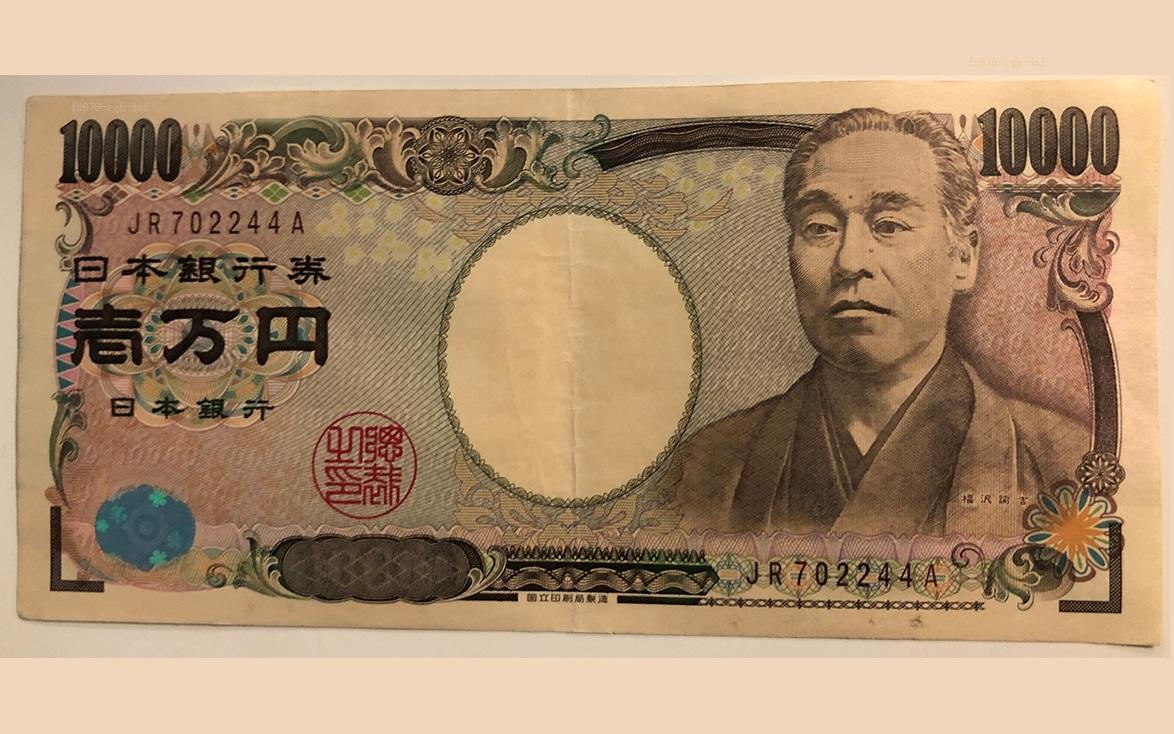
This bond market turmoil has weakened overseas investors' confidence in yen assets, making yen bulls cautious. However, the downside potential of the yen is also limited by multiple factors.
The market generally believes that the Japanese authorities are unlikely to tolerate a continued rapid depreciation of the yen. Finance Minister Satsuki Katayama has previously hinted that he does not rule out joint intervention with the United States to deal with excessive exchange rate volatility.
Furthermore, the Bank of Japan's policy expectations also provide potential support for the yen. Recent reports indicate that some officials within the Bank of Japan believe conditions for a further interest rate hike could be met as early as April. The inflationary backdrop has also reinforced expectations of a policy shift.
The Bank of Japan's latest survey shows that most households expect prices to continue to rise in the coming years, while official data shows that Japan's inflation has been above the central bank's 2% target level for four consecutive calendar years.
A weaker yen could exacerbate imported inflation, forcing central banks to act more quickly on the path to policy normalization.
Against this backdrop, the market is choosing to remain cautious ahead of the Bank of Japan's meeting. The Bank of Japan will announce its interest rate decision on Friday, and the market widely expects it to maintain the status quo. The central bank previously raised the overnight rate to 0.75% in December last year, the highest level in 30 years.
The real focus will be on Governor Kazuo Ueda's remarks at the post-meeting press conference. His wording will directly influence the market's judgment on the timing of the next interest rate hike, thereby determining the directional trend of the yen.
Meanwhile, easing trade concerns provided some support, offering a short-term floor for the USD/JPY exchange rate. Investors are awaiting US PCE price index and quarterly GDP data for new drivers.
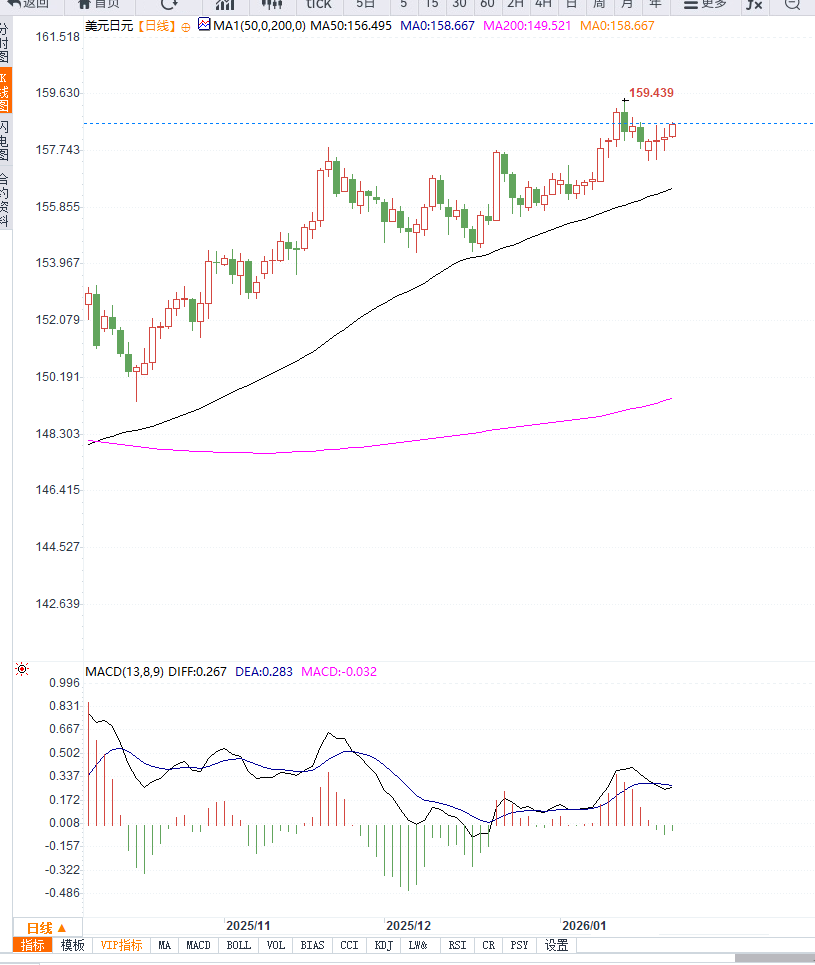
From a technical perspective, the USD/JPY pair previously broke through the 158.20 level, which coincides with the 100-hour moving average and the 38.2% Fibonacci retracement level of the previous pullback. The overall structure after the breakout is slightly favorable for the bulls. The MACD indicator remains above the zero line, but the momentum bars are contracting, indicating that upward momentum has cooled somewhat.
The RSI is around 58, indicating a short-term bullish bias but not yet overbought. The 159.00 level forms direct resistance; a decisive break above this level could lead to a move towards 159.50. Conversely, failure to hold above this level could result in a pullback to test the 100-hour moving average support, with the short-term trend remaining largely range-bound.
Editor's Note:
The core characteristic of the current yen's exchange rate is its "uncertainty about direction." Improved external risk sentiment has weakened its safe-haven appeal, while domestic bond market turmoil has limited its attractiveness. However, the Bank of Japan's potential interest rate hike path and expectations of official intervention provide important support at the bottom.
The market is likely to remain cautious ahead of the Bank of Japan's meeting results. Once a clear shift in policy signals emerges, the yen could quickly break out of its consolidation phase and enter a new trend.
Risk assets rebounded sharply on related news, and the spillover of risk sentiment also boosted Asian markets, further suppressing the safe-haven demand for the yen.
On the other hand, domestic fundamentals in Japan have not provided clear support for the yen. The Japanese government bond market experienced a sharp sell-off this week, with concerns about Prime Minister Sanae Takashi's fiscal expansion policies, coupled with a weak response to the 20-year bond auction, pushing long-term bond yields to record highs.
This bond market turmoil has weakened overseas investors' confidence in yen assets, making yen bulls cautious. However, the downside potential of the yen is also limited by multiple factors.
The market generally believes that the Japanese authorities are unlikely to tolerate a continued rapid depreciation of the yen. Finance Minister Satsuki Katayama has previously hinted that he does not rule out joint intervention with the United States to deal with excessive exchange rate volatility.
Furthermore, the Bank of Japan's policy expectations also provide potential support for the yen. Recent reports indicate that some officials within the Bank of Japan believe conditions for a further interest rate hike could be met as early as April. The inflationary backdrop has also reinforced expectations of a policy shift.
The Bank of Japan's latest survey shows that most households expect prices to continue to rise in the coming years, while official data shows that Japan's inflation has been above the central bank's 2% target level for four consecutive calendar years.
A weaker yen could exacerbate imported inflation, forcing central banks to act more quickly on the path to policy normalization.
Against this backdrop, the market is choosing to remain cautious ahead of the Bank of Japan's meeting. The Bank of Japan will announce its interest rate decision on Friday, and the market widely expects it to maintain the status quo. The central bank previously raised the overnight rate to 0.75% in December last year, the highest level in 30 years.
The real focus will be on Governor Kazuo Ueda's remarks at the post-meeting press conference. His wording will directly influence the market's judgment on the timing of the next interest rate hike, thereby determining the directional trend of the yen.
Meanwhile, easing trade concerns provided some support, offering a short-term floor for the USD/JPY exchange rate. Investors are awaiting US PCE price index and quarterly GDP data for new drivers.
From a technical perspective, the USD/JPY pair previously broke through the 158.20 level, which coincides with the 100-hour moving average and the 38.2% Fibonacci retracement level of the previous pullback. The overall structure after the breakout is slightly favorable for the bulls. The MACD indicator remains above the zero line, but the momentum bars are contracting, indicating that upward momentum has cooled somewhat.
The RSI is around 58, indicating a short-term bullish bias but not yet overbought. The 159.00 level forms direct resistance; a decisive break above this level could lead to a move towards 159.50. Conversely, failure to hold above this level could result in a pullback to test the 100-hour moving average support, with the short-term trend remaining largely range-bound.
Editor's Note:
The core characteristic of the current yen's exchange rate is its "uncertainty about direction." Improved external risk sentiment has weakened its safe-haven appeal, while domestic bond market turmoil has limited its attractiveness. However, the Bank of Japan's potential interest rate hike path and expectations of official intervention provide important support at the bottom.
The market is likely to remain cautious ahead of the Bank of Japan's meeting results. Once a clear shift in policy signals emerges, the yen could quickly break out of its consolidation phase and enter a new trend.
- Risk Warning and Disclaimer
- The market involves risk, and trading may not be suitable for all investors. This article is for reference only and does not constitute personal investment advice, nor does it take into account certain users’ specific investment objectives, financial situation, or other needs. Any investment decisions made based on this information are at your own risk.