Silver Outlook: Easing risk aversion triggers pullback, but long-term bullish trend remains unchanged.
2026-01-22 20:04:14
On Thursday (January 22), silver prices initially surged during the European session, reaching a high of $95.362 per ounce, just shy of the previous high of $95.857, demonstrating strong bullish momentum. However, just as the market anticipated a breakout above the key resistance level of $95, prices encountered significant selling pressure, gradually retreating to around $94.20 and consolidating. A slight recovery occurred towards the end of the session, but prices failed to hold above $95.

Behind this trend, besides technical selling pressure at key price levels, the marginal easing of risk aversion is the core driving factor. Recently, global stock markets have gradually stabilized, with the Dow Jones Industrial Average and Nasdaq Composite Index closing higher for three consecutive trading days. The attractiveness of risk assets has rebounded, leading some funds to flow out of safe-haven assets like silver and into the equity market. Meanwhile, market focus is highly concentrated on the upcoming monetary policy decision from the Bank of Japan. Ahead of this crucial event, investors are generally choosing to reduce positions and wait and see, further exacerbating the volatility of silver prices.
It's worth noting that silver's failure to break through $95 this time is not a sign of weakening bullish momentum, but rather a result of short-term profit-taking and sentiment-driven trading. Looking at trading volume, the pullback did not see a significant increase, indicating that active selling was relatively limited, and most investors are still holding long positions, awaiting further directional guidance.
I. Market Characteristics Analysis: Highly Technically Driven, a Dual Game of Leverage and Volatility
The silver market has always possessed commodity, financial, and safe-haven attributes, and its technical characteristics are particularly prominent in the current trending market. As previous market patterns have shown, every $5 increase in silver prices is followed by a technical correction. Whether it's $80, $85, $90, or now $95, these have all become key points in the battle between bulls and bears. This cyclical fluctuation stems from investors' psychological expectations regarding round numbers and is also closely related to overbought signals from technical indicators.
From a technical perspective, the Relative Strength Index (RSI) for silver futures remained around 71 during the session. Although it has fallen slightly from the previous high of 75, it is still in overbought territory, providing technical support for a short-term pullback. Furthermore, the Bollinger Bands indicator shows that silver prices are currently trading between the upper bands of the double Bollinger Bands. The outer upper band is providing some resistance, while the inner upper band (currently at $91.50) forms important short-term support. If the price subsequently falls back to near the middle band, it will likely attract a return of bullish funds.
The prevalence of leveraged trading has further amplified the volatility of the silver market. For institutional and individual investors using high leverage, even small fluctuations in silver prices can trigger significant changes in account profits and losses. In the current market environment, some investors, in pursuit of short-term gains, are heavily betting on silver breaking through $100. This aggressive approach undoubtedly exacerbates market fragility—an unexpected price correction could trigger forced liquidation, further accelerating the price decline, and in extreme cases, even causing the price to fall from $95 to $75 in a short period. However, it's important to clarify that such corrections are primarily driven by short-term liquidity and will not alter the long-term trend of silver. Instead, they may provide better entry opportunities for rational investors.
II. Short-term strategy: Wait for a pullback and stabilization; avoid blindly chasing highs.
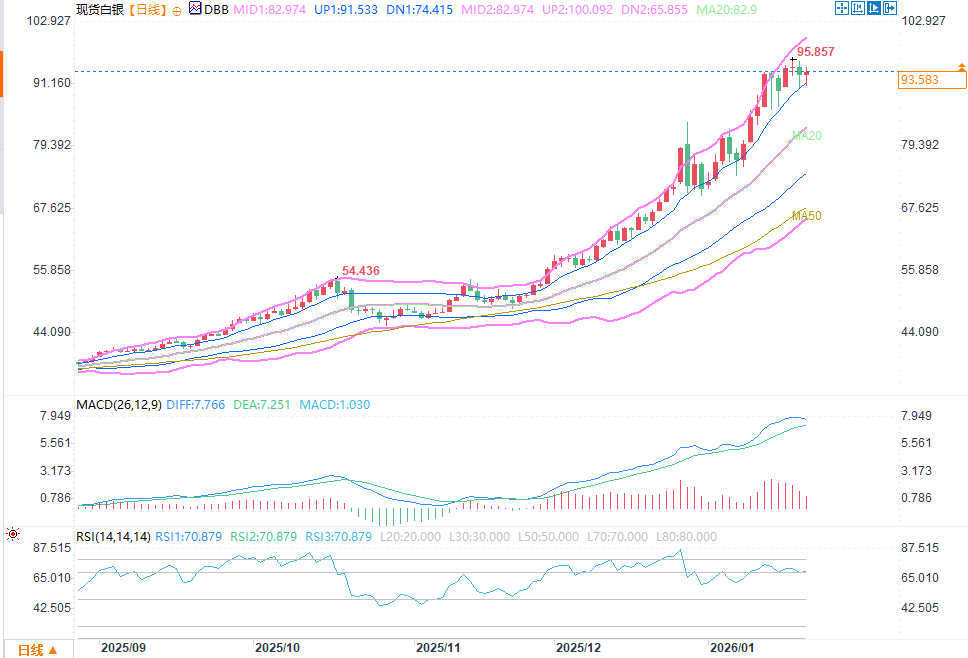
(Spot silver daily chart source: EasyTrade)
Given the current extremely overbought and crowded market environment, blindly chasing highs is clearly unwise. From a trading perspective, this pullback is essentially a correction of the previous rapid rise, and a process of market sentiment returning from frenzy to rationality. This correction is actually conducive to prolonging the subsequent bullish trend. Therefore, the safest strategy at present is to "wait"—wait for the price to fall back to the key support level and for a clear signal of stabilization and rebound to emerge before gradually establishing long positions.
Specifically, in the short term, three support levels are worth paying close attention to: The first support level is the $92-$93 range, which is the consolidation range after the previous breakout above $90 and has strong support strength; the second support level is the upper inner Bollinger Band at $91.50, and if the price falls back to this level, the technical support signal will be further strengthened; the third support level is the psychological level of $90, which was an important resistance level in the past and has now become strong support after being broken. If this level is lost, it may mean that the short-term trend has turned into a consolidation phase.
Regarding entry signals, in addition to price stabilization, it's necessary to consider the resonance of trading volume and indicators: First, a gradual decrease in trading volume during a pullback followed by a significant increase during a rebound indicates that bullish funds are actively entering the market; second, the RSI indicator stabilizes and rebounds after falling back to the 50-60 range, and a rebound after moving out of the overbought zone is more sustainable; third, the appearance of bullish candlestick patterns such as hammers and morning stars further confirms the effectiveness of support. Furthermore, for investors with low risk tolerance, it is recommended to control position size and reduce leverage to avoid significant losses due to short-term fluctuations.
III. Long-term outlook: The $100 mark is a must-win, and the bottom range is gradually shifting upwards.
Despite short-term downward pressure, the long-term bullish trend for silver remains unchanged, with the $100 mark becoming the next target based on market consensus. This price level is not only an important psychological barrier but also reflects the market's comprehensive expectations regarding the supply and demand dynamics of silver and the macroeconomic environment. Therefore, it is highly likely to become the core area for the battle between bulls and bears. The breakout process may be accompanied by repeated fluctuations, but the upside potential after the breakout will be further unlocked.
From a macro perspective, the core logic supporting the long-term rise in silver prices remains solid. On the one hand, global central banks continue to increase their gold reserves, driving up demand for precious metals such as silver. As of December 2025, global central bank gold reserves increased by 8% year-on-year, reaching a five-year high. As a "shadow commodity" of gold, silver often strengthens in tandem with gold. On the other hand, the global economic recovery is slowing, and major economies are maintaining relatively loose monetary policies with low real interest rates. In this environment, silver's value preservation and appreciation attributes will be further highlighted, attracting more capital inflows. In addition, industrial demand for silver is gradually recovering, with growth in demand from new energy, electronics, and other sectors providing fundamental support for silver prices.
It's important to note that a long-term bullish trend doesn't guarantee a continuous, one-sided price increase; there will inevitably be multiple pullbacks and fluctuations along the way. While focusing on the long-term trend, investors should be wary of the impact of short-term risk events. In addition to the Bank of Japan's monetary policy decision, key factors to watch include the Federal Reserve's interest rate decision, global geopolitical situations, and the US dollar index, all of which could trigger sharp short-term fluctuations in silver prices.
Behind this trend, besides technical selling pressure at key price levels, the marginal easing of risk aversion is the core driving factor. Recently, global stock markets have gradually stabilized, with the Dow Jones Industrial Average and Nasdaq Composite Index closing higher for three consecutive trading days. The attractiveness of risk assets has rebounded, leading some funds to flow out of safe-haven assets like silver and into the equity market. Meanwhile, market focus is highly concentrated on the upcoming monetary policy decision from the Bank of Japan. Ahead of this crucial event, investors are generally choosing to reduce positions and wait and see, further exacerbating the volatility of silver prices.
It's worth noting that silver's failure to break through $95 this time is not a sign of weakening bullish momentum, but rather a result of short-term profit-taking and sentiment-driven trading. Looking at trading volume, the pullback did not see a significant increase, indicating that active selling was relatively limited, and most investors are still holding long positions, awaiting further directional guidance.
I. Market Characteristics Analysis: Highly Technically Driven, a Dual Game of Leverage and Volatility
The silver market has always possessed commodity, financial, and safe-haven attributes, and its technical characteristics are particularly prominent in the current trending market. As previous market patterns have shown, every $5 increase in silver prices is followed by a technical correction. Whether it's $80, $85, $90, or now $95, these have all become key points in the battle between bulls and bears. This cyclical fluctuation stems from investors' psychological expectations regarding round numbers and is also closely related to overbought signals from technical indicators.
From a technical perspective, the Relative Strength Index (RSI) for silver futures remained around 71 during the session. Although it has fallen slightly from the previous high of 75, it is still in overbought territory, providing technical support for a short-term pullback. Furthermore, the Bollinger Bands indicator shows that silver prices are currently trading between the upper bands of the double Bollinger Bands. The outer upper band is providing some resistance, while the inner upper band (currently at $91.50) forms important short-term support. If the price subsequently falls back to near the middle band, it will likely attract a return of bullish funds.
The prevalence of leveraged trading has further amplified the volatility of the silver market. For institutional and individual investors using high leverage, even small fluctuations in silver prices can trigger significant changes in account profits and losses. In the current market environment, some investors, in pursuit of short-term gains, are heavily betting on silver breaking through $100. This aggressive approach undoubtedly exacerbates market fragility—an unexpected price correction could trigger forced liquidation, further accelerating the price decline, and in extreme cases, even causing the price to fall from $95 to $75 in a short period. However, it's important to clarify that such corrections are primarily driven by short-term liquidity and will not alter the long-term trend of silver. Instead, they may provide better entry opportunities for rational investors.
II. Short-term strategy: Wait for a pullback and stabilization; avoid blindly chasing highs.
(Spot silver daily chart source: EasyTrade)
Given the current extremely overbought and crowded market environment, blindly chasing highs is clearly unwise. From a trading perspective, this pullback is essentially a correction of the previous rapid rise, and a process of market sentiment returning from frenzy to rationality. This correction is actually conducive to prolonging the subsequent bullish trend. Therefore, the safest strategy at present is to "wait"—wait for the price to fall back to the key support level and for a clear signal of stabilization and rebound to emerge before gradually establishing long positions.
Specifically, in the short term, three support levels are worth paying close attention to: The first support level is the $92-$93 range, which is the consolidation range after the previous breakout above $90 and has strong support strength; the second support level is the upper inner Bollinger Band at $91.50, and if the price falls back to this level, the technical support signal will be further strengthened; the third support level is the psychological level of $90, which was an important resistance level in the past and has now become strong support after being broken. If this level is lost, it may mean that the short-term trend has turned into a consolidation phase.
Regarding entry signals, in addition to price stabilization, it's necessary to consider the resonance of trading volume and indicators: First, a gradual decrease in trading volume during a pullback followed by a significant increase during a rebound indicates that bullish funds are actively entering the market; second, the RSI indicator stabilizes and rebounds after falling back to the 50-60 range, and a rebound after moving out of the overbought zone is more sustainable; third, the appearance of bullish candlestick patterns such as hammers and morning stars further confirms the effectiveness of support. Furthermore, for investors with low risk tolerance, it is recommended to control position size and reduce leverage to avoid significant losses due to short-term fluctuations.
III. Long-term outlook: The $100 mark is a must-win, and the bottom range is gradually shifting upwards.
Despite short-term downward pressure, the long-term bullish trend for silver remains unchanged, with the $100 mark becoming the next target based on market consensus. This price level is not only an important psychological barrier but also reflects the market's comprehensive expectations regarding the supply and demand dynamics of silver and the macroeconomic environment. Therefore, it is highly likely to become the core area for the battle between bulls and bears. The breakout process may be accompanied by repeated fluctuations, but the upside potential after the breakout will be further unlocked.
From a macro perspective, the core logic supporting the long-term rise in silver prices remains solid. On the one hand, global central banks continue to increase their gold reserves, driving up demand for precious metals such as silver. As of December 2025, global central bank gold reserves increased by 8% year-on-year, reaching a five-year high. As a "shadow commodity" of gold, silver often strengthens in tandem with gold. On the other hand, the global economic recovery is slowing, and major economies are maintaining relatively loose monetary policies with low real interest rates. In this environment, silver's value preservation and appreciation attributes will be further highlighted, attracting more capital inflows. In addition, industrial demand for silver is gradually recovering, with growth in demand from new energy, electronics, and other sectors providing fundamental support for silver prices.
It's important to note that a long-term bullish trend doesn't guarantee a continuous, one-sided price increase; there will inevitably be multiple pullbacks and fluctuations along the way. While focusing on the long-term trend, investors should be wary of the impact of short-term risk events. In addition to the Bank of Japan's monetary policy decision, key factors to watch include the Federal Reserve's interest rate decision, global geopolitical situations, and the US dollar index, all of which could trigger sharp short-term fluctuations in silver prices.
- Risk Warning and Disclaimer
- The market involves risk, and trading may not be suitable for all investors. This article is for reference only and does not constitute personal investment advice, nor does it take into account certain users’ specific investment objectives, financial situation, or other needs. Any investment decisions made based on this information are at your own risk.