WTI oil price squeeze: potential to hit $65
2026-01-27 01:40:35
Currently, WTI oil prices are poised for a short squeeze, primarily due to the forced liquidation of speculators' short positions, leading to a price increase. Speculators had previously aggressively shorted, significantly increasing their short positions, but the liquidation of these positions is putting upward pressure on oil prices. In the short term, geopolitical risks in Iran, extreme cold weather, and structural buying activity from countries like China and India are likely to be key factors driving oil price increases.
Venezuela and floating warehouse inventory changes
The recovery of Venezuelan crude oil exports and the reduction of floating storage are shifting the market focus from a "surplus" to changes in onshore inventories. Saudi Aramco CEO Amin Nasser noted, "Predictions of an oil surplus have been severely exaggerated… On a five-year average, global oil inventories are low, and much of the offshore inventory consists of sanctioned crude oil." As floating storage gradually diminishes, market focus will shift to changes in onshore inventories, particularly those observable crude oil stocks.
EIA Inventory Forecasts
The EIA report points out that while a large amount of crude oil is still being transported at sea, the amount of crude oil gradually entering onshore inventories is increasing. "There are signs that more and more oil is accumulating at sea or in floating storage, which has begun to put pressure on oil prices." The EIA predicts that the tightening of global crude oil inventories may become apparent in the second and third quarters of 2026. In the short term, oil prices may fluctuate at the end of the first quarter as arrivals increase.
The impact of geopolitics
While geopolitical factors have repeatedly driven oil prices up, these rallies typically fail to last more than a week. For example, the Russia-Ukraine conflict, the October 7th Israeli attack, and future geopolitical conflicts could all push oil prices up in the short term, but market sentiment quickly returns to normal. As past patterns have shown, if the situation with Iran escalates (e.g., a ground attack or closure of the Straits of Hormuz), the market may experience short-term oil price fluctuations before prices enter a trading range.
The impact of extreme cold weather
Extreme cold weather has had a significant impact on North American crude oil production. According to an analysis by Energy Aspects, the extreme cold has led to the shutdown of oil production facilities in parts of the United States, particularly in the Permian Basin. "U.S. crude oil production is declining as extreme cold weather forces producers to shut down facilities. Analysts and regulators say the production cuts could exceed 300,000 barrels per day." These factors could further push up oil prices, especially if the cold snap continues to affect production.
Position data analysis (COT)
COT (Commercial Occupations Test) data shows a significant decrease in speculators' short positions, indicating a rush to close out their positions. In particular, non-commercial speculators reduced their short positions by approximately 21,991 contracts, resulting in a substantial overall decline in short positions. This change could drive oil prices further up, especially as speculators close out their positions.
The market is undergoing "institutional change." COT data shows that the decrease in non-commercial short positions indicates an accelerated withdrawal of speculators, which could trigger a short squeeze. According to recent COT data, non-commercial short positions decreased by 9.64%, while commercial short positions decreased by only 0.21%, suggesting that short-selling pressure in the market is weakening.
Market Trading Strategies
The current trading strategy is as follows: If the price breaks through $60.18 and the order flow supports it, consider going long with a stop-loss below $60. If the price gaps up, a "wait-and-see" strategy can be adopted, waiting for a pullback to around $60 before entering the market. For intraday trading, if the price reaches the $63 area, consider chasing the price and buying at a higher pullback level.
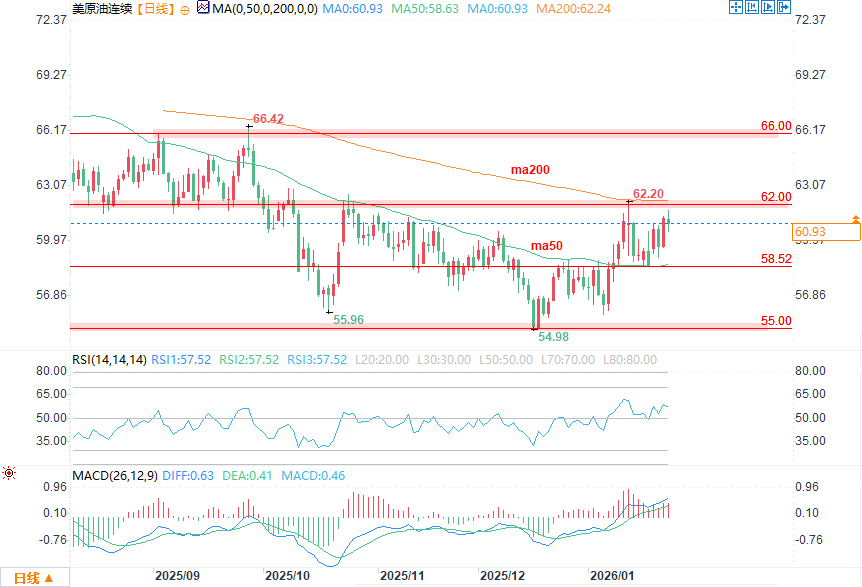
(WTI crude oil daily chart source: FX678)
Summarize
Overall, with speculators forced to liquidate their short positions, coupled with tensions in Iran, the impact of extreme cold weather, and continued oil demand from China and India, WTI crude oil prices could potentially reach $65. Furthermore, the gradual recovery of Venezuelan oil supply and the reduction in floating storage inventories are easing the pressure of a "surplus" of crude oil. Investors should closely monitor inventory data and geopolitical risks, and adjust their trading strategies flexibly.
Venezuela and floating warehouse inventory changes
The recovery of Venezuelan crude oil exports and the reduction of floating storage are shifting the market focus from a "surplus" to changes in onshore inventories. Saudi Aramco CEO Amin Nasser noted, "Predictions of an oil surplus have been severely exaggerated… On a five-year average, global oil inventories are low, and much of the offshore inventory consists of sanctioned crude oil." As floating storage gradually diminishes, market focus will shift to changes in onshore inventories, particularly those observable crude oil stocks.
EIA Inventory Forecasts
The EIA report points out that while a large amount of crude oil is still being transported at sea, the amount of crude oil gradually entering onshore inventories is increasing. "There are signs that more and more oil is accumulating at sea or in floating storage, which has begun to put pressure on oil prices." The EIA predicts that the tightening of global crude oil inventories may become apparent in the second and third quarters of 2026. In the short term, oil prices may fluctuate at the end of the first quarter as arrivals increase.
The impact of geopolitics
While geopolitical factors have repeatedly driven oil prices up, these rallies typically fail to last more than a week. For example, the Russia-Ukraine conflict, the October 7th Israeli attack, and future geopolitical conflicts could all push oil prices up in the short term, but market sentiment quickly returns to normal. As past patterns have shown, if the situation with Iran escalates (e.g., a ground attack or closure of the Straits of Hormuz), the market may experience short-term oil price fluctuations before prices enter a trading range.
The impact of extreme cold weather
Extreme cold weather has had a significant impact on North American crude oil production. According to an analysis by Energy Aspects, the extreme cold has led to the shutdown of oil production facilities in parts of the United States, particularly in the Permian Basin. "U.S. crude oil production is declining as extreme cold weather forces producers to shut down facilities. Analysts and regulators say the production cuts could exceed 300,000 barrels per day." These factors could further push up oil prices, especially if the cold snap continues to affect production.
Position data analysis (COT)
COT (Commercial Occupations Test) data shows a significant decrease in speculators' short positions, indicating a rush to close out their positions. In particular, non-commercial speculators reduced their short positions by approximately 21,991 contracts, resulting in a substantial overall decline in short positions. This change could drive oil prices further up, especially as speculators close out their positions.
The market is undergoing "institutional change." COT data shows that the decrease in non-commercial short positions indicates an accelerated withdrawal of speculators, which could trigger a short squeeze. According to recent COT data, non-commercial short positions decreased by 9.64%, while commercial short positions decreased by only 0.21%, suggesting that short-selling pressure in the market is weakening.
Market Trading Strategies
The current trading strategy is as follows: If the price breaks through $60.18 and the order flow supports it, consider going long with a stop-loss below $60. If the price gaps up, a "wait-and-see" strategy can be adopted, waiting for a pullback to around $60 before entering the market. For intraday trading, if the price reaches the $63 area, consider chasing the price and buying at a higher pullback level.
(WTI crude oil daily chart source: FX678)
Summarize
Overall, with speculators forced to liquidate their short positions, coupled with tensions in Iran, the impact of extreme cold weather, and continued oil demand from China and India, WTI crude oil prices could potentially reach $65. Furthermore, the gradual recovery of Venezuelan oil supply and the reduction in floating storage inventories are easing the pressure of a "surplus" of crude oil. Investors should closely monitor inventory data and geopolitical risks, and adjust their trading strategies flexibly.
- Risk Warning and Disclaimer
- The market involves risk, and trading may not be suitable for all investors. This article is for reference only and does not constitute personal investment advice, nor does it take into account certain users’ specific investment objectives, financial situation, or other needs. Any investment decisions made based on this information are at your own risk.