Crude oil trading alert: Geopolitical tensions drive oil prices higher, with a short-term bullish trend expected to continue.
2026-01-30 10:01:13
During Friday's Asian trading session, US crude oil prices fell slightly, trading around $64.80 per barrel. The short-term trend remains bullish. Recently, major international investment banks have collectively raised their 2026 crude oil price forecasts, reflecting the market's repricing of geopolitical uncertainties.
According to the latest survey results, the annual average price forecast for Brent crude oil has been revised upward to $61.33 per barrel, and the average price forecast for WTI crude oil has been revised upward to $58.14 per barrel, a significant increase from previous forecasts. It is worth noting that this adjustment in forecasts did not occur in an environment of significantly tightening supply and demand, but rather against the backdrop of continued growth potential in global crude oil supply.
This means that the upward shift in the central oil price is more due to risk premiums than to fundamental structural changes. Oil prices rose approximately 4% yesterday, with Brent crude briefly returning above $70, while WTI crude also rebounded sharply.

The main factor driving the rapid price increase is market concerns about the escalating situation in the Middle East, particularly the anticipated potential impact on shipping security in the Strait of Hormuz. As one of the world's most critical energy transport routes, any disturbance in this region is likely to be amplified and interpreted by the market.
From the perspective of capital behavior, the current rise in oil prices is more like a "defensive pricing" rather than a result of a trend of supply and demand imbalance.
A geopolitical analysis director pointed out: "The speed at which oil prices react indicates that the market is viewing related military actions as a real and imminent risk. Weather factors can only explain part of the volatility; the current increase is more consistent with the characteristics of a geopolitical risk premium reverting to its previous level."
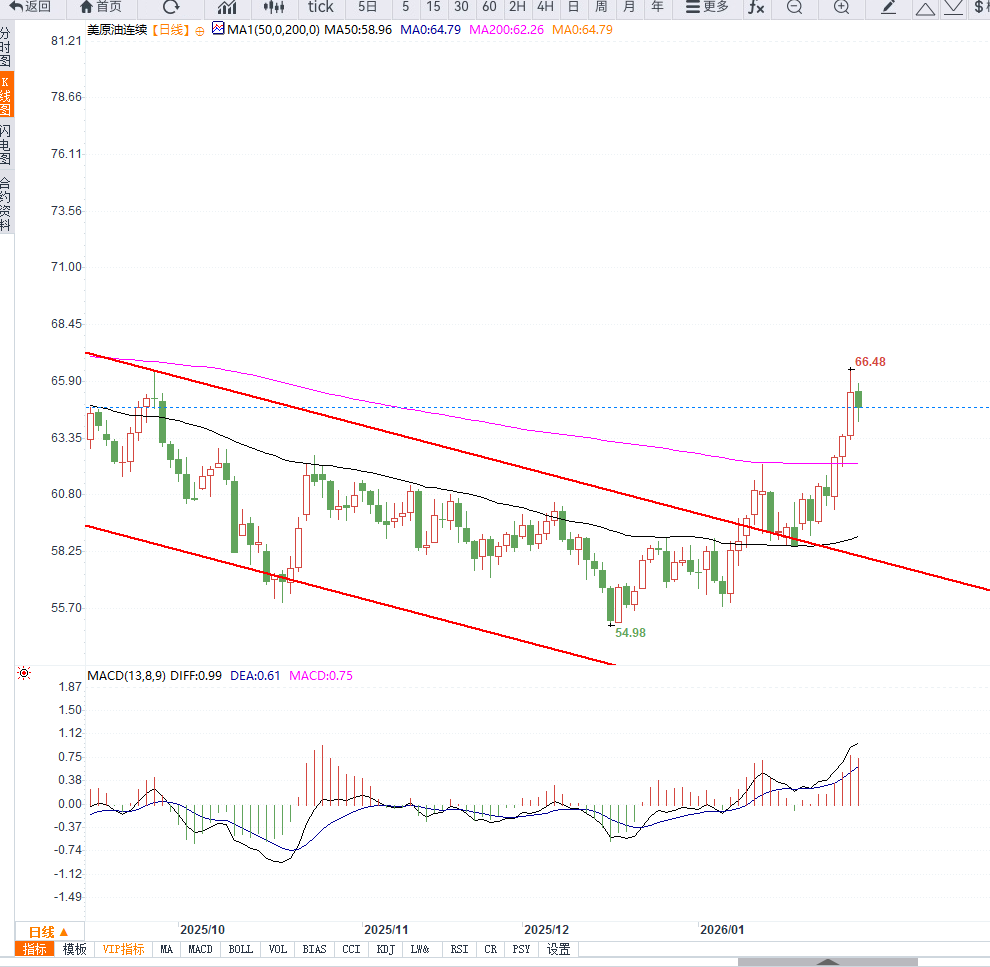
From a daily chart perspective, US crude oil has recently completed a key technical correction. After a period of decline, prices formed a support zone around $56, which is both a previous area of dense trading volume and an important defensive level for a medium-term pullback.
Prices rebounded quickly after touching this area, indicating significantly strengthened support below. In terms of moving averages, WTI's daily chart remains below the 50-day and 100-day moving averages, but the short-term downtrend has clearly slowed.
Recently, the candlestick body has climbed back above the 5-day and 10-day moving averages, and the short-term moving averages are beginning to flatten and attempt to turn upwards, suggesting that bearish momentum is waning and the market is entering a technical correction phase. In terms of momentum indicators, the RSI has rebounded from the oversold zone and is currently operating in a neutral-to-strong range, indicating that after a rapid price decline, sentiment has recovered from an extremely pessimistic state.
Meanwhile, the MACD histogram continues to converge, and the two lines are nearing convergence. A golden cross in the future would further confirm the validity of the short-term rebound structure. Overall, WTI's daily chart remains in a medium-term weak consolidation pattern, but it has the conditions for a continued short-term rebound. If the price can firmly hold above $64.00, it may test the $67 psychological level.
Conversely, if geopolitical risk sentiment eases, the probability of oil prices falling back to fluctuate above $64 remains. The quarterly price path and OPEC+ factor survey results indicate that the average price expectation for US crude oil in the second quarter is $57.15, rising slightly in the third quarter, with a year-end target of $58.25.
This path reflects the market consensus: risk-driven, pulse-like price increases offset supply growth, allowing oil prices to maintain a fluctuating upward trend rather than a one-sided one.
Meanwhile, OPEC+ is expected to maintain its production policy at its upcoming meeting. The previous decision to suspend production increases has left the market lacking a clear "supply hedge" in the face of geopolitical risks. At this stage, OPEC+'s wait-and-see attitude itself constitutes implicit support for oil prices.
Editor's Note:
The oil market is currently at a critical turning point: the supply and demand logic still exists, but pricing power has been taken over by geopolitical risks and sentiment factors in the short term. From a technical perspective, the stabilization of US crude oil at a key support level provides a basis for the risk premium to be transmitted to prices;
From a macro perspective, as long as the uncertainties in the Middle East are not fully digested, the downside potential for oil prices will remain limited. The current market is not a one-sided trend, but rather a combination of "event-driven factors and technical corrections." For macro observers, energy price volatility will remain a crucial variable influencing inflation expectations and policy decisions.
According to the latest survey results, the annual average price forecast for Brent crude oil has been revised upward to $61.33 per barrel, and the average price forecast for WTI crude oil has been revised upward to $58.14 per barrel, a significant increase from previous forecasts. It is worth noting that this adjustment in forecasts did not occur in an environment of significantly tightening supply and demand, but rather against the backdrop of continued growth potential in global crude oil supply.
This means that the upward shift in the central oil price is more due to risk premiums than to fundamental structural changes. Oil prices rose approximately 4% yesterday, with Brent crude briefly returning above $70, while WTI crude also rebounded sharply.
The main factor driving the rapid price increase is market concerns about the escalating situation in the Middle East, particularly the anticipated potential impact on shipping security in the Strait of Hormuz. As one of the world's most critical energy transport routes, any disturbance in this region is likely to be amplified and interpreted by the market.
From the perspective of capital behavior, the current rise in oil prices is more like a "defensive pricing" rather than a result of a trend of supply and demand imbalance.
A geopolitical analysis director pointed out: "The speed at which oil prices react indicates that the market is viewing related military actions as a real and imminent risk. Weather factors can only explain part of the volatility; the current increase is more consistent with the characteristics of a geopolitical risk premium reverting to its previous level."
From a daily chart perspective, US crude oil has recently completed a key technical correction. After a period of decline, prices formed a support zone around $56, which is both a previous area of dense trading volume and an important defensive level for a medium-term pullback.
Prices rebounded quickly after touching this area, indicating significantly strengthened support below. In terms of moving averages, WTI's daily chart remains below the 50-day and 100-day moving averages, but the short-term downtrend has clearly slowed.
Recently, the candlestick body has climbed back above the 5-day and 10-day moving averages, and the short-term moving averages are beginning to flatten and attempt to turn upwards, suggesting that bearish momentum is waning and the market is entering a technical correction phase. In terms of momentum indicators, the RSI has rebounded from the oversold zone and is currently operating in a neutral-to-strong range, indicating that after a rapid price decline, sentiment has recovered from an extremely pessimistic state.
Meanwhile, the MACD histogram continues to converge, and the two lines are nearing convergence. A golden cross in the future would further confirm the validity of the short-term rebound structure. Overall, WTI's daily chart remains in a medium-term weak consolidation pattern, but it has the conditions for a continued short-term rebound. If the price can firmly hold above $64.00, it may test the $67 psychological level.
Conversely, if geopolitical risk sentiment eases, the probability of oil prices falling back to fluctuate above $64 remains. The quarterly price path and OPEC+ factor survey results indicate that the average price expectation for US crude oil in the second quarter is $57.15, rising slightly in the third quarter, with a year-end target of $58.25.
This path reflects the market consensus: risk-driven, pulse-like price increases offset supply growth, allowing oil prices to maintain a fluctuating upward trend rather than a one-sided one.
Meanwhile, OPEC+ is expected to maintain its production policy at its upcoming meeting. The previous decision to suspend production increases has left the market lacking a clear "supply hedge" in the face of geopolitical risks. At this stage, OPEC+'s wait-and-see attitude itself constitutes implicit support for oil prices.
Editor's Note:
The oil market is currently at a critical turning point: the supply and demand logic still exists, but pricing power has been taken over by geopolitical risks and sentiment factors in the short term. From a technical perspective, the stabilization of US crude oil at a key support level provides a basis for the risk premium to be transmitted to prices;
From a macro perspective, as long as the uncertainties in the Middle East are not fully digested, the downside potential for oil prices will remain limited. The current market is not a one-sided trend, but rather a combination of "event-driven factors and technical corrections." For macro observers, energy price volatility will remain a crucial variable influencing inflation expectations and policy decisions.
- Risk Warning and Disclaimer
- The market involves risk, and trading may not be suitable for all investors. This article is for reference only and does not constitute personal investment advice, nor does it take into account certain users’ specific investment objectives, financial situation, or other needs. Any investment decisions made based on this information are at your own risk.