Is the USD/JPY rally strong on the surface but weak underneath? How long can it last?
2026-02-05 17:41:46
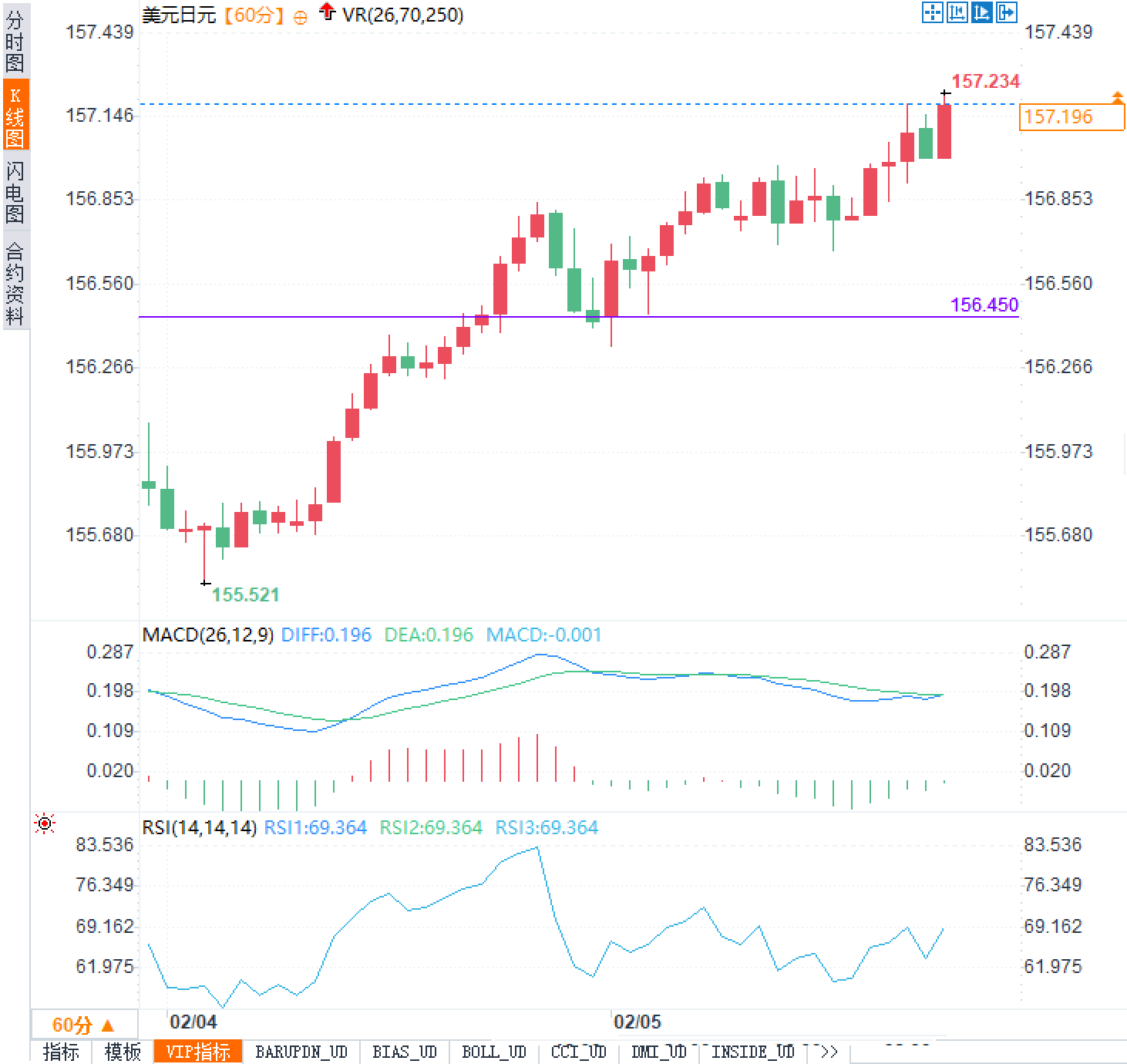
On Thursday, February 5th, the USD/JPY pair traded around 157.20 during the European session, maintaining a slightly bullish short-term trend. The price has gradually risen from a low of 155.521, steadily advancing along an upward channel with relatively small pullbacks, indicating strong bullish control. Technically, this upward move exhibits a typical "higher highs, higher lows" structure, suggesting continued buying pressure. However, upward pressure is also emerging, with the 157.50 area becoming the first resistance level.

Meanwhile, support lies around 156.450, a key area not only for the previous consolidation but also for the bulls' ability to maintain their strong structure. A breach of this level could lead to a pullback to 156.20 or even 156.00 for rebalancing, significantly weakening the short-term trend. The RSI is currently at 69.364, nearing overbought territory, suggesting that while bulls hold the upper hand in the short term, the risk of chasing the rally is also increasing. Analysts point out that in this high-level environment, if the price fails to break through 157.20 with significant volume and instead experiences consolidation or a pullback, it wouldn't be surprising.
One of the core factors driving the recent strengthening of the USD/JPY exchange rate is the rising uncertainty in the market regarding Japan's future fiscal path. With the Japanese election on February 8th drawing near, the policy outlook has become increasingly unclear, and forex traders have reacted quickly by pricing in the potential risks of fiscal expansion. Typically, concerns about fiscal deficits lead to higher yields on medium- and long-term government bonds, weakening the attractiveness of the local currency and consequently dragging down exchange rate performance.
It's worth noting that despite the significant weakening of the yen, the Japanese bond market has remained relatively calm. Recent auctions of 30-year government bonds saw better-than-expected demand, with long-term yields falling from a record high of 3.65% to 3.5%, and 20-year yields also declining from nearly 3.20% to 3.13%. This indicates that the bond market has not simultaneously reflected pessimistic expectations of "fiscal runaway" expectations, but rather demonstrated a certain degree of resilience. This divergence between a falling foreign exchange market and a calm bond market reflects a difference in understanding of future policy directions between the two markets—the foreign exchange market is more sensitive and pre-prices in risks, while the bond market is still waiting for clearer policy signals.
Different election results will have different impacts on exchange rates. If the ruling party gains a larger advantage, it may be seen as a harbinger of expansionary fiscal policy, and the yen may come under further pressure; however, if its stronger position reduces the need for additional easing commitments from a coalition government, policies may stabilize, and yen volatility may moderate. Therefore, the same result can be interpreted as "negative" or "positive," depending on whether the post-election budget arrangements and official statements are consistent and clear.
While the weakening yen is primarily driven by fiscal sentiment, cross-market interest rate differentials remain a fundamental and undeniable factor. Currently, the market widely expects the Federal Reserve to have room for two more rate cuts this year, limiting the possibility of a further significant strengthening of the US dollar. Although the Bank of Japan is not in a hurry to raise interest rates, its policymakers have expressed concern about a weak yen pushing up inflation, implying that there is still room for discussion on policy normalization in the first half of the year. This means that the US-Japan interest rate differential is not widening unilaterally, and the exchange rate cannot sustainably diverge based solely on the interest rate differential.
Furthermore, an increasingly important constraint is the risk of intervention. As the USD/JPY pair approaches its previous highs, the probability of verbal intervention by Japanese authorities has significantly increased, frequently triggering market speculation about coordinated intervention. Such events often do not immediately reverse the trend, but frequently lead to a "surge followed by a pullback" and a sharp increase in volatility, creating a de facto "ceiling effect." Therefore, even if the overall trend is bullish, it is not advisable to use simplistic linear thinking to bet on a one-sided market movement.
Analysts believe the current market is at a convergence point of "event-driven + technical juncture." On one hand, policy statements before and after the Japanese election may further ignite market sentiment; on the other hand, US economic data and speeches by Federal Reserve officials may reshape expectations for interest rate cuts, thereby affecting the dollar's performance. If US data is strong and expectations for interest rate cuts cool, the dollar will receive support; conversely, weak data may cause the exchange rate to encounter resistance and fall back from its highs.
Meanwhile, support lies around 156.450, a key area not only for the previous consolidation but also for the bulls' ability to maintain their strong structure. A breach of this level could lead to a pullback to 156.20 or even 156.00 for rebalancing, significantly weakening the short-term trend. The RSI is currently at 69.364, nearing overbought territory, suggesting that while bulls hold the upper hand in the short term, the risk of chasing the rally is also increasing. Analysts point out that in this high-level environment, if the price fails to break through 157.20 with significant volume and instead experiences consolidation or a pullback, it wouldn't be surprising.
With the election countdown underway, fiscal concerns are crushing confidence in the yen.
One of the core factors driving the recent strengthening of the USD/JPY exchange rate is the rising uncertainty in the market regarding Japan's future fiscal path. With the Japanese election on February 8th drawing near, the policy outlook has become increasingly unclear, and forex traders have reacted quickly by pricing in the potential risks of fiscal expansion. Typically, concerns about fiscal deficits lead to higher yields on medium- and long-term government bonds, weakening the attractiveness of the local currency and consequently dragging down exchange rate performance.
It's worth noting that despite the significant weakening of the yen, the Japanese bond market has remained relatively calm. Recent auctions of 30-year government bonds saw better-than-expected demand, with long-term yields falling from a record high of 3.65% to 3.5%, and 20-year yields also declining from nearly 3.20% to 3.13%. This indicates that the bond market has not simultaneously reflected pessimistic expectations of "fiscal runaway" expectations, but rather demonstrated a certain degree of resilience. This divergence between a falling foreign exchange market and a calm bond market reflects a difference in understanding of future policy directions between the two markets—the foreign exchange market is more sensitive and pre-prices in risks, while the bond market is still waiting for clearer policy signals.
Different election results will have different impacts on exchange rates. If the ruling party gains a larger advantage, it may be seen as a harbinger of expansionary fiscal policy, and the yen may come under further pressure; however, if its stronger position reduces the need for additional easing commitments from a coalition government, policies may stabilize, and yen volatility may moderate. Therefore, the same result can be interpreted as "negative" or "positive," depending on whether the post-election budget arrangements and official statements are consistent and clear.
Interest rate differentials and intervention dynamics make it difficult to predict whether a one-sided trend will continue.
While the weakening yen is primarily driven by fiscal sentiment, cross-market interest rate differentials remain a fundamental and undeniable factor. Currently, the market widely expects the Federal Reserve to have room for two more rate cuts this year, limiting the possibility of a further significant strengthening of the US dollar. Although the Bank of Japan is not in a hurry to raise interest rates, its policymakers have expressed concern about a weak yen pushing up inflation, implying that there is still room for discussion on policy normalization in the first half of the year. This means that the US-Japan interest rate differential is not widening unilaterally, and the exchange rate cannot sustainably diverge based solely on the interest rate differential.
Furthermore, an increasingly important constraint is the risk of intervention. As the USD/JPY pair approaches its previous highs, the probability of verbal intervention by Japanese authorities has significantly increased, frequently triggering market speculation about coordinated intervention. Such events often do not immediately reverse the trend, but frequently lead to a "surge followed by a pullback" and a sharp increase in volatility, creating a de facto "ceiling effect." Therefore, even if the overall trend is bullish, it is not advisable to use simplistic linear thinking to bet on a one-sided market movement.
Analysts believe the current market is at a convergence point of "event-driven + technical juncture." On one hand, policy statements before and after the Japanese election may further ignite market sentiment; on the other hand, US economic data and speeches by Federal Reserve officials may reshape expectations for interest rate cuts, thereby affecting the dollar's performance. If US data is strong and expectations for interest rate cuts cool, the dollar will receive support; conversely, weak data may cause the exchange rate to encounter resistance and fall back from its highs.
- Risk Warning and Disclaimer
- The market involves risk, and trading may not be suitable for all investors. This article is for reference only and does not constitute personal investment advice, nor does it take into account certain users’ specific investment objectives, financial situation, or other needs. Any investment decisions made based on this information are at your own risk.