Gold's V-shaped reversal holds hidden secrets; is an even bigger market move on the way?
2026-02-06 21:51:25
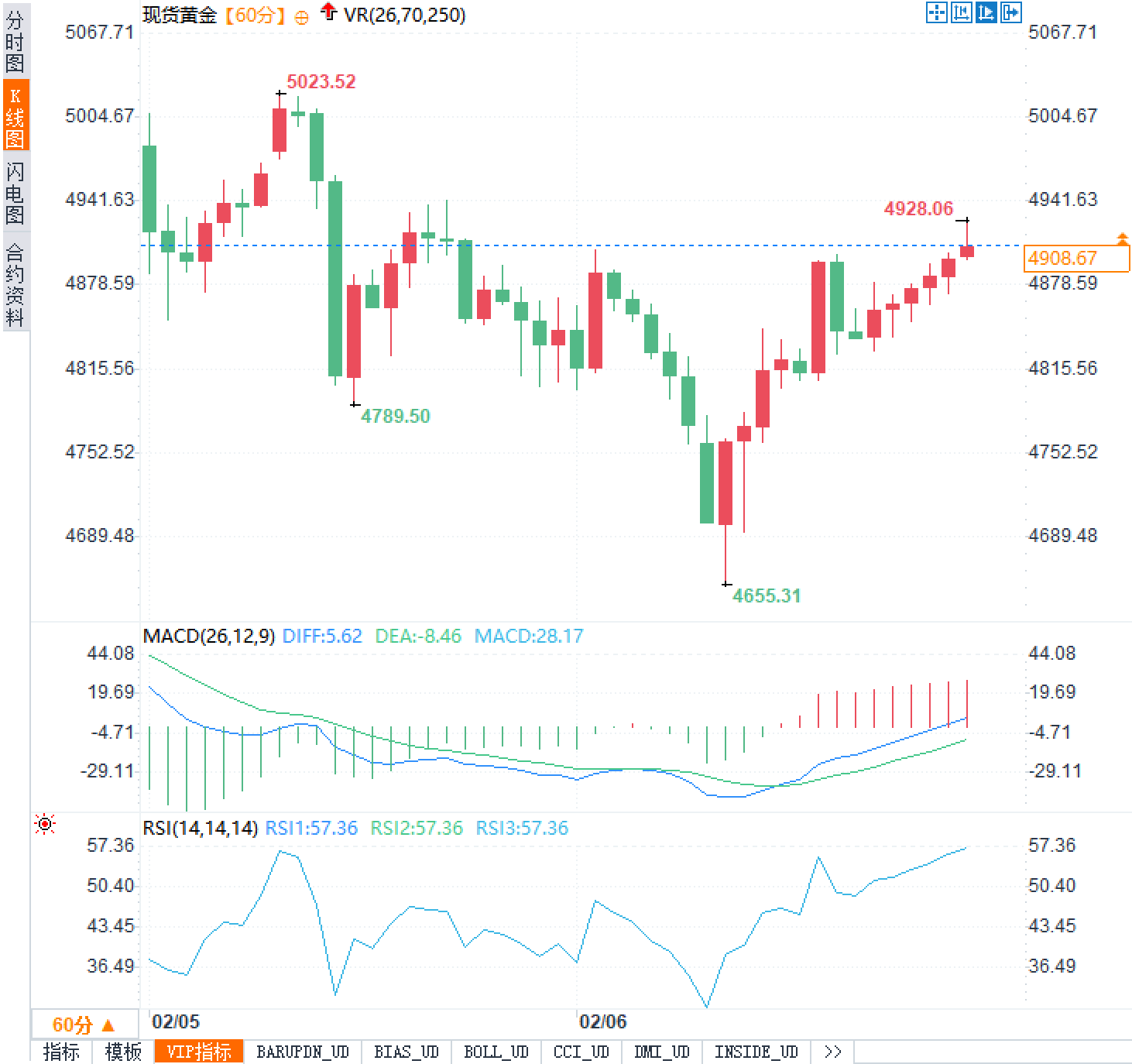
On Friday, February 6th, spot gold traded above $4900 during the North American session. After a sharp correction from its previous high of $5023.52, the price found support and rebounded around $4655.31, showing signs of stabilization and indicating that bulls are attempting to recover lost ground. Although it still faces resistance from the previous high, technical patterns suggest that bearish momentum is gradually weakening, and market sentiment is shifting from panic to a wait-and-see approach, or even tentative long positions.
This pullback is not a trend reversal, but rather a rapid repricing process in a highly volatile environment. Against the backdrop of increased volatility in global asset classes, funds are frequently switching between risky and safe-haven assets, leading to sharp rises and falls in gold prices. Especially during periods of uncertainty surrounding monetary policy expectations, the market's judgment on the Federal Reserve's future path is constantly being revised, coupled with intensified discussions about its leadership prospects, making it difficult to stabilize the short-term pricing anchor. In this environment, gold benefits from safe-haven demand while being constrained by the pressure of a temporarily strengthening US dollar, resulting in a clearly tug-of-war in its price movement.
One of the key variables supporting the medium-term outlook for gold is the marginal weakening of the US labor market. Latest data shows that job openings have fallen to 6.54 million, while weekly initial jobless claims have risen to 231,000, both indicators pointing to a cooling job market. This change is significant—it not only suggests an increased likelihood of further inflation declines but also significantly increases market bets on the Federal Reserve initiating interest rate cuts this year.
Expectations of declining interest rates typically benefit non-interest-bearing assets like gold, as the opportunity cost of holding gold decreases. If subsequent economic data continues to confirm the trends of weak employment and slowing inflation, the market's expectation of an earlier easing cycle may be further accelerated, thus building a more solid bottom for gold prices. Analysts believe that gold's current resilience stems from this macroeconomic backdrop: even with short-term pressure, a sustained sharp decline is unlikely; instead, key support levels are likely to attract bargain hunters.
However, while expectations of interest rate cuts provide medium- to long-term support, they don't necessarily mean a straight upward surge in gold prices. The policy moves of other major central banks also influence global capital flows. Recent dovish signals from the Bank of England and the European Central Bank have weakened the euro and pound, indirectly pushing up the dollar index and putting short-term pressure on gold. This is one reason why gold prices have repeatedly surged and then retreated during their rebounds, with gains quickly erased.
Beyond fundamental factors, geopolitical risks remain a significant driver of safe-haven buying. The volatile situation in the Middle East and the uncertainty surrounding negotiations have increased market vigilance regarding tail risks. Whenever uncertainty escalates, funds tend to increase their gold holdings to hedge against portfolio volatility. As long as geopolitical tensions do not ease significantly, gold is unlikely to experience a one-sided decline; even if it suffers a sharp drop, it often quickly attracts bargain hunters at lower levels, forming a V-shaped rebound.
From a technical perspective, the current chart also reveals positive signals. The MACD indicator shows a gradual increase in the red histogram momentum, reflecting a weakening of bearish momentum and a stronger willingness of the bulls to recover. The Relative Strength Index (RSI) is running at 57.36, in a neutral to slightly bullish range, neither overheated nor lacking upward potential, while also showing some support. Structurally, $4655.31 is considered an important support level; a break below this level could trigger a new round of risk release. On the other hand, $5023.52 is the previous high resistance zone; if this level cannot be effectively broken, the market will likely enter a period of high-level consolidation, digesting selling pressure over time.
In summary, the core contradiction for gold currently lies in the following: the medium- to long-term logic is favorable—rising expectations of interest rate cuts, increased macroeconomic uncertainty, and geopolitical risks providing support; however, short-term disturbances remain significant—dollar volatility, exchange rate shocks from dovish stances by other central banks, and technical resistance at key levels. Therefore, the trading rhythm is more inclined towards range-bound trading and rapid market corrections, with a directional move awaiting new catalysts.
Whether gold prices can truly break out of the stalemate depends on two key factors: first, whether the upcoming US economic data continues to confirm weak employment and a downward trend in inflation; and second, whether new conflicts or major changes will erupt in the geopolitical situation. If the data remains weak and market risk appetite remains cautious, gold is expected to consolidate around $4,900 before challenging higher resistance levels. Conversely, if the data improves and expectations for interest rate cuts cool, gold prices may return to a range-bound pattern, awaiting the next opportunity to break out.
The market is currently at a delicate balance: on the one hand, the overall macroeconomic environment is favorable for gold; on the other hand, frequent short-term disturbances make it difficult for the price to rise in one fell swoop.
This pullback is not a trend reversal, but rather a rapid repricing process in a highly volatile environment. Against the backdrop of increased volatility in global asset classes, funds are frequently switching between risky and safe-haven assets, leading to sharp rises and falls in gold prices. Especially during periods of uncertainty surrounding monetary policy expectations, the market's judgment on the Federal Reserve's future path is constantly being revised, coupled with intensified discussions about its leadership prospects, making it difficult to stabilize the short-term pricing anchor. In this environment, gold benefits from safe-haven demand while being constrained by the pressure of a temporarily strengthening US dollar, resulting in a clearly tug-of-war in its price movement.
Cooling employment rates fuel expectations of interest rate cuts, providing a "hidden boost" to gold prices.
One of the key variables supporting the medium-term outlook for gold is the marginal weakening of the US labor market. Latest data shows that job openings have fallen to 6.54 million, while weekly initial jobless claims have risen to 231,000, both indicators pointing to a cooling job market. This change is significant—it not only suggests an increased likelihood of further inflation declines but also significantly increases market bets on the Federal Reserve initiating interest rate cuts this year.
Expectations of declining interest rates typically benefit non-interest-bearing assets like gold, as the opportunity cost of holding gold decreases. If subsequent economic data continues to confirm the trends of weak employment and slowing inflation, the market's expectation of an earlier easing cycle may be further accelerated, thus building a more solid bottom for gold prices. Analysts believe that gold's current resilience stems from this macroeconomic backdrop: even with short-term pressure, a sustained sharp decline is unlikely; instead, key support levels are likely to attract bargain hunters.
However, while expectations of interest rate cuts provide medium- to long-term support, they don't necessarily mean a straight upward surge in gold prices. The policy moves of other major central banks also influence global capital flows. Recent dovish signals from the Bank of England and the European Central Bank have weakened the euro and pound, indirectly pushing up the dollar index and putting short-term pressure on gold. This is one reason why gold prices have repeatedly surged and then retreated during their rebounds, with gains quickly erased.
Driven by both geopolitical and technological factors, the battle between bulls and bears has reached a fever pitch.
Beyond fundamental factors, geopolitical risks remain a significant driver of safe-haven buying. The volatile situation in the Middle East and the uncertainty surrounding negotiations have increased market vigilance regarding tail risks. Whenever uncertainty escalates, funds tend to increase their gold holdings to hedge against portfolio volatility. As long as geopolitical tensions do not ease significantly, gold is unlikely to experience a one-sided decline; even if it suffers a sharp drop, it often quickly attracts bargain hunters at lower levels, forming a V-shaped rebound.
From a technical perspective, the current chart also reveals positive signals. The MACD indicator shows a gradual increase in the red histogram momentum, reflecting a weakening of bearish momentum and a stronger willingness of the bulls to recover. The Relative Strength Index (RSI) is running at 57.36, in a neutral to slightly bullish range, neither overheated nor lacking upward potential, while also showing some support. Structurally, $4655.31 is considered an important support level; a break below this level could trigger a new round of risk release. On the other hand, $5023.52 is the previous high resistance zone; if this level cannot be effectively broken, the market will likely enter a period of high-level consolidation, digesting selling pressure over time.
In summary, the core contradiction for gold currently lies in the following: the medium- to long-term logic is favorable—rising expectations of interest rate cuts, increased macroeconomic uncertainty, and geopolitical risks providing support; however, short-term disturbances remain significant—dollar volatility, exchange rate shocks from dovish stances by other central banks, and technical resistance at key levels. Therefore, the trading rhythm is more inclined towards range-bound trading and rapid market corrections, with a directional move awaiting new catalysts.
Where will the journey lead next? Data and risk will determine the outcome.
Whether gold prices can truly break out of the stalemate depends on two key factors: first, whether the upcoming US economic data continues to confirm weak employment and a downward trend in inflation; and second, whether new conflicts or major changes will erupt in the geopolitical situation. If the data remains weak and market risk appetite remains cautious, gold is expected to consolidate around $4,900 before challenging higher resistance levels. Conversely, if the data improves and expectations for interest rate cuts cool, gold prices may return to a range-bound pattern, awaiting the next opportunity to break out.
The market is currently at a delicate balance: on the one hand, the overall macroeconomic environment is favorable for gold; on the other hand, frequent short-term disturbances make it difficult for the price to rise in one fell swoop.
- Risk Warning and Disclaimer
- The market involves risk, and trading may not be suitable for all investors. This article is for reference only and does not constitute personal investment advice, nor does it take into account certain users’ specific investment objectives, financial situation, or other needs. Any investment decisions made based on this information are at your own risk.