Crude Oil Futures Weekly Outlook: Geopolitical Risks Dominate Market Tone
2026-02-09 19:52:02
On Monday (February 9), during the European session, West Texas Intermediate (WTI) crude oil futures in the United States initially fluctuated and consolidated before experiencing a significant surge at the end of the session. The price broke through the upper limit of the recent trading range, indicating increased short-term bullish momentum. The price reached $63.8 per barrel during the session, up 0.39%.

US-Iran talks keep crude oil prices consolidating.
WTI crude oil futures closed lower last week. Despite concerns about supply disruptions due to the US Navy's deployment in the Strait of Hormuz, long positions were reduced, and new buying was scarce. The US-Iran negotiations brokered by Oman were the main reason for the market's cautious stance last week.
The negotiation path carries two risks.
The outcome of negotiations between the two nuclear superpowers remains uncertain, as reflected in weekly price movements. A report from an Iranian diplomat that the negotiations are "progressing well" may be limiting the upside potential of oil prices. If negotiations continue and a formal agreement is reached, oil prices may fall back to support levels.
However, negotiations also risk breaking down, at which point investors will begin pricing in a potential military strike by the U.S. Navy. Furthermore, Iran could retaliate by attacking U.S. interests globally or even by blocking the Strait of Hormuz—which supplies 20% of the world's oil.
Supply risks dominate: Oil prices may fluctuate by $10.
The current core logic of oil prices depends entirely on supply. If negotiations break down, the US launches a strike, Iran retaliates, or the Strait of Hormuz is blocked, the upside potential for oil prices is clear. With multiple negative factors combined, oil prices could surge by $10.
On the downside, if the US and Iran reach an agreement and the US Navy begins to withdraw from the region, oil prices could plummet by $5-10.
Other influencing factors
Other factors influencing oil prices include the dollar's performance, which will be driven by US labor market data, Federal Reserve policy expectations, and overall market sentiment. A weaker dollar will boost demand for dollar-denominated crude oil, while a stronger dollar will dampen demand.
Traders will also be watching U.S. crude oil inventory data – a larger-than-expected drop last Wednesday unexpectedly provided support for oil prices. Furthermore, any news regarding Russian crude oil supplies could trigger significant market volatility.
Technical Analysis: Range-bound trading, with a slight upward bias.
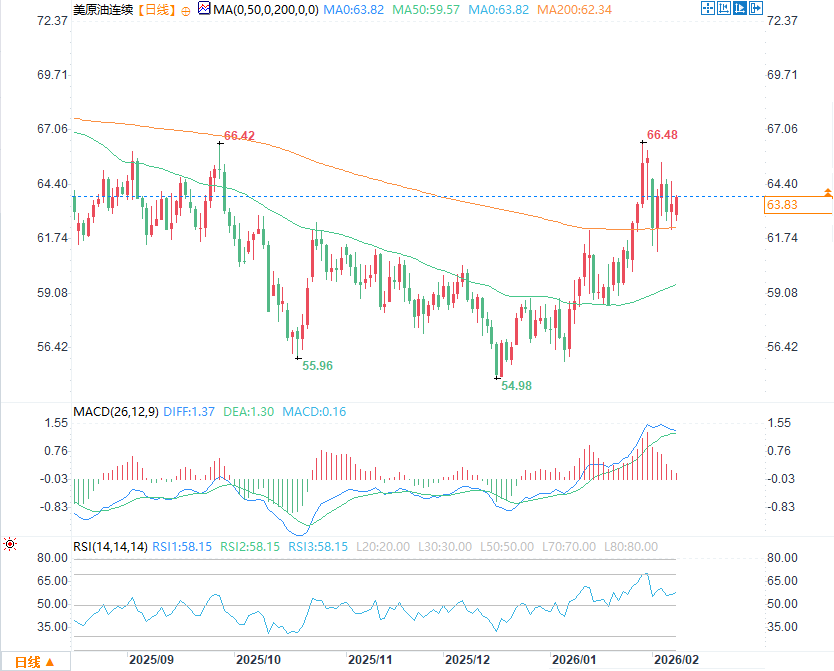
(WTI crude oil daily chart source: FX678)
From a technical perspective, crude oil futures are likely to maintain range-bound trading with an overall upward bias, mainly supported by geopolitical risk premiums.
At the start of the new week, oil prices are trading above the 52-week moving average ($60.62) and the 50% Fibonacci retracement level ($60.59). This support zone provides a floor for oil prices, with the core driver being the supply disruption premium.
Oil prices fluctuated around the long-term 50% Fibonacci level of $63.62 throughout the week, ultimately closing below that level, indicating a slight weakening of the war premium.
The medium-term trading range is $75.12–$54.70, corresponding to a Fibonacci retracement resistance range of $64.91–$67.32. This area previously suppressed oil prices to a peak of $66.48 during the week of January 30.
This Week's Outlook: Focus is entirely on the Iran-US negotiations
This week, the market's focus will be on the progress of US-Iran negotiations, which is the biggest variable. An agreement could put downward pressure on oil prices, while a complete breakdown in negotiations would likely trigger renewed war premium buying, pushing up oil prices.
US-Iran talks keep crude oil prices consolidating.
WTI crude oil futures closed lower last week. Despite concerns about supply disruptions due to the US Navy's deployment in the Strait of Hormuz, long positions were reduced, and new buying was scarce. The US-Iran negotiations brokered by Oman were the main reason for the market's cautious stance last week.
The negotiation path carries two risks.
The outcome of negotiations between the two nuclear superpowers remains uncertain, as reflected in weekly price movements. A report from an Iranian diplomat that the negotiations are "progressing well" may be limiting the upside potential of oil prices. If negotiations continue and a formal agreement is reached, oil prices may fall back to support levels.
However, negotiations also risk breaking down, at which point investors will begin pricing in a potential military strike by the U.S. Navy. Furthermore, Iran could retaliate by attacking U.S. interests globally or even by blocking the Strait of Hormuz—which supplies 20% of the world's oil.
Supply risks dominate: Oil prices may fluctuate by $10.
The current core logic of oil prices depends entirely on supply. If negotiations break down, the US launches a strike, Iran retaliates, or the Strait of Hormuz is blocked, the upside potential for oil prices is clear. With multiple negative factors combined, oil prices could surge by $10.
On the downside, if the US and Iran reach an agreement and the US Navy begins to withdraw from the region, oil prices could plummet by $5-10.
Other influencing factors
Other factors influencing oil prices include the dollar's performance, which will be driven by US labor market data, Federal Reserve policy expectations, and overall market sentiment. A weaker dollar will boost demand for dollar-denominated crude oil, while a stronger dollar will dampen demand.
Traders will also be watching U.S. crude oil inventory data – a larger-than-expected drop last Wednesday unexpectedly provided support for oil prices. Furthermore, any news regarding Russian crude oil supplies could trigger significant market volatility.
Technical Analysis: Range-bound trading, with a slight upward bias.
(WTI crude oil daily chart source: FX678)
From a technical perspective, crude oil futures are likely to maintain range-bound trading with an overall upward bias, mainly supported by geopolitical risk premiums.
At the start of the new week, oil prices are trading above the 52-week moving average ($60.62) and the 50% Fibonacci retracement level ($60.59). This support zone provides a floor for oil prices, with the core driver being the supply disruption premium.
Oil prices fluctuated around the long-term 50% Fibonacci level of $63.62 throughout the week, ultimately closing below that level, indicating a slight weakening of the war premium.
The medium-term trading range is $75.12–$54.70, corresponding to a Fibonacci retracement resistance range of $64.91–$67.32. This area previously suppressed oil prices to a peak of $66.48 during the week of January 30.
This Week's Outlook: Focus is entirely on the Iran-US negotiations
This week, the market's focus will be on the progress of US-Iran negotiations, which is the biggest variable. An agreement could put downward pressure on oil prices, while a complete breakdown in negotiations would likely trigger renewed war premium buying, pushing up oil prices.
- Risk Warning and Disclaimer
- The market involves risk, and trading may not be suitable for all investors. This article is for reference only and does not constitute personal investment advice, nor does it take into account certain users’ specific investment objectives, financial situation, or other needs. Any investment decisions made based on this information are at your own risk.