The crude oil market is experiencing contradictory price movements; who is lying?
2026-02-10 20:19:03
On Tuesday, February 10th, Brent crude oil traded around $69.40 in pre-market trading. This round of price action lacked a clear one-sided trend, resembling more the result of a fierce struggle between bulls and bears at key levels. On one hand, news of potential progress in US-Iran negotiations eased geopolitical tensions; on the other hand, multiple supply disruptions emerged, including a sharp drop in Kazakhstan exports, restrictions on Russian oil transportation, and changes in India's purchasing structure. These factors offset each other, making traders hesitant to bet on the direction, resulting in an overall cautious sentiment.

In this stalemate, oil price fluctuations are more driven by breaking news than by fundamental trends. Whenever there's a glimmer of hope for easing negotiations, the market quickly absorbs the "risk premium," causing oil prices to fall in the short term; but once new signs of supply disruption appear, prices immediately rebound and recover lost ground. The current situation suggests that the market is waiting for a clearer signal through range-bound trading—is it the dawn of peace, or a full-blown supply crisis?
While geopolitical negotiations have brought a glimmer of optimism, analysts note that the real risks have not been eliminated, but rather are quietly accumulating in other areas. The most concerning issue is Kazakhstan's export situation. The slow recovery of production at the country's main oil field, Tengiz, directly impacts crude oil shipments via the CPC pipeline and its Black Sea terminal. Data shows that current daily exports may only be around 1.1 million barrels, far below the originally planned 1.7 million barrels, equivalent to a nearly 35% reduction in supply per month. If this level of shortfall persists for several weeks, it could significantly alter the short-term global crude oil supply and demand balance, particularly putting pressure on near-month futures contracts, pushing the discount to narrow or even turn into a premium.
At the same time, the flow of Russian crude oil is facing new challenges. With some countries adjusting their import strategies, India, one of the largest buyers of Russian oil in recent years, may reduce its purchases in the near future. Although its daily imports will remain at 1.1 million to 1.2 million barrels in December, competition in the spot market will intensify if it needs to supplement its demand from other regions in the future, particularly in the competition for medium and heavy crude oil, which will drive up premiums.
Furthermore, the oil-producing alliance as a whole has maintained stable production levels and has not signaled a significant increase in output, meaning that the supply side lacks the capacity for rapid replenishment. With the peak consumption season approaching and restocking demand expected to rebound, any localized disruptions could be amplified. These factors combined are quietly reshaping the market's pricing logic for near-term supply.
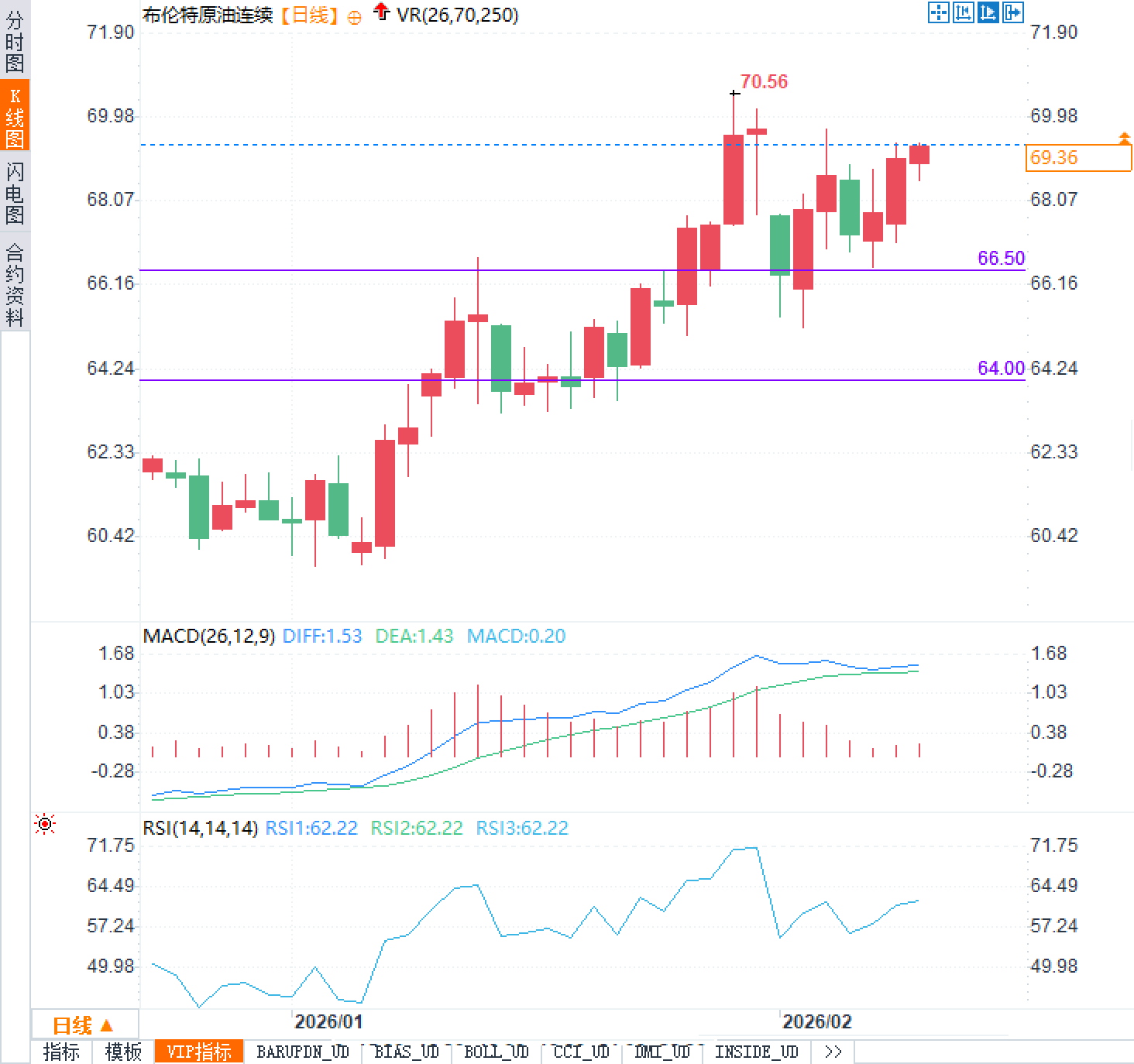
From a technical chart perspective, Brent crude oil is still in a consolidation phase on the daily chart, but the overall trend is bullish. The current price is trading just below the psychological level of $70. A successful break above this level could open up further upside potential; conversely, if it encounters resistance and falls back, the first support level to watch is $66.50, followed by the crucial support level of $64.00.
In terms of indicators, the MACD is still running above the zero line, with a DIFF value of 1.53, a DEA value of 1.43, and a histogram of approximately 0.20, indicating that while bullish momentum remains, the rate of expansion has clearly slowed, consistent with the characteristics of consolidation. The RSI is currently at 62.22, not yet in overbought territory, suggesting that the price still has room to test higher levels, but it is likely to encounter profit-taking pressure near the resistance zone. Overall, the trend reflects that the market is in a state of accumulation, awaiting an external catalyst to break the deadlock.
It's worth noting that such range-bound price movements are often short-lived. Once key variables materialize—whether it's the lifting of US-Iran sanctions or the recovery of Kazakh exports—prices are likely to quickly move in the opposite direction. In particular, a persistent export discrepancy between 1.1 million and 1.7 million barrels, or confirmation that India has actually reduced its Russian oil purchases, could be the trigger for a market correction.
In summary, Brent crude oil is likely to continue trading within a range in the short term, but the underlying dynamics have become increasingly complex. On one hand, if the US-Iran negotiations make substantial progress, market concerns about escalating conflict will further diminish, and some risk premiums will be systematically retraced, potentially pushing oil prices down to test support levels at $66.50 or even $64.00. In this scenario, financial pressures may also increase, especially if expectations of a Fed rate hike rise again, a stronger dollar would exert additional downward pressure on commodities.
On the other hand, if multiple supply-side disturbances continue to escalate—including sluggish exports from Kazakhstan, restrictions on Russian oil transportation, and a shift in Indian purchasing—the market will have to reassess the near-term supply and demand tensions. At that point, even if geopolitical tensions ease, structural shortages in the physical market could still support oil prices to retest the $70.56 level, or even attempt to break through it.
In this stalemate, oil price fluctuations are more driven by breaking news than by fundamental trends. Whenever there's a glimmer of hope for easing negotiations, the market quickly absorbs the "risk premium," causing oil prices to fall in the short term; but once new signs of supply disruption appear, prices immediately rebound and recover lost ground. The current situation suggests that the market is waiting for a clearer signal through range-bound trading—is it the dawn of peace, or a full-blown supply crisis?
A triple bombshell on the supply side has quietly detonated, stirring up undercurrents in the global oil market.
While geopolitical negotiations have brought a glimmer of optimism, analysts note that the real risks have not been eliminated, but rather are quietly accumulating in other areas. The most concerning issue is Kazakhstan's export situation. The slow recovery of production at the country's main oil field, Tengiz, directly impacts crude oil shipments via the CPC pipeline and its Black Sea terminal. Data shows that current daily exports may only be around 1.1 million barrels, far below the originally planned 1.7 million barrels, equivalent to a nearly 35% reduction in supply per month. If this level of shortfall persists for several weeks, it could significantly alter the short-term global crude oil supply and demand balance, particularly putting pressure on near-month futures contracts, pushing the discount to narrow or even turn into a premium.
At the same time, the flow of Russian crude oil is facing new challenges. With some countries adjusting their import strategies, India, one of the largest buyers of Russian oil in recent years, may reduce its purchases in the near future. Although its daily imports will remain at 1.1 million to 1.2 million barrels in December, competition in the spot market will intensify if it needs to supplement its demand from other regions in the future, particularly in the competition for medium and heavy crude oil, which will drive up premiums.
Furthermore, the oil-producing alliance as a whole has maintained stable production levels and has not signaled a significant increase in output, meaning that the supply side lacks the capacity for rapid replenishment. With the peak consumption season approaching and restocking demand expected to rebound, any localized disruptions could be amplified. These factors combined are quietly reshaping the market's pricing logic for near-term supply.
Technically, the market is poised for a breakout; a directional move is just one step away.
From a technical chart perspective, Brent crude oil is still in a consolidation phase on the daily chart, but the overall trend is bullish. The current price is trading just below the psychological level of $70. A successful break above this level could open up further upside potential; conversely, if it encounters resistance and falls back, the first support level to watch is $66.50, followed by the crucial support level of $64.00.
In terms of indicators, the MACD is still running above the zero line, with a DIFF value of 1.53, a DEA value of 1.43, and a histogram of approximately 0.20, indicating that while bullish momentum remains, the rate of expansion has clearly slowed, consistent with the characteristics of consolidation. The RSI is currently at 62.22, not yet in overbought territory, suggesting that the price still has room to test higher levels, but it is likely to encounter profit-taking pressure near the resistance zone. Overall, the trend reflects that the market is in a state of accumulation, awaiting an external catalyst to break the deadlock.
It's worth noting that such range-bound price movements are often short-lived. Once key variables materialize—whether it's the lifting of US-Iran sanctions or the recovery of Kazakh exports—prices are likely to quickly move in the opposite direction. In particular, a persistent export discrepancy between 1.1 million and 1.7 million barrels, or confirmation that India has actually reduced its Russian oil purchases, could be the trigger for a market correction.
The key focus of the market outlook: risk premium retracement vs. supply tightness reassessment
In summary, Brent crude oil is likely to continue trading within a range in the short term, but the underlying dynamics have become increasingly complex. On one hand, if the US-Iran negotiations make substantial progress, market concerns about escalating conflict will further diminish, and some risk premiums will be systematically retraced, potentially pushing oil prices down to test support levels at $66.50 or even $64.00. In this scenario, financial pressures may also increase, especially if expectations of a Fed rate hike rise again, a stronger dollar would exert additional downward pressure on commodities.
On the other hand, if multiple supply-side disturbances continue to escalate—including sluggish exports from Kazakhstan, restrictions on Russian oil transportation, and a shift in Indian purchasing—the market will have to reassess the near-term supply and demand tensions. At that point, even if geopolitical tensions ease, structural shortages in the physical market could still support oil prices to retest the $70.56 level, or even attempt to break through it.
- Risk Warning and Disclaimer
- The market involves risk, and trading may not be suitable for all investors. This article is for reference only and does not constitute personal investment advice, nor does it take into account certain users’ specific investment objectives, financial situation, or other needs. Any investment decisions made based on this information are at your own risk.