Crude oil trading alert: Increased inventories cannot mask geopolitical premiums; oil prices maintain a volatile upward trend.
2026-02-12 09:15:51
International oil prices continued to rise in Asian trading on Thursday, supported by multiple factors, approaching the $65 mark and nearing the upper limit of the year's trading range. The core driver of this rally is not improved inventory levels, but rather the rapid accumulation of geopolitical risk premiums.
The U.S. Department of Defense has requested that a second carrier strike group prepare for deployment to the Middle East and is considering stronger measures against oil tankers carrying Iranian crude. Market concerns are that if these measures are implemented, Iranian exports could face temporary disruptions, thereby altering the short-term global supply balance.
"The current oil market is mainly influenced by geopolitics, the trade environment, and technological structure, with geopolitics being the dominant force determining price trends at this stage." — Francisco Blanch, Head of Global Commodities Research at Bank of America

Data shows that Iran's daily production is approximately 3.3 million barrels, and its daily exports are about 1.63 million barrels, maintaining a significant position within OPEC. Any export restrictions could have a ripple effect on Asian markets in the short term.
At the same time, US macroeconomic data released positive signals. Strong employment performance improved economic growth expectations and strengthened the resilience of transportation fuel and industrial energy demand.
“The labor market remains resilient, supporting demand for transportation fuels and petrochemicals and mitigating downside risks to consumption.” — Claudio Galimberti, Chief Energy Economist at Rezidor
However, signs of easing on the supply side persist. The International Energy Agency (IEA) has warned of a potential large-scale supply glut in the market this year. Data from the U.S. Energy Information Administration shows that crude oil inventories rose by 8.5 million barrels last week, the largest weekly increase this year.
Despite a significant increase in inventories, oil prices have reacted relatively restrainedly, indicating that market trading logic remains centered around geopolitical risks. Year-to-date, WTI crude oil has risen by nearly 13%, with its price structure exhibiting a clear risk premium-driven characteristic.
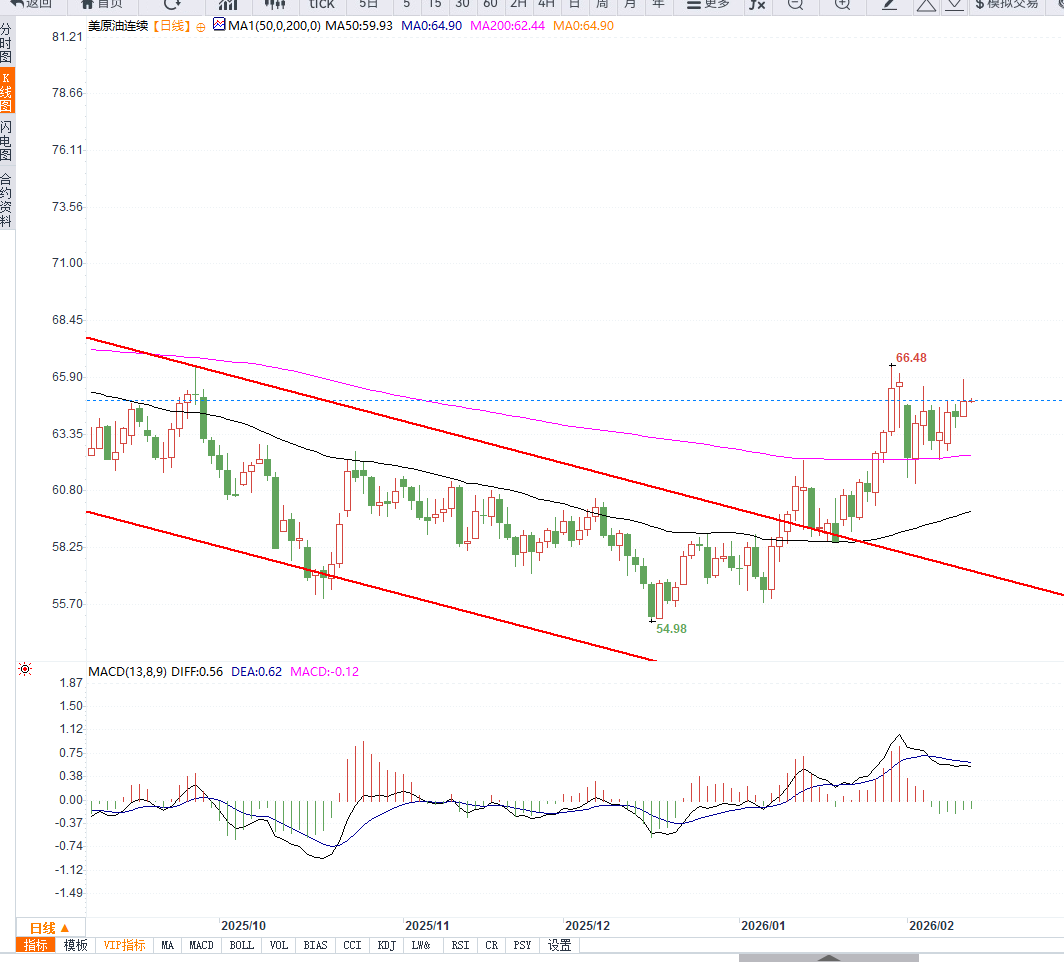
From the daily chart, WTI crude oil has been operating within an upward channel. Recently, after rebounding from around $60, the price has closed with consecutive positive candles and has regained its position above the 50-day and 100-day moving averages. The moving average system shows a bullish pattern, indicating that the medium-term trend remains strong.
The current price is trading near the upper channel line, with the $64-$65 range forming a key short-term resistance zone. A decisive break above the year's high of $65.20 would open up potential for a move towards the previous high-volume trading area around $67.80.
Conversely, if the bullish momentum weakens and the price falls below $62.50, it means the upward pace may slow down, and the market will retest the $60 psychological level and the lower channel support at $59.80.
In terms of momentum indicators, the daily RSI is above 60 but has not yet entered the overbought zone, indicating that the bulls still have the upper hand but are approaching a relatively high level. The MACD indicator remains above the zero line, and the red bars continue to expand, reflecting that the trend momentum is still being released.
However, prices approaching the upper channel line usually indicates increased short-term volatility and a need for technical consolidation. Overall, the technical structure supports a slightly bullish oscillating pattern, but selling pressure in the upper resistance area may gradually increase, and whether or not a breakout occurs will be key to determining the direction in the next phase.
Editor's Note:
The current rise in oil prices reflects more the rapid accumulation of risk premiums than a fundamental improvement in supply and demand fundamentals. The market is already pricing in the possibility of potential supply disruptions, hence its limited reaction to bearish data such as increased inventories.
In the short term, as long as tensions remain high in the Middle East, oil prices are likely to maintain their current high levels and may even rise further. However, from a medium-term perspective, if the IEA's assessment of oversupply gradually materializes, and US inventories continue to accumulate, the probability of oil prices facing downward pressure at their current high levels will increase significantly.
Overall, the market is in a phase where "geopolitical factors outweigh fundamentals," and future trends may show increased volatility at high levels. Close attention needs to be paid to the dynamics in the Middle East and the changing dynamics of supply and demand reports.
The U.S. Department of Defense has requested that a second carrier strike group prepare for deployment to the Middle East and is considering stronger measures against oil tankers carrying Iranian crude. Market concerns are that if these measures are implemented, Iranian exports could face temporary disruptions, thereby altering the short-term global supply balance.
"The current oil market is mainly influenced by geopolitics, the trade environment, and technological structure, with geopolitics being the dominant force determining price trends at this stage." — Francisco Blanch, Head of Global Commodities Research at Bank of America
Data shows that Iran's daily production is approximately 3.3 million barrels, and its daily exports are about 1.63 million barrels, maintaining a significant position within OPEC. Any export restrictions could have a ripple effect on Asian markets in the short term.
At the same time, US macroeconomic data released positive signals. Strong employment performance improved economic growth expectations and strengthened the resilience of transportation fuel and industrial energy demand.
“The labor market remains resilient, supporting demand for transportation fuels and petrochemicals and mitigating downside risks to consumption.” — Claudio Galimberti, Chief Energy Economist at Rezidor
However, signs of easing on the supply side persist. The International Energy Agency (IEA) has warned of a potential large-scale supply glut in the market this year. Data from the U.S. Energy Information Administration shows that crude oil inventories rose by 8.5 million barrels last week, the largest weekly increase this year.
Despite a significant increase in inventories, oil prices have reacted relatively restrainedly, indicating that market trading logic remains centered around geopolitical risks. Year-to-date, WTI crude oil has risen by nearly 13%, with its price structure exhibiting a clear risk premium-driven characteristic.
From the daily chart, WTI crude oil has been operating within an upward channel. Recently, after rebounding from around $60, the price has closed with consecutive positive candles and has regained its position above the 50-day and 100-day moving averages. The moving average system shows a bullish pattern, indicating that the medium-term trend remains strong.
The current price is trading near the upper channel line, with the $64-$65 range forming a key short-term resistance zone. A decisive break above the year's high of $65.20 would open up potential for a move towards the previous high-volume trading area around $67.80.
Conversely, if the bullish momentum weakens and the price falls below $62.50, it means the upward pace may slow down, and the market will retest the $60 psychological level and the lower channel support at $59.80.
In terms of momentum indicators, the daily RSI is above 60 but has not yet entered the overbought zone, indicating that the bulls still have the upper hand but are approaching a relatively high level. The MACD indicator remains above the zero line, and the red bars continue to expand, reflecting that the trend momentum is still being released.
However, prices approaching the upper channel line usually indicates increased short-term volatility and a need for technical consolidation. Overall, the technical structure supports a slightly bullish oscillating pattern, but selling pressure in the upper resistance area may gradually increase, and whether or not a breakout occurs will be key to determining the direction in the next phase.
Editor's Note:
The current rise in oil prices reflects more the rapid accumulation of risk premiums than a fundamental improvement in supply and demand fundamentals. The market is already pricing in the possibility of potential supply disruptions, hence its limited reaction to bearish data such as increased inventories.
In the short term, as long as tensions remain high in the Middle East, oil prices are likely to maintain their current high levels and may even rise further. However, from a medium-term perspective, if the IEA's assessment of oversupply gradually materializes, and US inventories continue to accumulate, the probability of oil prices facing downward pressure at their current high levels will increase significantly.
Overall, the market is in a phase where "geopolitical factors outweigh fundamentals," and future trends may show increased volatility at high levels. Close attention needs to be paid to the dynamics in the Middle East and the changing dynamics of supply and demand reports.
- Risk Warning and Disclaimer
- The market involves risk, and trading may not be suitable for all investors. This article is for reference only and does not constitute personal investment advice, nor does it take into account certain users’ specific investment objectives, financial situation, or other needs. Any investment decisions made based on this information are at your own risk.