Strong non-farm payroll data put pressure on gold prices, but central bank gold purchases limited the downside.
2026-02-12 09:38:51
On Thursday (February 12) during the Asian session, spot gold fluctuated downwards, currently trading around $5055 per ounce, down about 0.55% on the day. Overnight, the US January non-farm payroll data exceeded expectations, prompting the market to reprice the Federal Reserve's policy stance for the first half of 2026, believing it to be less dovish than previously anticipated. Gold prices briefly fell to around $5020, but global central bank gold purchases, White House policy uncertainty, and doubts about the dollar's credibility continued to provide support, and gold prices still closed up 1.2% on Wednesday, settling at $5083.51 per ounce.

Earlier, the US January non-farm payrolls report, delayed due to the three-day US government shutdown, far exceeded expectations, showing an increase of 130,000 jobs, a significant rebound from December's 50,000 and also higher than the market expectation of 70,000. The unemployment rate subsequently fell from 4.4% to 4.3%, prompting investors to adjust their expectations. Currently, the market anticipates the Federal Reserve's first interest rate cut will occur in July.
Meanwhile, Kansas City Federal Reserve President Jeffrey Schmid poured cold water on President Donald Trump's support for interest rate cuts. Schmid reiterated his hawkish stance, stating that "rate cuts could lead to higher inflation lasting longer."
Schmid stated that current policies have not constrained the economy, adding that monetary policy should remain restrictive as long as inflation remains around 3%.
Gold prices initially fell overnight to a daily low of $5,020.07, but bargain hunting subsequently helped them recover their losses, and the price fluctuated around $5,050 before closing at $5,083.51.
Rising US Treasury yields continued to put downward pressure on gold prices. The 10-year US Treasury yield rose by nearly 3 basis points, while the US dollar index rose moderately for two consecutive trading days, fluctuating narrowly around 96.95 during Thursday's Asian session.
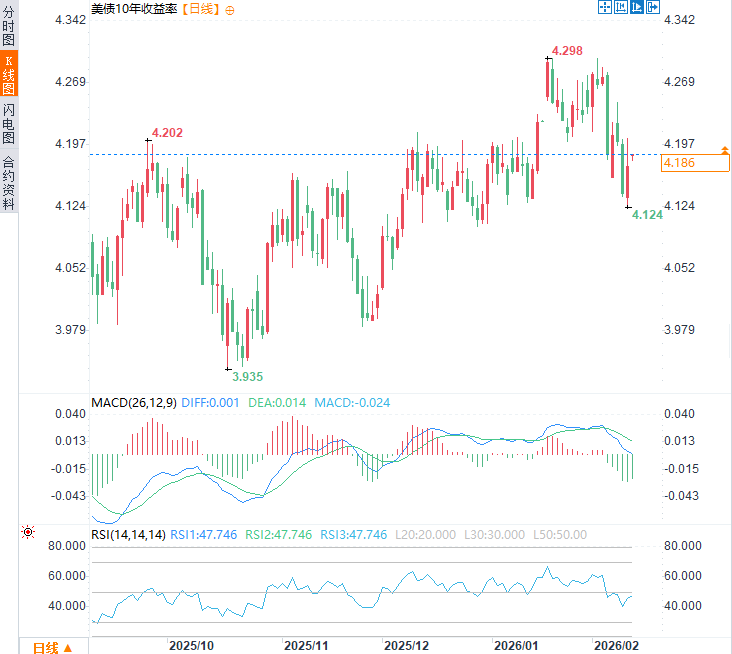
(Daily chart of 10-year US Treasury yield, source: EasyTrade)
Meanwhile, new developments have emerged on the geopolitical front. Ukrainian President Zelenskyy stated that the territorial issue will be the core topic of the next round of talks with the United States. He confirmed that Ukraine has accepted the US invitation to hold a new round of negotiations next week, focusing on the possibility of establishing a free economic zone in the Donbas region as a buffer.
Despite Zelensky's emphasis that "this is our territory and must be governed by us," he acknowledged that both Russia and Ukraine were skeptical of the US proposal. This statement was interpreted by the outside world as Ukraine potentially being forced to show greater flexibility on the issue of territorial concessions under strong US mediation in exchange for a ceasefire, reconstruction aid, and security guarantees. This suggests that the Russia-Ukraine conflict may be entering a substantial turning point.
Currently, gold prices remain high, driven by multiple safe-haven factors. Global central banks have been increasing their gold reserves for several years to hedge against the potential weakening of the US dollar's dominance. This "de-dollarization" trend will accelerate further between 2025 and 2026: on the one hand, the dollar's credibility is being questioned due to the continued expansion of the US fiscal deficit, debt ceiling pressure, and the controversy surrounding the Federal Reserve's independence; on the other hand, the aggressive tariff policies, trade protectionist measures, and public pressure on the Federal Reserve introduced by the Trump administration have further exacerbated market expectations of a long-term weakening dollar. Many institutional investors view gold as a core hedging tool for "currency devaluation trading," leading to increased demand for gold. Even with short-term profit-taking, the overall upward trend remains solid.
A Bloomberg headline article on Wednesday stated that "Trump is privately weighing withdrawing from the USMCA, which he personally negotiated." The article noted, "This move would shake the foundations of one of the world's largest trading relationships—an agreement covering approximately $2 trillion in goods and services—and even the mere threat of a U.S. withdrawal would create uncertainty for investors and world leaders."
Thursday will see the release of initial jobless claims for the week ending February 7, along with speeches from several Federal Reserve officials, which investors should pay close attention to. On Friday, traders will turn their attention to the January Consumer Price Index (CPI) report, which is widely expected to be lower than the previous figure. Overall inflation and core inflation are projected to slow to 2.5% year-on-year from 2.7% and 2.6%, respectively.
If the data meets expectations, gold prices may resume their upward trend, given that Federal Reserve officials have previously emphasized that they may consider cutting interest rates if the anti-inflation process restarts.
The daily chart for gold prices shows that the upward trend remains intact. As long as gold prices hold above the 20-day moving average (MA, 4957.36), the market structure remains bullish, and bulls are targeting higher prices.
The 14-day Relative Strength Index (RSI) is significantly above the midline, indicating a bullish bias; the MACD oscillator histogram continues to narrow in the negative zone, showing that the bearish momentum is gradually weakening.
On the upside, if the $5,100 level can be recovered, it may accelerate to the high of $5,450.95 on January 30. If it strengthens further, it may challenge the historical peak of $5,596.33.
On the downside, if gold prices break below the 20-day moving average, the bears may first target the February 6 low of $4,655.31, and then test the 50-day moving average of $4,613.02.
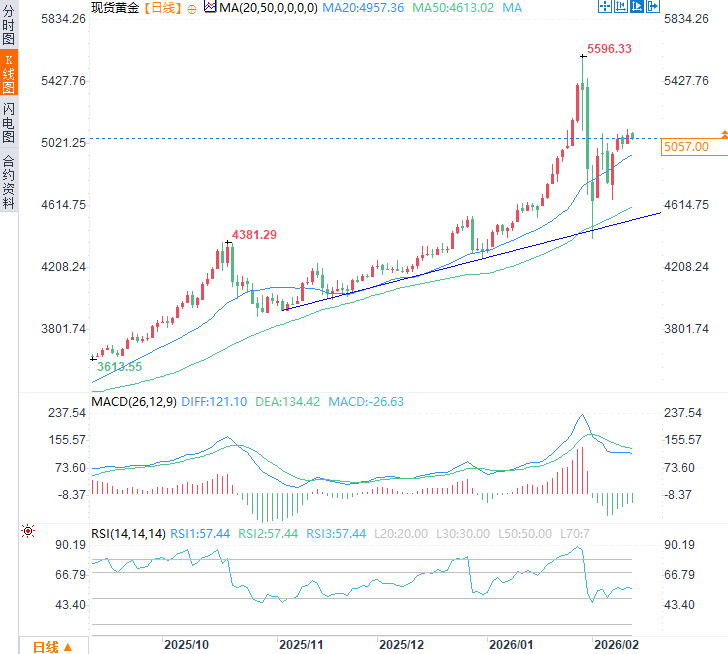
(Spot gold daily chart, source: FX678)
At 9:37 Beijing time, spot gold was trading at $5060.91 per ounce.
Gold prices fell overnight before stabilizing, influenced by non-farm payroll data and hawkish comments from the Federal Reserve.
Earlier, the US January non-farm payrolls report, delayed due to the three-day US government shutdown, far exceeded expectations, showing an increase of 130,000 jobs, a significant rebound from December's 50,000 and also higher than the market expectation of 70,000. The unemployment rate subsequently fell from 4.4% to 4.3%, prompting investors to adjust their expectations. Currently, the market anticipates the Federal Reserve's first interest rate cut will occur in July.
Meanwhile, Kansas City Federal Reserve President Jeffrey Schmid poured cold water on President Donald Trump's support for interest rate cuts. Schmid reiterated his hawkish stance, stating that "rate cuts could lead to higher inflation lasting longer."
Schmid stated that current policies have not constrained the economy, adding that monetary policy should remain restrictive as long as inflation remains around 3%.
Gold prices initially fell overnight to a daily low of $5,020.07, but bargain hunting subsequently helped them recover their losses, and the price fluctuated around $5,050 before closing at $5,083.51.
Rising US Treasury yields supported the dollar and pressured gold prices.
Rising US Treasury yields continued to put downward pressure on gold prices. The 10-year US Treasury yield rose by nearly 3 basis points, while the US dollar index rose moderately for two consecutive trading days, fluctuating narrowly around 96.95 during Thursday's Asian session.
(Daily chart of 10-year US Treasury yield, source: EasyTrade)
As geopolitical risks from the Russia-Ukraine conflict ease, demand for gold as a safe haven weakens.
Meanwhile, new developments have emerged on the geopolitical front. Ukrainian President Zelenskyy stated that the territorial issue will be the core topic of the next round of talks with the United States. He confirmed that Ukraine has accepted the US invitation to hold a new round of negotiations next week, focusing on the possibility of establishing a free economic zone in the Donbas region as a buffer.
Despite Zelensky's emphasis that "this is our territory and must be governed by us," he acknowledged that both Russia and Ukraine were skeptical of the US proposal. This statement was interpreted by the outside world as Ukraine potentially being forced to show greater flexibility on the issue of territorial concessions under strong US mediation in exchange for a ceasefire, reconstruction aid, and security guarantees. This suggests that the Russia-Ukraine conflict may be entering a substantial turning point.
Uncertainty stemming from central bank gold purchases and controversial White House policies continues to support gold prices.
Currently, gold prices remain high, driven by multiple safe-haven factors. Global central banks have been increasing their gold reserves for several years to hedge against the potential weakening of the US dollar's dominance. This "de-dollarization" trend will accelerate further between 2025 and 2026: on the one hand, the dollar's credibility is being questioned due to the continued expansion of the US fiscal deficit, debt ceiling pressure, and the controversy surrounding the Federal Reserve's independence; on the other hand, the aggressive tariff policies, trade protectionist measures, and public pressure on the Federal Reserve introduced by the Trump administration have further exacerbated market expectations of a long-term weakening dollar. Many institutional investors view gold as a core hedging tool for "currency devaluation trading," leading to increased demand for gold. Even with short-term profit-taking, the overall upward trend remains solid.
A Bloomberg headline article on Wednesday stated that "Trump is privately weighing withdrawing from the USMCA, which he personally negotiated." The article noted, "This move would shake the foundations of one of the world's largest trading relationships—an agreement covering approximately $2 trillion in goods and services—and even the mere threat of a U.S. withdrawal would create uncertainty for investors and world leaders."
Key points to watch in the future
Thursday will see the release of initial jobless claims for the week ending February 7, along with speeches from several Federal Reserve officials, which investors should pay close attention to. On Friday, traders will turn their attention to the January Consumer Price Index (CPI) report, which is widely expected to be lower than the previous figure. Overall inflation and core inflation are projected to slow to 2.5% year-on-year from 2.7% and 2.6%, respectively.
If the data meets expectations, gold prices may resume their upward trend, given that Federal Reserve officials have previously emphasized that they may consider cutting interest rates if the anti-inflation process restarts.
Technical Analysis: Gold prices have stabilized above the 20-day moving average, and bullish momentum is building.
The daily chart for gold prices shows that the upward trend remains intact. As long as gold prices hold above the 20-day moving average (MA, 4957.36), the market structure remains bullish, and bulls are targeting higher prices.
The 14-day Relative Strength Index (RSI) is significantly above the midline, indicating a bullish bias; the MACD oscillator histogram continues to narrow in the negative zone, showing that the bearish momentum is gradually weakening.
On the upside, if the $5,100 level can be recovered, it may accelerate to the high of $5,450.95 on January 30. If it strengthens further, it may challenge the historical peak of $5,596.33.
On the downside, if gold prices break below the 20-day moving average, the bears may first target the February 6 low of $4,655.31, and then test the 50-day moving average of $4,613.02.
(Spot gold daily chart, source: FX678)
At 9:37 Beijing time, spot gold was trading at $5060.91 per ounce.
- Risk Warning and Disclaimer
- The market involves risk, and trading may not be suitable for all investors. This article is for reference only and does not constitute personal investment advice, nor does it take into account certain users’ specific investment objectives, financial situation, or other needs. Any investment decisions made based on this information are at your own risk.