Crude oil outlook under pressure: WTI nears $60 mark, oversupply expectations dominate market sentiment.
2026-02-13 19:48:41
On Friday (February 13), during the European trading session, WTI crude oil continued its short-term weakness as the week's trading neared its end, with a cumulative decline of nearly 4% in recent trading days. This new round of selling pressure mainly stemmed from the International Energy Agency's (IEA) downward revision of its 2026 global oil demand growth forecast, coupled with warnings of oversupply, leading to a significant cooling of market risk appetite.

WTI crude oil has now fallen below the $63 mark and continues to test the $62 support level. If the demand outlook deteriorates further, oil prices may continue to be under pressure in the short term, and the risk of falling to $60 or even lower is increasing.
Demand expectations revised downward: Growth momentum slows significantly
According to the International Energy Agency's (IEA) February 2026 monthly oil market report, the global oil demand growth forecast for 2026 has been lowered to 850,000 barrels per day, a decrease of 83,000 barrels per day from the previous forecast of 932,000 barrels per day. Total global oil demand for the year is projected to be approximately 104.87 million barrels per day.
The IEA points out that seasonal weakness, global economic uncertainty, and the dampening effect of high oil prices on consumption have collectively led to a slowdown in demand growth momentum.
Meanwhile, the IEA projects supply growth of 2.4 million barrels per day in 2026, with about half coming from OPEC+ and the other half from non-OPEC countries. This means the market could experience a supply surplus of approximately 3.7 million barrels per day throughout the year, potentially a record high.
EIA inventory forecasts reinforce the bearish logic.
The U.S. Energy Information Administration (EIA) further projects that global oil inventories will increase by an average of 3.1 million barrels per day in 2026, up from 2.7 million barrels per day in 2025. This continued accumulation of inventories will exert systemic pressure on prices.
The EIA forecasts that the average price of Brent crude oil in 2026 will be around $58 per barrel, while the average price of WTI crude oil may fall to around $53 per barrel. This official forecast reinforces the market's judgment that the medium-term price center will shift downward.
Supply structure: Non-OPEC production increases become a key variable
Although OPEC+ suspended further production increases from February 1, weak demand recovery limited market optimism. Current supply growth is primarily coming from non-OPEC countries, particularly the United States and Brazil.
Analysts believe that unless geopolitical risks, such as those in the Middle East, escalate significantly, new supply will continue to suppress oil prices amid weak demand. The recent unexpected increase of 8.5 million barrels in US crude oil inventories has also exacerbated short-term selling pressure.
Sentiment and Positions: Bulls Have Not Completely Exited
Market sentiment indicators suggest increasing caution. In retail sentiment, only about 16% are bullish, 50.4% are neutral, and 33.6% are bearish, indicating an overall bearish bias.
However, according to the latest positioning data released by the U.S. Commodity Futures Trading Commission (CFTC), as of February 3, 2026, large speculators' net long positions rose to 121,900 contracts, a six-month high; asset managers' net long positions were approximately 76,800 contracts.
Furthermore, Saxo Bank analysis points out that the combined net long position in Brent and WTI crude oil futures rose to 341,300 contracts, also at a six-month high, reflecting that some funds are still betting on the potential risk of supply disruptions from Iran.
However, it should be noted that against the backdrop of the IEA's downward revision of demand, the supporting effect of speculative bullish positions has weakened significantly, and market pricing logic is returning to fundamentals.
Technical Analysis: $60 Becomes a Key Pivot
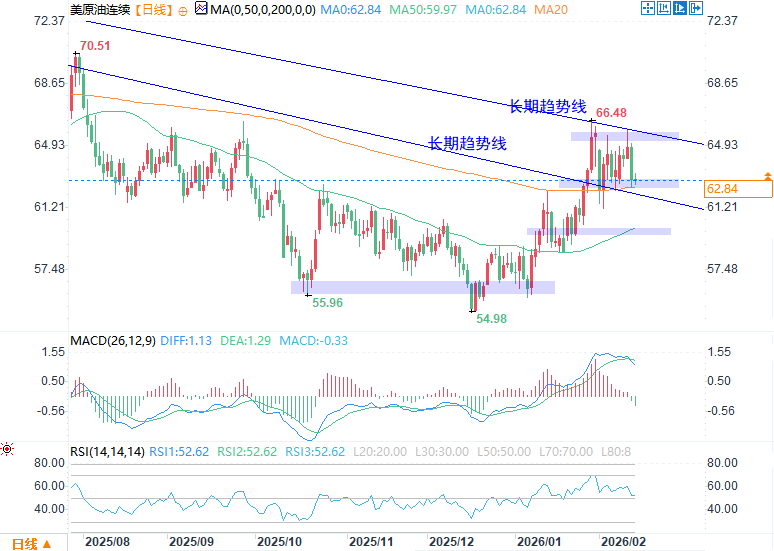
(WTI crude oil daily chart source: FX678)
From a technical perspective, the long-term downtrend of WTI crude oil has not yet been effectively broken. The daily chart shows that the rebound from the low of $54.70 was more like a three-wave correction, and the momentum is currently clearly weakening.
Key technical signals include:
The RSI is hovering around 50, indicating a balance of momentum but a lack of trend breakout;
The MACD histogram fluctuates around the zero axis, reflecting that the market is in a phase of directional choice.
The moving average system is generally bearish, with prices trading below multiple short-term moving averages.
Key price levels:
$65: A key resistance level, close to recent highs and the downtrend line. A decisive break above this level could open up upside potential to $70.
$62: Currently testing a support level, coinciding with the 200-period moving average and the previous high area.
$60: A key psychological and technical support level, coinciding with the 50-period moving average and the January volume spike zone (VPOC). A decisive break below this level could accelerate the decline towards the $54 area.
Conclusion: Fundamentals dominate; $60 becomes a watershed for direction.
In summary, although CFTC positioning data shows that speculative long positions still have some resilience, the supply and demand imbalance described by the IEA and EIA is dominating market pricing logic.
Against the backdrop of slowing global demand growth, continued inventory accumulation, and strong non-OPEC supply growth, WTI will continue to face structural downward pressure in 2026.
In the short term, the $60 mark will be a key directional pivot. If demand expectations continue to be revised downwards or geopolitical risks ease, oil prices may weaken further; if support holds and signs of improving demand emerge, a phase of rebound is still possible.
Current prices are fluctuating around $62-63, with the main market driver remaining concerns about supply-demand imbalances. Unless a sudden supply disruption occurs, the downward trend in oil prices is unlikely to reverse.
WTI crude oil has now fallen below the $63 mark and continues to test the $62 support level. If the demand outlook deteriorates further, oil prices may continue to be under pressure in the short term, and the risk of falling to $60 or even lower is increasing.
Demand expectations revised downward: Growth momentum slows significantly
According to the International Energy Agency's (IEA) February 2026 monthly oil market report, the global oil demand growth forecast for 2026 has been lowered to 850,000 barrels per day, a decrease of 83,000 barrels per day from the previous forecast of 932,000 barrels per day. Total global oil demand for the year is projected to be approximately 104.87 million barrels per day.
The IEA points out that seasonal weakness, global economic uncertainty, and the dampening effect of high oil prices on consumption have collectively led to a slowdown in demand growth momentum.
Meanwhile, the IEA projects supply growth of 2.4 million barrels per day in 2026, with about half coming from OPEC+ and the other half from non-OPEC countries. This means the market could experience a supply surplus of approximately 3.7 million barrels per day throughout the year, potentially a record high.
EIA inventory forecasts reinforce the bearish logic.
The U.S. Energy Information Administration (EIA) further projects that global oil inventories will increase by an average of 3.1 million barrels per day in 2026, up from 2.7 million barrels per day in 2025. This continued accumulation of inventories will exert systemic pressure on prices.
The EIA forecasts that the average price of Brent crude oil in 2026 will be around $58 per barrel, while the average price of WTI crude oil may fall to around $53 per barrel. This official forecast reinforces the market's judgment that the medium-term price center will shift downward.
Supply structure: Non-OPEC production increases become a key variable
Although OPEC+ suspended further production increases from February 1, weak demand recovery limited market optimism. Current supply growth is primarily coming from non-OPEC countries, particularly the United States and Brazil.
Analysts believe that unless geopolitical risks, such as those in the Middle East, escalate significantly, new supply will continue to suppress oil prices amid weak demand. The recent unexpected increase of 8.5 million barrels in US crude oil inventories has also exacerbated short-term selling pressure.
Sentiment and Positions: Bulls Have Not Completely Exited
Market sentiment indicators suggest increasing caution. In retail sentiment, only about 16% are bullish, 50.4% are neutral, and 33.6% are bearish, indicating an overall bearish bias.
However, according to the latest positioning data released by the U.S. Commodity Futures Trading Commission (CFTC), as of February 3, 2026, large speculators' net long positions rose to 121,900 contracts, a six-month high; asset managers' net long positions were approximately 76,800 contracts.
Furthermore, Saxo Bank analysis points out that the combined net long position in Brent and WTI crude oil futures rose to 341,300 contracts, also at a six-month high, reflecting that some funds are still betting on the potential risk of supply disruptions from Iran.
However, it should be noted that against the backdrop of the IEA's downward revision of demand, the supporting effect of speculative bullish positions has weakened significantly, and market pricing logic is returning to fundamentals.
Technical Analysis: $60 Becomes a Key Pivot
(WTI crude oil daily chart source: FX678)
From a technical perspective, the long-term downtrend of WTI crude oil has not yet been effectively broken. The daily chart shows that the rebound from the low of $54.70 was more like a three-wave correction, and the momentum is currently clearly weakening.
Key technical signals include:
The RSI is hovering around 50, indicating a balance of momentum but a lack of trend breakout;
The MACD histogram fluctuates around the zero axis, reflecting that the market is in a phase of directional choice.
The moving average system is generally bearish, with prices trading below multiple short-term moving averages.
Key price levels:
$65: A key resistance level, close to recent highs and the downtrend line. A decisive break above this level could open up upside potential to $70.
$62: Currently testing a support level, coinciding with the 200-period moving average and the previous high area.
$60: A key psychological and technical support level, coinciding with the 50-period moving average and the January volume spike zone (VPOC). A decisive break below this level could accelerate the decline towards the $54 area.
Conclusion: Fundamentals dominate; $60 becomes a watershed for direction.
In summary, although CFTC positioning data shows that speculative long positions still have some resilience, the supply and demand imbalance described by the IEA and EIA is dominating market pricing logic.
Against the backdrop of slowing global demand growth, continued inventory accumulation, and strong non-OPEC supply growth, WTI will continue to face structural downward pressure in 2026.
In the short term, the $60 mark will be a key directional pivot. If demand expectations continue to be revised downwards or geopolitical risks ease, oil prices may weaken further; if support holds and signs of improving demand emerge, a phase of rebound is still possible.
Current prices are fluctuating around $62-63, with the main market driver remaining concerns about supply-demand imbalances. Unless a sudden supply disruption occurs, the downward trend in oil prices is unlikely to reverse.
- Risk Warning and Disclaimer
- The market involves risk, and trading may not be suitable for all investors. This article is for reference only and does not constitute personal investment advice, nor does it take into account certain users’ specific investment objectives, financial situation, or other needs. Any investment decisions made based on this information are at your own risk.